
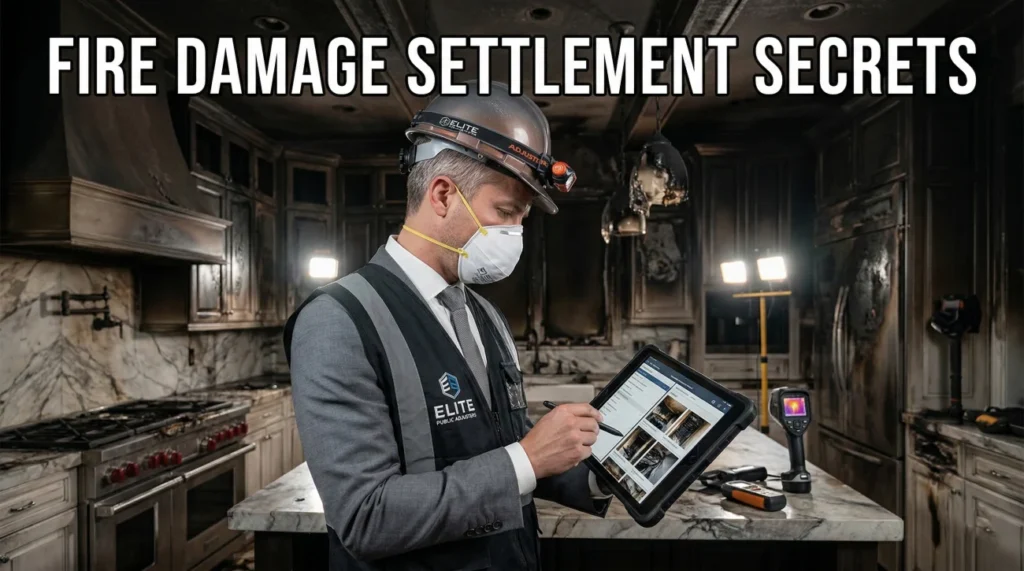
- The visible damage from a house fire is usually just a fraction of your actual loss. Smoke, soot, and water from firefighting efforts cause hidden damage that standard adjusters frequently miss.
- The true cost of smoke: It doesn’t just stain walls; it forces toxic particles deep into HVAC systems, insulation, and seemingly untouched materials.
- While your contractor can provide a repair estimate, they cannot legally negotiate the claim scope with your insurer in most states. That requires a licensed public adjuster.
- If your settlement does not include line items for HVAC cleaning, code upgrades, and non-visible smoke remediation, your claim is likely underpaid and requires a professional review.
Why Your Fire Claim Settlement Feels Incomplete
Fire claims are among the most heavily disputed property claims in the industry. The reason is simple: the visible scope is easy to document, but the non-visible scope requires specialist knowledge, time, and specific testing methods.
When an insurance company sends a standard field adjuster, their goal is to document the obvious loss quickly and move on to the next file. They take photos of the burned structure, measure the rooms, and input the data into estimating software like Xactimate. However, a fast inspection almost guarantees an incomplete scope.
This leaves homeowners in an extremely difficult position. You are displaced from your home, dealing with the emotional trauma of a fire, and suddenly you are expected to know whether a 30-page technical estimate accurately covers the restoration of your property. Without professional representation, it is incredibly difficult to challenge the insurance company’s numbers because they rely on industry-specific software that most homeowners cannot read or debate.
What Insurers Commonly Miss in Fire Estimates
When a fire damage insurance claim is underpaid, the gap is rarely just a disagreement over the cost of drywall. Usually, whole categories of damage have been left off entirely. Here are the specific areas I constantly see missing from initial fire claim offers.
- 🔥 Smoke and soot in HVAC systems: Adjusters often write to clean the vent covers, but they miss the deep contamination inside the ductwork and the mechanical units themselves.
- 🔥 Odor contamination in “undamaged” materials: Items that look perfectly fine, like clothing, upholstery, and porous building materials, can harbor permanent smoke odor if not properly treated or replaced.
- 🔥 Water from firefighting efforts: The thousands of gallons of water used to save your structure often pool in wall cavities and subfloors. If this isn’t documented correctly from day one, it leads to denied mold claims months later.
- 🔥 Additional Living Expenses (ALE): Most homeowners do not know their policy covers temporary housing and food while displaced. Adjusters rarely volunteer the full extent of this coverage upfront, leaving you paying unnecessarily out of pocket.
- 🔥 Code upgrade requirements: If your home is older, rebuilding the burned section will likely require bringing plumbing or electrical elements up to current building codes. Many initial estimates omit this crucial “Ordinance or Law” coverage.
- 🔥 Aggressive content depreciation: Insurers initially calculate your ruined belongings at heavily depreciated values (Actual Cash Value) rather than what it actually costs to buy them new today (Replacement Cost Value), often undervaluing your personal property loss.
Accepting the settlement because the adjuster included all the rooms that physically caught fire, assuming you can ask for more money later if the contractor finds issues.
Recognizing that if hidden smoke, soot, and water damage are not explicitly listed in the line-item estimate now, the insurance company has no obligation to pay for their remediation later.
Why Smoke Damage Changes Everything
Because smoke forces toxic particles deep into your home’s infrastructure, the restoration process is far more complex than simply cleaning visible stains. You cannot just wipe down a wall or run a standard air purifier to eliminate the contamination.
Properly remediating a smoke-damaged home requires specialized chemical cleaning, ozone treatments, encapsulation, and often the complete removal of porous materials like insulation and drywall that look perfectly fine to the naked eye. An adjuster doing a standard 60-minute walk-through will almost never capture the full scope of this intensive remediation, which is why a properly documented public adjuster smoke damage claim often yields significantly different results.
Warning: If your estimate only includes “painting” or “wiping down” walls in rooms adjacent to the fire, your scope is fundamentally flawed. Paint does not kill smoke odor; it only traps it temporarily.
Total Loss vs. Partial Loss
How your claim is handled depends heavily on whether the insurance company classifies your home as a partial loss or a total loss. These are two entirely different coverage paths.
| Classification | What It Means For Your Claim |
|---|---|
| Partial Loss | The structure can be repaired. These are the most disputed claims because the scope of what to save versus what to replace is highly subjective. |
| Total Loss | The home is destroyed beyond repair. The fight here often shifts from the structure to maximizing your personal property (contents) payout and additional living expenses. |
Which category your claim falls into also determines how quickly your leverage disappears if the scope isn’t challenged early.
The Contractor Problem: Why Builders Cannot Negotiate For You
Regardless of which category your claim falls into, the next critical mistake most homeowners make is assuming their contractor can simply fix any gaps in the estimate. After a fire, you will likely speak with several restoration companies. Many will look at the insurance estimate, tell you it is far too low, and offer to “handle the insurance company for you.”
A contractor is an expert at building and repairing, and they can write a detailed estimate for the physical work. However, in most states, a contractor is legally prohibited from negotiating your insurance claim, debating policy language, or disputing the adjuster’s scope of loss on your behalf.
Key Point: A contractor builds the house. A public adjuster builds the claim. Mixing up these roles is one of the most common reasons fire settlements stall out entirely.
If you have a gap between the insurance offer and the real cost to rebuild, handing a contractor’s bid to the insurance desk adjuster rarely works. The insurer will simply say the contractor’s pricing is too high. Closing that gap requires someone legally authorized to argue the scope and valuation directly with the carrier.
Signs Your Fire Damage Claim Scope Is Incomplete
If you suspect your fire damage settlement is too low, you do not need to be an insurance expert to spot the warning signs of an underpaid claim. Look closely at the estimate your insurance company provided. If your fire settlement does not include a distinct line item for a specialized HVAC inspection, smoke remediation in non-fire areas, or building code upgrades for the affected systems, your scope is likely incomplete.
The problem is knowing exactly how much money is missing. That answer depends entirely on your specific policy endorsements, the actual spread of smoke through your structure, and how the original field adjuster documented the loss.
You cannot determine this simply by walking through the house. Uncovering the missing scope requires a professional who can compare the insurer’s Xactimate report line by line against the physical reality of the damage.
Final Thoughts Before You Accept an Offer
A fast settlement offer on a fire claim is rarely a complete offer. Insurance companies know that you are anxious to begin rebuilding and get your life back to normal. But accepting a check before the full extent of the hidden damage is documented can leave you paying tens of thousands of dollars out of pocket later.
Bringing a public adjuster into the process before you cash that first check or sign any final release gives you the strongest leverage. If your contractor is telling you the numbers are wrong, or if you simply feel that the adjuster missed areas of your home, do not guess. A licensed public adjuster can review your policy and your initial estimate to identify exactly what was left out. Because they work on a contingency basis, they only get paid if they recover more money for you, meaning it costs you nothing to find out if your claim has missing scope.
❓ FAQ
🔥 Should I hire a public adjuster for a partial fire loss?
Yes. Partial losses are actually the most highly disputed claims because insurers often try to clean materials that a public adjuster can prove must be entirely replaced due to smoke saturation.
💨 How do I know if I have hidden smoke damage?
If you can still smell smoke days after the fire, or if there is a sticky film on hard surfaces in rooms far from the fire source, you likely have hidden soot contamination that requires specialized remediation.
💰 What percentage does a public adjuster take for a fire claim?
Public adjusters typically charge a contingency fee ranging from 10% to 20% of the total settlement they recover, meaning they are only paid if you get paid.
⏳ Is it too late to hire a public adjuster if I already cashed the first check?
In many cases, no. Unless you signed a final release of all claims, the first check is often considered an undisputed advance. A public adjuster can usually reopen the claim to file a supplement for the missing damage.
👷 Can my general contractor talk to the insurance adjuster for me?
A contractor can answer technical questions about their repair estimate, but in most states, it is illegal for them to negotiate the claim settlement or argue policy coverage on your behalf.
📄 What is the difference between ACV and RCV in a fire claim?
Actual Cash Value (ACV) pays you the depreciated worth of an item today. Replacement Cost Value (RCV) pays the actual cost to buy that item brand new. Many claims require you to replace the item first to get the full RCV payout.
🏠 Does insurance pay for code upgrades after a fire?
It depends on your policy. If you have Ordinance or Law coverage, the insurer must pay the extra costs required to bring the rebuilt structure up to current building codes. Adjusters often miss this entirely.
👃 How do you get rid of smoke smell after a small house fire?
Proper smoke odor removal requires specialized professional treatments. If your estimate only pays to paint over the damage, a public adjuster can step in to prove the need for full remediation before the smell becomes permanent.
Fire claims are among the most complex. These explain the coverage and process side.
- How a claim moves from filing to final payment
- What your policy actually covers and what it does not
- How fire damage is classified and what drives the valuation
- When filing a claim makes sense and when it works against you
- What to do after a denial and what your actual options are
- What a public adjuster does and when you actually need one
- When legal help is the move that changes the outcome
Smoke and hidden scope problems are not exclusive to fire. See which other types follow the same pattern.
- How to tell whether your fire settlement captured the full scope
- Who the adjuster at your door actually works for
- Where water damage estimates most often fall short
- What fire damage settlements commonly leave out
- Why your roofer's number and the insurer's estimate do not match
- When a denial needs legal leverage, not just negotiation
- Four paths to fight a denial, including one most homeowners miss
Disclosure: I'm sharing my personal industry experience, but I am not an attorney or a licensed insurance agent. The guides on this site are for informational purposes to help you understand the operational side of property claims: process, organization, and documentation. Every policy is unique, so please defer to your specific policy language. For legal interpretation, contested situations, or binding advice, always consult a licensed professional in your jurisdiction.