
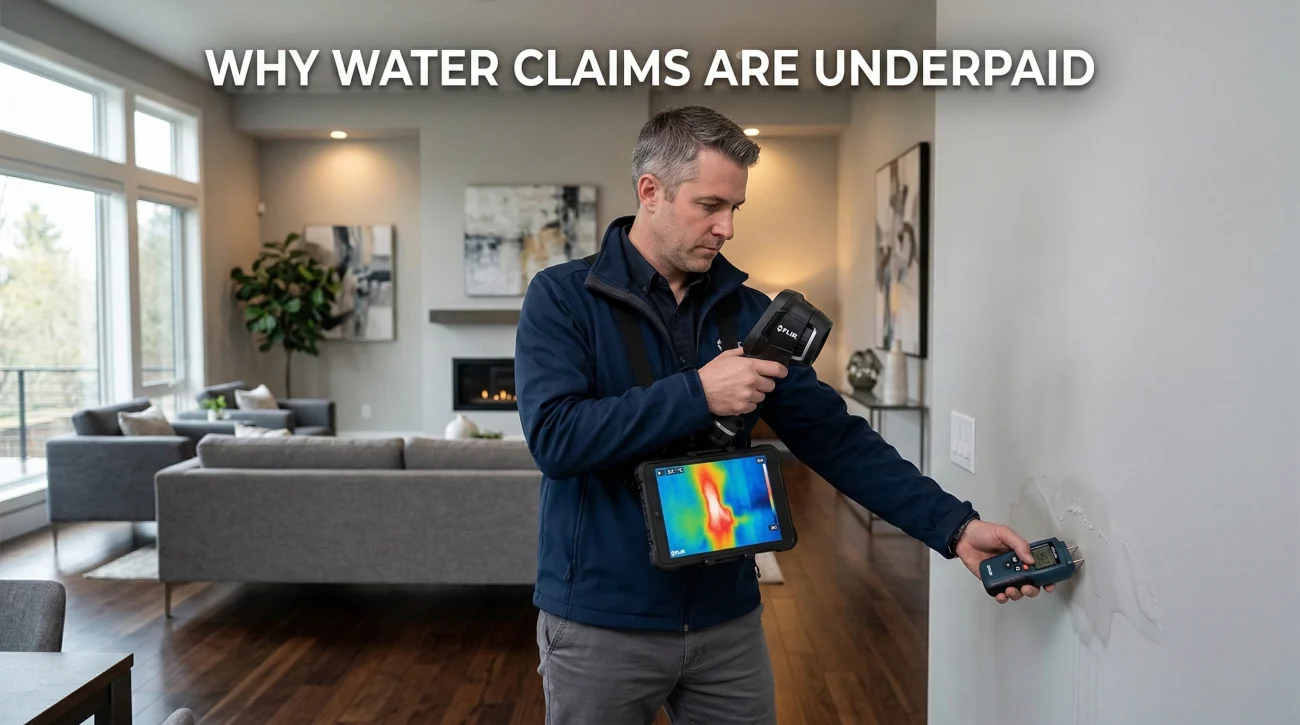
- If your insurance adjuster spent less than two hours inspecting a major water leak, they likely missed significant hidden damage.
- Moisture behind drywall, under subfloors, and inside HVAC systems is consistently left off initial settlement offers.
- Fast claim payouts are often a trap. Accepting a quick check usually means paying out of pocket when trapped moisture causes rot months later.
- A public adjuster finds the missing scope, rebuilds the estimate, and negotiates directly with your insurer on a contingency basis.
The Hidden Cost of a Fast Water Damage Inspection
Your insurer sent their adjuster, the visit seemed to go smoothly, and the settlement offer arrived surprisingly fast. On the surface, it feels like good customer service. But when you show that estimate to a contractor, they tell you the numbers do not even come close to covering the real cost of repairs.
I have reviewed hundreds of water damage claims from the other side of the desk. When a homeowner tells me their settlement feels too low, my first question is always about the inspection. A standard insurance inspection for a burst pipe or appliance leak typically takes less than two hours. The problem is that the hidden damage missed during that brief window can take months to appear, and by then, the settlement check has already been cashed.
If you are looking at an estimate that feels inadequate, you are likely experiencing a gap between visible damage and actual scope. Understanding exactly where that gap occurs is the first step in knowing whether you need a professional to step in.
Why Water Damage Claims Are Consistently Underpaid
Water damage is one of the most frequently filed insurance claims, yet it is also one of the most commonly underpaid. The reason comes down to how adjusters are trained to document a loss. The adjuster sent by your insurance company, or an independent adjuster contracted by them, is generally looking for visible, obvious destruction.
They photograph the puddle on the floor. They note the warped baseboards. They measure the visible water stain on the ceiling. However, water does not respect what we can see. It follows gravity, capillary action, and the path of least resistance into the structural bones of your home.
In my years in the field, the most consistent pattern I see in underpaid water claims is a scope of loss written entirely from an eye-level visual check. If an adjuster does not aggressively look for where the water traveled behind the walls, those line items simply will not exist on your settlement offer.
When the visible damage gets documented but the hidden damage does not, the resulting payout will only cover a cosmetic repair. You are left with the liability of the structural repair.
Common Scenario: A homeowner files a claim for a burst kitchen pipe. The adjuster spends 90 minutes on site and offers a $4,200 settlement. A week later, the homeowner’s contractor quotes $11,000 for the actual rebuild. That $6,800 gap is rarely contractor markup. It is almost always missing scope, typically trapped moisture in the subfloor and contamination in the HVAC system that the adjuster failed to document.
4 Places Standard Adjuster Inspections Usually Miss
To know if your claim has been undervalued, you need to know where adjusters typically fail to look. Based on operational experience, here are the four areas most commonly omitted from an initial water damage settlement.
1. Wall Cavities Behind Wet Drywall
Drywall acts like a sponge. When a pipe bursts, water wicks upward into the wall cavity, soaking the insulation and the back side of the drywall. A standard adjuster might write an estimate to replace the bottom two feet of drywall. What they often miss is the moisture that has wicked much higher, creating a perfect environment for mold inside the closed wall cavity.
2. Subfloors Underneath Saturated Flooring
If your hardwood or laminate flooring is ruined, the insurer will usually pay to replace the surface layer. However, water flows through the seams and pools on the subfloor beneath. If the estimate does not include line items for removing the flooring to expose, dry, and potentially treat or replace the subfloor, the scope is incomplete.
Accepting a settlement that only covers the cost to install new laminate over an unverified subfloor.
Pausing the repair process until moisture levels in the underlying plywood and joists are professionally quantified.
3. HVAC Systems and Ductwork
When hot water leaks, or when a massive amount of water evaporates inside a closed home, the humidity spikes drastically. Your HVAC system pulls this moisture laden air into the ductwork. Over time, this causes secondary damage and contamination far away from the original leak. Line items for HVAC inspection, duct cleaning, and secondary mold prevention are almost always missing from first offers. Mold can begin forming inside dark, damp ductwork within 48 to 72 hours, long before you notice the smell.
4. Structural Framing
Water eventually reaches the lowest point, which means sill plates and structural studs get soaked. If these wooden components are not properly dried using commercial desiccant dehumidifiers before the walls are closed up, they will rot. Insurers frequently omit the heavy drying logs and antimicrobial treatments required to save the framing.
The Danger of the Fast Settlement Pattern
It is a common scenario. The adjuster visits on a Tuesday, and by Friday, you have a settlement document in your inbox and a check in the mail. Many homeowners mistake this speed for efficiency.
In reality, water claims that close very quickly almost always have a heavily limited scope. Insurers are not slow when the payout is small. They want to close the file before the hidden moisture has time to warp the cabinets, bubble the paint in the next room, or manifest as a visible mold issue.
Warning: Cashing a fast settlement check often comes with signing a release form. Once you accept that the claim is resolved based on the visible damage, it becomes incredibly difficult to reopen the file when the hidden damage finally reveals itself.
If you suspect your payout is too low, waiting is rarely safe. The longer a claim sits uncontested, the harder it becomes to connect new damage to the original event. A public adjuster can tell you quickly whether your claim is still actionable, and that conversation costs you nothing.
How to Know If Your Claim Scope Is Incomplete
Figuring out if your claim is shortchanged often comes down to looking at the adjuster’s behavior on the day of the inspection. If you are debating whether to accept the initial offer, ask yourself these practical questions.
- Did the adjuster spend less than 90 minutes at your property?
- Did they rely purely on photographs without using penetrating moisture meters on the baseboards or floors?
- Is your contractor’s repair quote significantly higher than the insurance estimate?
- Does the estimate lack any mention of “antimicrobial application” or “air mover” rental days?
If you answered yes to any of these, your settlement is likely based on an incomplete picture of the loss. The gap between what your insurer offered and what it will actually cost to rebuild is not a contractor markup. It is simply missing scope.
A Brief Note: Flood vs. Water Damage
It is important to understand the terminology before escalating a claim. In the insurance world, water damage and flood damage are entirely different coverage paths. If a pipe bursts inside your ceiling, that is water damage. If a river overflows and water enters your home from the outside, that is a flood.
Standard homeowners policies cover sudden and accidental internal water damage. They typically do not cover external flooding without a separate specific policy. If your claim was outright denied rather than underpaid, verify which terminology the insurer applied to your event.
Final: What a Public Adjuster Does Differently
Knowing that your claim is missing hidden damage is only half the battle. Proving it to your insurance company requires specialized documentation. Insurance adjusters use complex line item software called Xactimate to build their estimates. To successfully challenge their numbers, you must speak their language.
Most homeowners can see the damage clearly. The problem is translating that into the line items an insurer is required to pay. This is exactly where the DIY approach usually breaks down. You know the floor is ruined, but you do not know the specific industry codes required to force the insurer to pay for subfloor remediation, vapor barriers, and baseboard matching.
Hiring a public adjuster for water damage changes this dynamic. They work strictly for you, not the insurance company. They perform a licensed reinspection, build an independent, line by line scope of loss that includes the hidden damage, and negotiate directly with the insurer’s desk adjuster.
Most importantly, public adjusters work on a contingency basis. This means they only get paid a percentage of the additional money they recover for you. If they review your settlement and determine the insurer actually paid you fairly, they will tell you so, and you owe them nothing. The risk is entirely on their shoulders.
To be clear, not every situation requires representation. If your damage is purely cosmetic, falls under your deductible, and your contractor agrees with the insurance estimate, you likely do not need a public adjuster. But if your claim involves hidden moisture, complex structural repairs, or a massive gap between the offer and reality, professional leverage is necessary.
Whether your specific claim has missing scope depends entirely on your policy, your damage type, and how that first inspection was conducted. That is a question that requires a professional set of eyes. Once you sign a release or cash a check marked as final, your options to recover those missing funds drastically shrink. Before you make that irreversible decision, get a second opinion.
❓ FAQ
💧 Should I hire a public adjuster for water damage?
If your water damage is extensive, involves hidden moisture in walls or floors, or your settlement offer is significantly lower than your contractor’s estimate, a public adjuster can identify the missing scope and negotiate a proper payout.
⏱️ When is it too late to hire a public adjuster for a water leak?
It is best to hire one before you sign a final release or cash the settlement check. However, in many states, a public adjuster can still reopen a claim and file a supplement if you discover hidden damage up to a year or more after the event.
📉 Why is my water damage settlement so low?
Low settlements usually happen because the insurance adjuster only estimated for visible, cosmetic repairs. They frequently omit the costs for structural drying, subfloor replacement, and mold prevention.
🔍 Will my insurance pay for hidden water damage?
Yes, if the hidden damage was caused by a covered sudden and accidental event. However, you must prove the damage exists using professional moisture readings and proper documentation to get it paid.
💵 What percentage does a public adjuster take for a water claim?
Public adjusters typically charge a contingency fee ranging from 10 to 20 percent of the final settlement. You pay nothing upfront, and they only get paid if they successfully recover money for you.
🛑 Can I dispute a denied water damage claim?
Yes. Many water claims are denied due to the insurer misclassifying a sudden pipe burst as a long term maintenance issue. A professional review can determine if the denial was improperly issued based on your policy language.
🏠 Does homeowners insurance cover a burst pipe?
Most standard policies cover the water damage resulting from a sudden burst pipe. They typically do not pay to repair the pipe itself, but they are responsible for the resulting damage to your walls, floors, and personal property.
📸 How does an adjuster evaluate water damage?
Insurance adjusters usually perform a visual inspection and take photos. Unless they use specialized equipment like thermal imaging cameras or penetrating moisture meters, they will miss water trapped inside structural cavities.
✍️ Should I sign the release form from my insurance company?
Never sign a final release form or accept a check marked “paid in full” if you suspect the settlement is too low. Have your estimate reviewed professionally before signing away your right to supplement the claim.
⚖️ Is a public adjuster worth it for minor water damage?
If the damage is purely cosmetic, falls under your deductible, and your contractor agrees with the insurance estimate, a public adjuster may not be necessary. They add the most value on complex or disputed claims.
Water damage claims have specific coverage and documentation rules. These explain both.
- How a claim moves from filing to final payment
- The coverage rules that determine whether your water damage is paid
- How water damage is classified and what that means for your claim
- When filing a claim makes sense and when it works against you
- What to do after a denial and what your actual options are
- What a public adjuster does and when you actually need one
- When legal help is the move that changes the outcome
The hidden scope problem is not unique to water damage. See which other types follow the same pattern.
- 5 patterns that signal your settlement is probably short
- Who the adjuster at your door actually works for
- Where water damage estimates most often fall short
- What fire damage settlements commonly leave out
- Why your roofer's number and the insurer's estimate do not match
- When a denial needs legal leverage, not just negotiation
- Four paths to fight a denial, including one most homeowners miss
Disclosure: I'm sharing my personal industry experience, but I am not an attorney or a licensed insurance agent. The guides on this site are for informational purposes to help you understand the operational side of property claims: process, organization, and documentation. Every policy is unique, so please defer to your specific policy language. For legal interpretation, contested situations, or binding advice, always consult a licensed professional in your jurisdiction.