
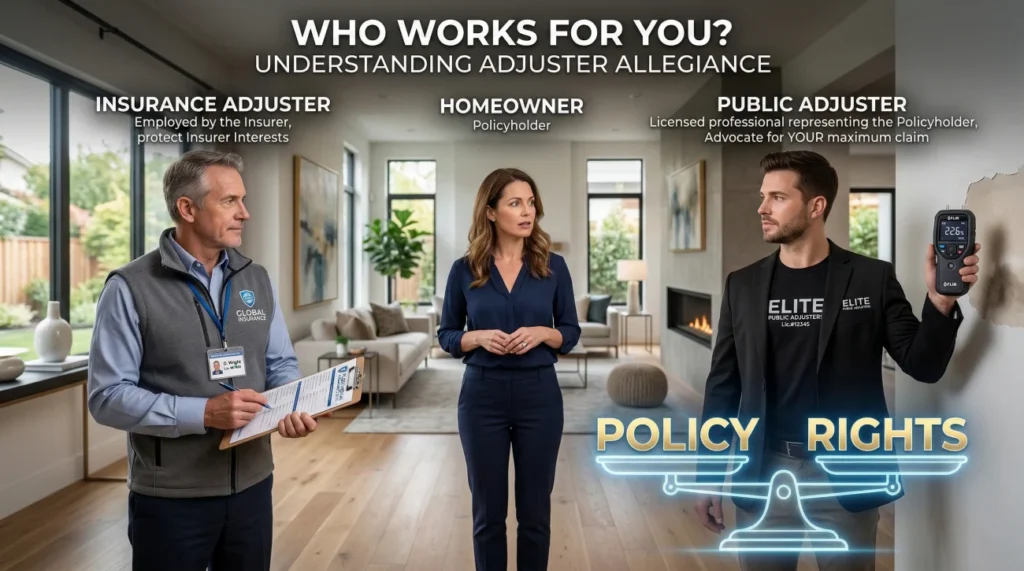
- The adjuster your insurance company sends to your home is not a neutral third party; they are paid by the insurer to protect the insurer’s bottom line.
- There are three types of adjusters: company adjusters (salaried employees), independent adjusters (contractors hired by the insurer), and public adjusters (hired exclusively by you).
- An “independent” adjuster is a misleading title for most homeowners. They still work for the insurance company, not for you.
- While contractors can estimate repair costs, they are legally restricted in most states from negotiating your insurance claim. Only a licensed public adjuster can do that on your behalf.
- If you feel your settlement is missing damaged items or undervalued, a public adjuster can step in to review the scope on a contingency basis, meaning they only get paid if you get paid more.
The Knock at the Door: Who Is Actually Inspecting Your Home?
When your home sustains severe damage, the days that follow are a blur of phone calls, cleanup, and stress. Eventually, you file your claim, and your insurance company tells you they are sending someone out to inspect the damage. When that person knocks on your door, hands you a clipboard, and introduces themselves as the “insurance adjuster,” it is completely natural to assume they are there to help you get your life back together.
I have sat across the table from adjusters on hundreds of claims, including navigating the chaotic aftermath of major Florida hurricanes, and I need to be direct with you: the person inspecting your home has a specific job, and it is not to maximize your payout.
Most homeowners assume the claims process is a straightforward evaluation of facts. You have damage, the adjuster writes it down, and the insurance company cuts a check for the repairs. But after reviewing countless underpaid claim files, I can tell you that the scope of damage documented in your file is heavily influenced by who is signing the inspector’s paycheck.
If you have recently received a settlement offer that feels too low, or if your contractor is pointing out missing line items in the adjuster’s estimate, you are likely experiencing the reality of this dynamic firsthand. Before you sign any release or accept that initial check, you need to understand exactly who was evaluating your home, and why you might need a professional on your side.
Public Adjuster vs Insurance Adjuster: Understanding Who Works for Whom
The biggest point of confusion I see in the field is the terminology. The insurance industry uses titles that sound remarkably similar but represent entirely different allegiances. To understand why your claim might be undervalued, you have to know the difference between the three types of insurance adjusters.
| Type of Adjuster | Who Hired Them? | How Are They Paid? | Who Do They Represent? |
|---|---|---|---|
| Company Adjuster | Your Insurance Company | Salaried employee of the insurer | The Insurance Company |
| Independent Adjuster | Your Insurance Company | Paid per claim or per day by the insurer | The Insurance Company |
| Public Adjuster | You (The Homeowner) | Percentage of your final settlement | You |
Public Adjuster vs Independent Adjuster: The “Aha” Moment
The pain point that catches almost every homeowner off guard involves the “independent adjuster.” I frequently speak with frustrated homeowners who tell me, “But Rachel, my insurance company sent an independent adjuster, so the estimate should be fair and unbiased, right?”
This is the most common and costly misunderstanding in the property claims process.
🗝️ Key Point: An independent adjuster is not independent from the insurance company. They are independent contractors hired by the insurance company to handle overflow claims, especially after large storms or natural disasters.
Because they do not work directly in the insurer’s corporate office, they use the title “independent.” However, their invoice is paid by the very same insurance company that holds your policy. When they finish inspecting your home, they submit their findings directly to the carrier’s desk adjuster for approval. If they consistently write estimates that are too high or include borderline coverage items, the insurance company will simply stop giving them work.
When the insurer controls the workflow and the payment, the inspector is inherently incentivized to view the damage through a conservative lens. They are not acting maliciously; they are simply doing the job they were hired to do.
Follow the Money: How the Payment Model Shapes Your Estimate
To truly grasp why your settlement might be falling short, we have to look at how these professionals get paid. The compensation structure dictates the effort, the time spent, and the level of detail in your claim file.
Company adjusters receive a salary. Independent adjusters are typically paid based on a fee schedule tied to the size of the claim, or a day rate, and their goal is volume. After a major event, an independent adjuster might have to inspect five to seven houses in a single day. That means they have maybe 60 to 90 minutes to document your entire loss.
In my field experience handling claims after major storm events, when an adjuster is rushing to hit a daily quota, they only document the obvious, visible damage. They are not pulling back baseboards to check for moisture, they are not mapping out complex roof flashing failures, and they certainly are not fighting the desk adjuster to get you extra money.”
A public adjuster’s payment model is entirely different. They work on contingency, charging a percentage of the final settlement amount they recover for you. If they take on a claim and recover nothing, they do not get paid. This creates a direct alignment of interests.
Field Note: The Reality of Contingency
In a recent water damage claim I reviewed, the insurance company’s initial offer was $18,400. After a public adjuster mapped the hidden moisture and rewrote the scope, the final settlement reached $31,200. Even after the public adjuster’s 15% fee ($4,680), the homeowner walked away with an additional $8,120 net gain to properly fix their home. That is the value of aligned financial interests.
The Contractor Confusion: Why Your Roofer Can’t Fix the Claim
If a public adjuster is the one getting you that extra money, where does your general contractor fit into the picture? When homeowners realize their insurance estimate is too low, their first instinct is often to hand the paperwork over to their contractor and say, “Can you just talk to the insurance company and get this sorted out?”
If you are in this situation right now, you have likely hit a brick wall. This is a massive point of friction in the claims process.
Assuming your contractor can legally dispute policy coverages, negotiate depreciation, and force the insurance company to change their settlement offer.
Understanding that contractors estimate construction costs, while public adjusters interpret policy language and negotiate the financial settlement of the claim.
In most states, there are strict laws regarding the unauthorized practice of public adjusting (UPPA). A contractor is absolutely qualified to write a repair estimate and tell you what it will cost to put your house back together. However, a contractor is legally prohibited from acting as your representative to negotiate the claim value with the insurance adjuster. Unlike roofing sales reps, licensed public adjusters are strictly regulated by state insurance departments, required to pass exams, and are held to legal and ethical standards.
When an insurance company lowballs a claim, they do not usually argue about the cost of a two-by-four. They argue about policy limitations, depreciation schedules, matching clauses, and actual cash value (ACV) versus replacement cost value (RCV). Your contractor is not licensed to fight those battles. That is precisely the gap a public adjuster fills.
What Changes When You Put a Public Adjuster on Your Side
When you sign a letter of representation with a public adjuster, the dynamic of your claim completely flips. I have watched this transformation happen on stalled claims countless times.
First, the insurance company is legally required to communicate directly through your public adjuster. Those frustrating, endless hold times and confusing emails from the desk adjuster will stop. Your public adjuster takes over the correspondence.
Second, the scope of loss changes from a defensive document to an offensive one. Adjusters use a complex estimating software called Xactimate. If you do not know the thousands of line-item codes, you will never know what was intentionally left out.
Kitchen Fire Example: The Hidden Damage
Consider a kitchen fire. The insurer might just pay to wipe down the cabinets and paint the walls. But a public adjuster knows to demand HVAC duct scoping, check for soot web penetration, and require odor-blocking primer for the subfloor.
Drywall Scope Example: The Secondary Line Items
Example of a Scope Dispute:
Your public adjuster’s estimate includes the drywall, plus the line items for masking the room, applying antimicrobial agent to the studs, drywall texturing, priming, and painting the entire continuous wall to ensure color matching.
The insurer’s adjuster leaves out these secondary line items because their initial inspection simply does not look for them. A public adjuster finds them because they spend hours analyzing your property, mapping out the true extent of the damage, and cross-referencing it with what your policy entitles you to claim.
When a Public Adjuster Is Not Enough: The Legal Route
While a public adjuster is excellent for scope and valuation disputes, they are not lawyers. There is a distinct line where their authority ends and you need legal leverage instead.
If your insurance company is outright denying a clearly covered loss, misrepresenting the language in your policy, or deliberately stalling your claim for months without cause, you have moved past a simple disagreement over drywall. You are entering “insurance bad faith” territory.
In these situations, an insurance claim attorney is often the required next step. Like public adjusters, these attorneys typically work on contingency. If you suspect your insurer is acting unlawfully or denying coverage entirely, getting a free legal consultation can help you determine if filing a lawsuit or threatening legal action is your best path forward. Do not let a bad faith denial stand unchallenged.
Diagnostic: Are You Leaving Money on the Table?
Not every claim requires professional help. If a tree branch broke a single window, the adjuster came out, and their check exactly matches your glass repair company’s invoice, you can safely close the claim yourself.
But how do you know if you are in the danger zone for underpayment? In my experience, you should strongly consider professional representation if you recognize any of these patterns in your current situation:
- 🚩 The rushed inspection: The company or independent adjuster spent less than 90 minutes assessing a major loss like a fire or severe water damage.
- 🚩 The contractor gap: Your reputable, local contractor’s estimate is 20% to 50% higher than the insurance company’s settlement offer, and the insurer is refusing to budge.
- 🚩 The missing damage: The adjuster’s estimate completely ignores secondary damage, such as water that seeped under your hardwood floors or smoke that traveled into your HVAC system.
- 🚩 The depreciation trap: You received a check that feels aggressively depreciated, and the adjuster has not clearly explained how you can recover the withheld depreciation (RCV).
Warning: The longer you wait to dispute a low settlement, the harder it becomes. Once repairs begin and evidence is thrown away in a dumpster, proving the insurer missed damage becomes an uphill battle.
The Next Step: Getting a Professional Second Opinion
If a company or independent adjuster has already evaluated your property, ask yourself one question: how confident are you that every single damaged area was included in the scope and valued at current market replacement costs?
If you have a sinking feeling that things were missed, or if the numbers simply do not add up, you do not have to accept their first offer as the final word. You also do not have to become an insurance expert overnight to fight back.
A licensed public adjuster can step in, evaluate your specific policy language, and compare it against the actual damage on the ground. They will identify exactly where the insurance company cut corners and tell you straight whether there is enough money left on the table to justify reopening the negotiations. Getting that second set of eyes is your best defense against a quiet underpayment. You paid your premiums for full coverage, not a discounted settlement. Find out if your claim has missing scope by getting a free claim review from a licensed public adjuster today.
❓ FAQ
🧐 What is the real difference between a public adjuster and an independent adjuster?
An independent adjuster is a contractor hired and paid by your insurance company to evaluate claims on their behalf. A public adjuster is hired directly by you, works exclusively for your financial interests, and is paid a percentage of the settlement they recover for you.
🕵️♂️ Who does the insurance adjuster work for in a standard claim?
The adjuster assigned to your claim, whether they are a salaried staff adjuster or a contracted independent adjuster, works for the insurance company. Their primary directive is to resolve the claim according to the insurer’s guidelines, which often means keeping payouts conservative.
⚖️ Should I hire a public adjuster or an attorney?
If your dispute is about the scope of damage or the cost of repairs, a public adjuster is usually the right choice. If your insurance company is acting in bad faith, misrepresenting policy language, or completely denying a clearly covered loss, you likely need to consult an insurance claim attorney.
💰 How much does a public adjuster take from my settlement?
Public adjusters generally work on a contingency fee, which usually ranges from 10% to 20% of the settlement they recover. Importantly, if they review your claim and determine they cannot get you more money, or if they fail to increase your payout, they typically charge nothing.
⏳ When is it too late to hire a public adjuster?
It is best to hire a public adjuster before you accept a settlement or start major repairs. However, in many states, you can still hire a public adjuster to reopen a claim and file a supplement even after you have cashed the initial check, provided you are within the state’s statute of limitations.
🚫 Can my insurance company drop me if I hire a public adjuster?
No, your insurance company cannot legally cancel your policy simply because you hired a licensed public adjuster to represent you. It is your legal right to have professional representation during the claims process.
🏗️ Why can’t my roofing contractor just talk to the insurance company?
In most states, contractors are legally prohibited from negotiating insurance claims on behalf of a homeowner (Unauthorized Practice of Public Adjusting). They can provide an estimate for their work, but they cannot argue policy coverage or negotiate the final settlement value.
📝 Can I hire my own adjuster to look at my roof?
Yes, hiring your own adjuster is exactly what hiring a public adjuster means. They will perform an independent inspection of your roof, document the damage using their own software, and present a competing estimate to your insurance company.
🤝 Do I really need a public adjuster if my claim is small?
Usually, no. If your claim is close to your deductible amount, or if the damage is minor and the insurance company’s offer matches your contractor’s quote, hiring a public adjuster is not necessary and may not be cost-effective.
🚩 What are the red flags to look for when hiring a public adjuster?
Avoid any public adjuster who demands a large upfront fee before doing any work, anyone who promises a specific dollar amount before reviewing your policy, or anyone who pressures you to use their specific repair contractor in exchange for handling the claim.
Understanding who was at your door changes how you read the offer you received.
- How a claim moves from filing to final payment
- What your policy actually covers and what it does not
- Which damage types get paid and which get excluded
- When filing a claim makes sense and when it works against you
- What to do after a denial and what your actual options are
- What a public adjuster does and when you actually need one
- When legal help is the move that changes the outcome
Knowing who the adjuster worked for is step one. These cover what to do next.
- How to tell if the scope that was filed actually covered your loss
- Who the adjuster at your door actually works for
- Where water damage estimates most often fall short
- What fire damage settlements commonly leave out
- Why your roofer's number and the insurer's estimate do not match
- When a denial needs legal leverage, not just negotiation
- Four paths to fight a denial, including one most homeowners miss
Disclosure: I'm sharing my personal industry experience, but I am not an attorney or a licensed insurance agent. The guides on this site are for informational purposes to help you understand the operational side of property claims: process, organization, and documentation. Every policy is unique, so please defer to your specific policy language. For legal interpretation, contested situations, or binding advice, always consult a licensed professional in your jurisdiction.