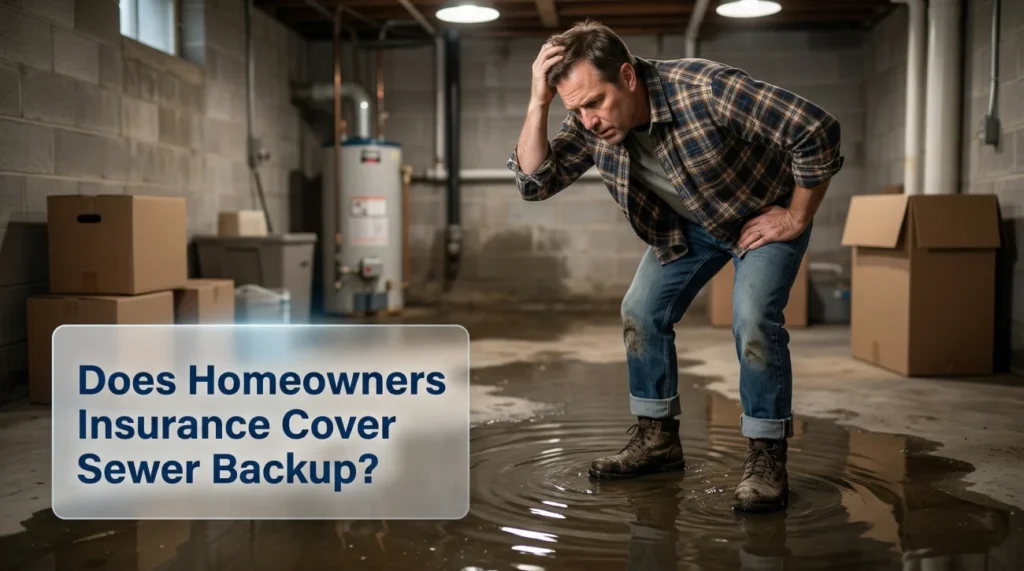
- Standard homeowners insurance policies almost never cover sewer or drain backups. It is a standard exclusion across the industry.
- Coverage is only available if you purchased a specific add on called a “Water Backup and Sump Overflow” endorsement.
- Even if you have the endorsement, limits are often capped at $5,000 or $10,000, which may not cover the full cost of hazardous sewage cleanup and structural repairs.
- If your adjuster tries to classify the backup as a “flood” or “maintenance issue” to avoid paying your endorsement limit, you need to challenge that determination immediately.
The Brutal Reality of Raw Sewage in Your Home
Raw sewage backing up into your basement or bathroom is arguably one of the most distressing and unhygienic property damage events you can experience. The smell is immediate, the health hazards are real, and the instinct is to call a cleanup crew right away while assuming your insurance will handle the bill.
I have sat across from hundreds of homeowners who are physically exhausted from dealing with a sewage backup, only to be hit with a second, financial disaster: their insurance adjuster informing them the claim is denied.
The hard truth is that most homeowners do not realize sewer backup is fundamentally excluded from a standard homeowners insurance policy. The assumption that “damage is damage” completely falls apart when municipal infrastructure is involved. Unless you proactively checked a specific box when you bought your policy, you might be facing a massive out of pocket expense.
In my field experience reviewing denied claims, sewer backup is the number one scenario where homeowners are genuinely blindsided by their policy language. They assume that because the water came up through their own pipes, their own policy will cover it. Insurers do not see it that way.
In this guide, I will walk you through exactly how insurers classify sewer backups, how to check your declarations page to see if you actually have coverage, and what to do if your adjuster is trying to deny a claim that should be paid.
Why Standard Policies Exclude Sewer Backup
To understand how to fight for your coverage, you first need to understand the logic insurers use to deny it. Standard homeowners insurance is designed to cover sudden, accidental events that occur entirely within the boundaries of your property, like a pipe bursting under your kitchen sink.
Sewer systems, however, are shared infrastructure. When a municipal sewer line is overwhelmed by heavy rain or a blockage in the city main, the water flows backward into the path of least resistance. Unfortunately, that path is often your basement floor drain or lower level toilet.
Insurers separate this risk from general property risk because it is a systemic issue. If a city’s infrastructure fails, it could back up into fifty homes on the same street simultaneously. Because the risk pool is fundamentally different, standard policies explicitly exclude it.
Arguing with the adjuster that “the water is inside my house, so it should be covered by my main policy.” This argument never wins against standard exclusion language.
Checking your policy immediately for a specific water backup endorsement and forcing the adjuster to evaluate the claim based on that add on coverage.
For a comprehensive look at other surprising things your standard policy will not pay for, you can review our full guide on what homeowners insurance does not cover.
Specifically Excluded Scenarios
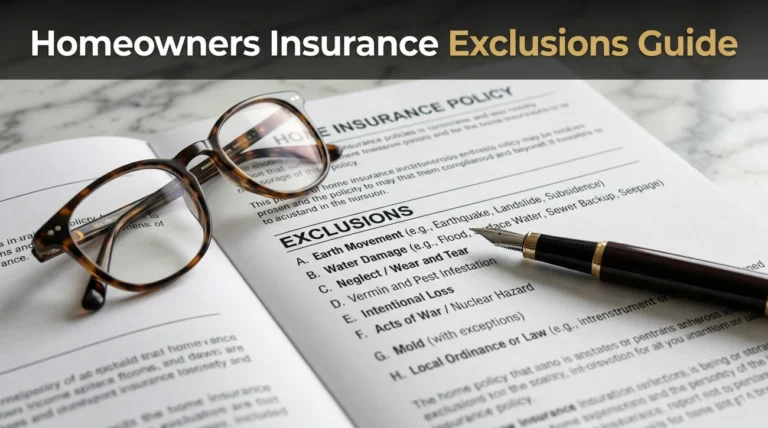
When you read the fine print under the exclusions section of a standard HO3 policy, you will find language that specifically removes coverage for several related events. Standard policies will deny claims for:
- 🛑 Municipal Sewer Backup: Water or raw sewage that reverses flow from the city’s main line into your home.
- 🛑 Lateral Line Blockages: Even if the blockage happens in the pipe connecting your house to the street (which you own), if the water backs up through a drain, it is typically excluded.
- 🛑 Sump Pump Failure: If your sump pump breaks mechanically or loses power during a storm, allowing groundwater to flood your basement, standard coverage will not apply.
- 🛑 Septic System Failure: Backups originating from a private septic tank overflow are treated exactly like municipal sewer backups.
The Water Backup Endorsement: Your Only Protection
The only way homeowners insurance will cover a sewer or drain backup is if you purchased a specific rider, commonly called a “Water Backup and Sump Overflow Endorsement.”
This endorsement is typically offered as an optional add on when you buy your policy, usually costing between $50 and $150 per year depending on your location. If you have a finished basement, this endorsement is absolutely vital.
To find out if you have it, you need to look at your Declarations Page. This is usually the first two or three pages of your policy packet. Look for line items listed as “Water Backup,” “Sewer and Drain Backup,” or sometimes “Service Line Coverage.” If you do not see it listed there, you likely do not have the coverage.
⚠️ Warning: The presence of the endorsement does not mean you have unlimited coverage. Water backup endorsements almost always come with strict sub limits.
The Sub Limit Problem
Even homeowners who smartly purchased the endorsement often face a severe financial shock during a claim. While your main dwelling coverage might be $400,000, your water backup endorsement is usually capped at a much lower, fixed amount.
| Typical Endorsement Limit | Average Sewage Cleanup & Repair Cost | The Financial Reality |
|---|---|---|
| $5,000 limit | $10,000 to $18,000 | Homeowner pays massive out of pocket gap. |
| $10,000 limit | $15,000 to $25,000 (if finished basement) | Homeowner must choose between replacing drywall or replacing flooring. |
| $25,000 limit | $15,000 to $25,000 | Usually adequate to cover both professional mitigation and reconstruction. |
Because raw sewage is classified as Category 3 black water, it requires specialized hazardous material cleanup. Any porous materials touched by sewage must be cut out and discarded. This means drywall, insulation, carpet, and baseboards are completely destroyed. A $5,000 limit is often entirely consumed just by the emergency extraction and sanitization crew, leaving absolutely zero insurance money left to rebuild your basement.
The Grey Areas: When Endorsements Still Get Denied
Having the endorsement on your policy is only half the battle. I often see adjusters attempt to deny these claims by categorizing the cause of the water incorrectly. The specific origin of the water dictates which bucket of coverage the adjuster uses.
The Flood vs Sewer Backup Trap
This is the most common dispute pattern I see in heavy storm scenarios. Let us say a massive rainstorm hits your town. The city sewer system gets overwhelmed, and water backs up through your basement drain. You have the water backup endorsement, so you file a claim.
The adjuster inspects the property and issues a denial, claiming the damage was caused by a “flood.” Standard policies, even with backup endorsements, exclude surface flood water. If the adjuster decides that external flooding triggered the municipal system to fail, they will try to push the claim into the flood exclusion category.
If you find yourself caught in this exact debate, you need to understand the strict definitions insurers must abide by. You can read our detailed breakdown on how sudden water damage rules are applied to see where adjusters commonly make errors in causation.
The Maintenance Argument
Another common denial tactic occurs when the backup is isolated to your specific property line. If a tree root breaks your lateral sewer line, causing a backup, the adjuster may deny the claim under the “failure to maintain” clause. They will argue that the root encroachment happened gradually over years, and it was your responsibility as a homeowner to clear the lines periodically.
To fight this assumption, do not let the adjuster guess the cause without proof. You must hire a licensed plumber to perform a sewer camera inspection. If the video shows the pipe collapsed suddenly from external pressure rather than being slowly choked by roots over a decade, you have concrete evidence to push back. Always request a written report from the plumber specifically noting the sudden nature of the failure.
How to Document a Sewage Claim Correctly
Knowing how adjusters think is only useful if you have the evidence to counter them. This is why strict documentation discipline is non-negotiable from the moment you discover the water.
Because sewage creates an immediate health hazard, you cannot wait days for an adjuster to arrive before you start cleaning up. You must hire a mitigation company immediately. However, the speed of this cleanup often destroys the visual evidence you need to prove your claim.
If the adjuster arrives to an empty, sanitized, dry basement, they have to rely on your word regarding where the water came from. Without proof, they often default to the cheapest denial category available, such as “foundation seepage.”
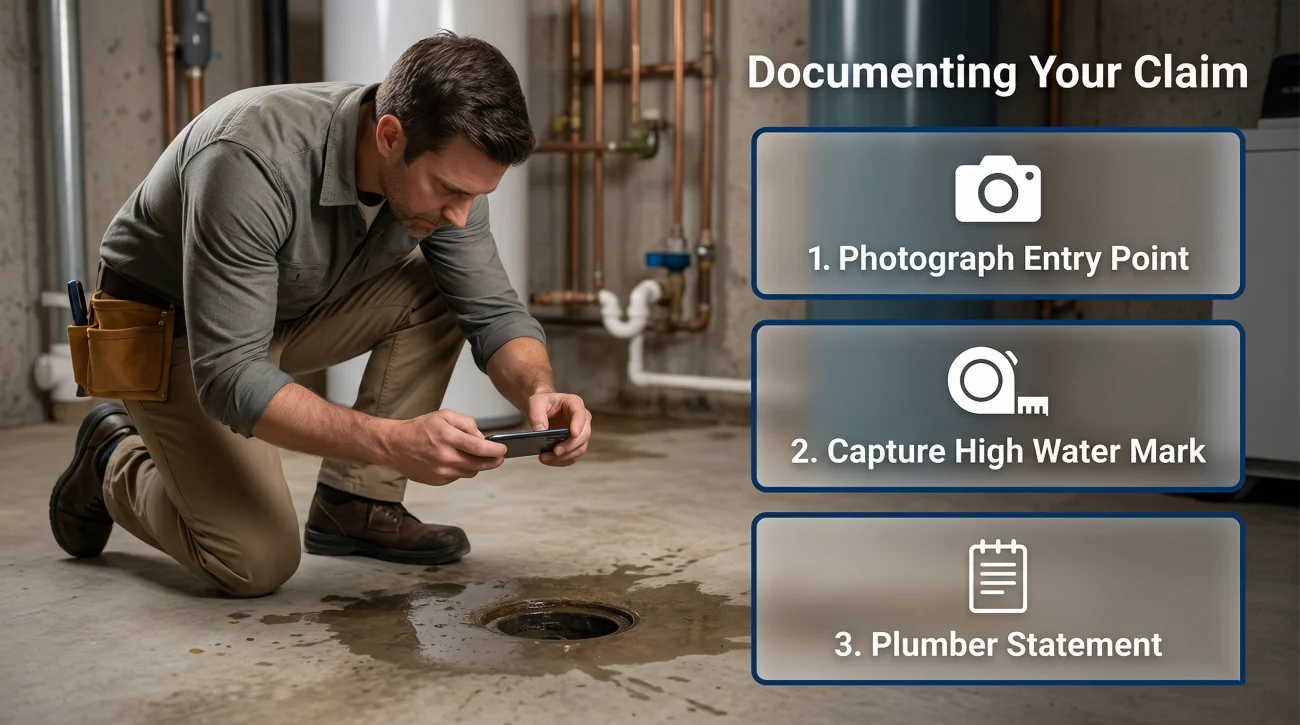
Before the extraction crew starts tearing out drywall, you must follow a strict documentation discipline:
- 📸 Photograph the exact point of entry. Get clear, timestamped photos showing water actively bubbling out of the floor drain, toilet, or sump pit.
- 📸 Photograph the high water mark on the walls and furniture before anything is moved.
- 📝 Get a written, signed statement from the emergency plumber detailing exactly what they found. The invoice should explicitly state “cleared blockage in main sewer line” or “replaced failed sump pump.” Vague invoices lead to denied claims.
💡 Pro Tip: Never throw away a broken sump pump. If your claim is based on sump pump failure, the insurance company has the right to inspect the mechanical parts to verify it actually broke and was not just unplugged. Tell your plumber to leave the broken unit in your garage.
Signs Your Sewer Backup Claim Is Being Mishandled
If you are currently trying to navigate a sewer or drain claim, you are likely exhausted and frustrated by confusing letters quoting policy jargon. In my experience, claims rarely go smoothly when infrastructure is involved.
You need to recognize when the adjuster is maneuvering toward an unjustified denial or an unfair settlement. Watch closely for these specific warning signs:
- You have the endorsement, but they cited “flood”: The adjuster’s report characterizes the water as surface runoff entering through foundation cracks, completely ignoring the photos you provided showing the water erupting from the floor drain.
- They are capping your payment incorrectly: You have a $10,000 endorsement limit, but the adjuster is only offering $3,000, claiming the rest of the damage is “unrelated” to the backup. Action: Request their line item estimate and compare it directly against your mitigation company’s invoice to dispute incorrectly labeled wear and tear.
- They blame a gradual pipe leak: Instead of acknowledging the sudden main line backup, the adjuster argues that an adjacent pipe had a slow leak for months, voiding coverage due to neglect. Action: Submit your plumber’s camera inspection report proving the blockage or break was a sudden event, not a chronic maintenance issue.
If your situation matches any of these patterns, the distinction between a paid claim and a denied claim relies entirely on how the facts of your damage are presented and negotiated. You are no longer just dealing with a cleanup; you are dealing with a coverage interpretation dispute.
When the adjuster’s characterization of the water source does not match the reality of what happened in your home, you have the right to push back. Understanding the exact boundaries of your coverage is crucial, which is why reviewing what a standard policy actually protects can help you spot when an adjuster is misapplying the rules.
If you are fighting a denial on a backup event, getting a professional review of the water damage scope from a licensed public adjuster can level the playing field. They understand the engineering reports, the plumbing terminology, and the exact policy language needed to prove causation. You can learn more about how a public adjuster handles water damage claim disputes to see if your situation warrants professional intervention.
How to Push Back on an Unfair Assessment
If you receive a verbal denial over the phone regarding your sewer backup, do not accept it as the final answer. Adjusters sometimes offer initial resistance to see if the homeowner will simply drop the issue. You must demand all determinations in writing.
If the adjuster tries to blame foundation seepage or external flooding when you know the water came from the drain, use a formal, written approach to demand clarity. Here is a safe, practical script you can adapt for your situation:
Subject: Request for itemized explanation of claim scope and causation – Claim # [Your Claim Number]
Hello [Adjuster Name],
I am writing to formally request clarification regarding the coverage determination on my recent claim. During our phone call on [Date], you indicated the damage would be classified as [insert their term, e.g., external seepage/flood].
As noted in my initial report and the attached plumber’s invoice, the water originated directly from the interior basement floor drain due to a blockage, which falls under my Water Backup Endorsement.
Please provide a written, itemized explanation detailing the specific policy language and the exact physical evidence you are relying on to characterize this event as [seepage/flood] rather than a drain backup.
I look forward to your written response so we can align on the facts of the loss.
Sincerely,
[Your Name]
This script works because it removes emotion from the equation and forces the adjuster to document their logic. If their logic is flawed, your public adjuster will have a much easier time dismantling their argument later.
Final Thoughts on Sewer Backup Claims
A sewer backup is traumatic enough without having to battle your insurance company over definitions and limits. The most important takeaway from my years of reviewing these files is that an adjuster’s first denial is often based on assumptions, not facts. Insurers frequently rely on the assumption that homeowners will be too overwhelmed by the emergency cleanup to fight back on the paperwork.
If you are in the middle of a claim, your strongest weapon is hard evidence. Plumber reports, video inspections, and immediate photos are what force an adjuster to honor the policy language instead of defaulting to a cheap denial. If the physical facts of your damage align with your coverage, do not let an incorrect causation label stand unchallenged.
❓ FAQ
🚽 Is a backed up toilet covered by standard insurance?
If the toilet backed up because of a simple clog within the bathroom’s plumbing, it is usually covered as sudden internal water damage. If it backed up because the main sewer line reversed flow, it requires a water backup endorsement.
💸 How much does sewer backup insurance cost?
The water backup endorsement is highly affordable, typically costing just a fraction of your overall premium depending on your location and the coverage limit you select.
🌧️ What happens if the city sewer backs up into my house during a storm?
The city rarely takes financial responsibility for these events, claiming acts of nature. Your standard homeowners policy will deny the claim unless you have the specific water backup endorsement active on your policy.
📝 Does insurance pay for the actual sewage cleanup company?
Yes, but only up to the limit of your endorsement. If you have a $5,000 limit and the emergency mitigation crew charges $8,000, you are responsible for the $3,000 difference out of pocket.
🏚️ Does sewer backup cover my ruined carpet and drywall?
Yes. The endorsement covers the structure (drywall, flooring) and personal property damaged by the sewage, provided you do not exceed the total financial cap of your endorsement.
🤢 Can I clean up a sewer backup myself to save my insurance limit?
It is highly discouraged. Raw sewage is Category 3 water containing severe pathogens and bacteria. Professional mitigation is required to sanitize the area properly and prevent future mold growth.
🛁 Does the water backup endorsement cover a sump pump failure?
Typically, yes. Most insurers package sewer, drain, and sump pump failures together under the same endorsement. However, the endorsement pays for the resulting water damage, not the cost of buying a new sump pump motor.
🏙️ Can I sue the city for a sewer backup?
It is very difficult. Municipalities have sovereign immunity and will only pay if you can prove gross negligence, such as them ignoring repeated requests to fix a known broken public pipe. If you suspect negligence, document all communication with the city and consult a local attorney, but do not delay your emergency cleanup waiting for a settlement.
🛑 How do I prove the water came from the sewer and not a flood?
You must take clear photographs of water actively bubbling out of the floor drain or toilet before the water recedes. A written statement from the emergency plumber verifying the main line was backed up is also crucial evidence.
📑 Will my homeowners insurance rates go up if I file a sewer claim?
Like almost any claim filed against your homeowners insurance, a sewer backup claim will go on your CLUE report and may result in an increase in your premium upon renewal.
Knowing what is covered is step one. These explain what happens from there.
- How a claim moves from filing to final payment
- What your policy actually covers and what it does not
- Which damage types get paid and which get excluded
- When filing a claim makes sense and when it works against you
- What to do after a denial and what your actual options are
- What a public adjuster does and when you actually need one
- When legal help is the move that changes the outcome
These cover what to do when the offer does not match what your policy says.
- 5 patterns that signal your settlement is probably short
- Who the adjuster at your door actually works for
- Where water damage estimates most often fall short
- What fire damage settlements commonly leave out
- Why your roofer's number and the insurer's estimate do not match
- When a denial needs legal leverage, not just negotiation
- Four paths to fight a denial, including one most homeowners miss
Disclosure: I'm sharing my personal industry experience, but I am not an attorney or a licensed insurance agent. The guides on this site are for informational purposes to help you understand the operational side of property claims: process, organization, and documentation. Every policy is unique, so please defer to your specific policy language. For legal interpretation, contested situations, or binding advice, always consult a licensed professional in your jurisdiction.