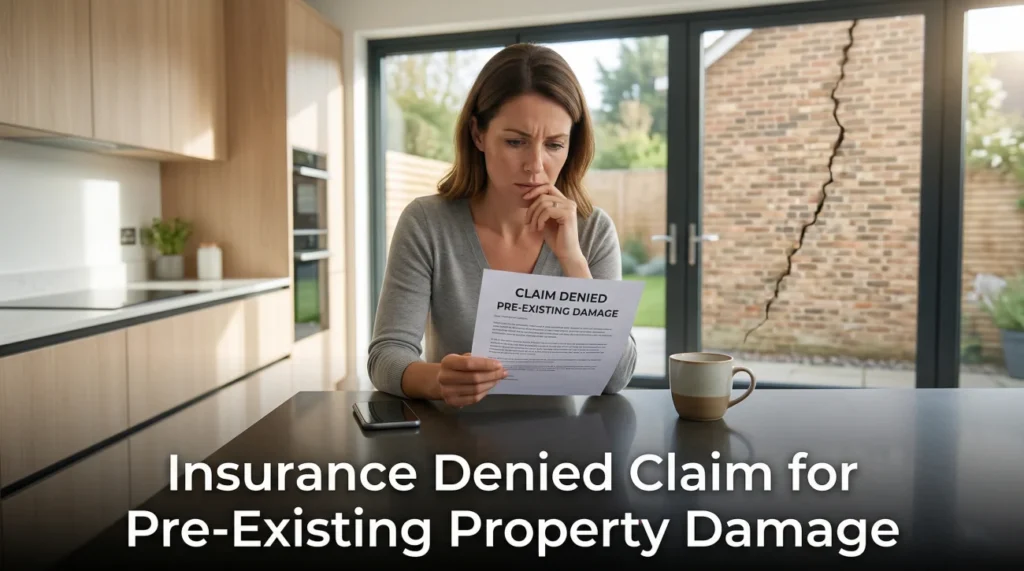
- Pre-existing property damage denials fall into three primary scenarios: damage pre-dating the policy, damage pre-dating the event, or issues resulting from late reporting.
- Adjusters often rely on high-resolution satellite imagery or CLUE reports to justify these denials, but these sources can be misinterpreted or lack the detail of an on-site inspection.
- You can challenge a pre-existing damage denial by producing a home inspection report from when you purchased the property or date-stamped photos showing the area was in good repair prior to the loss.
The “Pre-Existing” Trap: Why Insurers Use This Denial and What It Really Means
If you have just received a letter stating your insurance denied your claim for pre-existing property damage, it can feel like a direct accusation. The insurer is effectively saying the damage you are asking them to pay for was already there before the storm, the fire, or the pipe burst occurred. In my experience writing and reviewing property claims, this is one of the most frustrating barriers a homeowner can face because it relies on the insurer’s interpretation of your home’s history.
In many cases I have reviewed, the “pre-existing” label is used as a catch-all when an adjuster sees wear and tear but wants to use a more definitive exclusion. However, the legal and procedural definition of pre-existing damage is quite specific. It is not just “old” damage. It is damage that legally falls outside the window of your coverage period or the specific event you reported. Understanding how they reached this conclusion is the first step in understanding the common landscape of denied claims and deciding if you have a path forward.
I have sat across from adjusters who pointed at a water stain and claimed it was “years old” based on nothing more than the color of the drywall. While they are trained to look for these patterns, they are not infallible. This guide is designed to help you decode their evidence and gather the proof needed to show that your loss was indeed sudden and accidental.
The Three Scenarios for Pre-Existing Damage Denials
Not all pre-existing denials are the same. When a carrier uses this exclusion, they are usually pointing toward one of three distinct timelines in your property history. Knowing which one applies to you changes how you build your counter-argument.
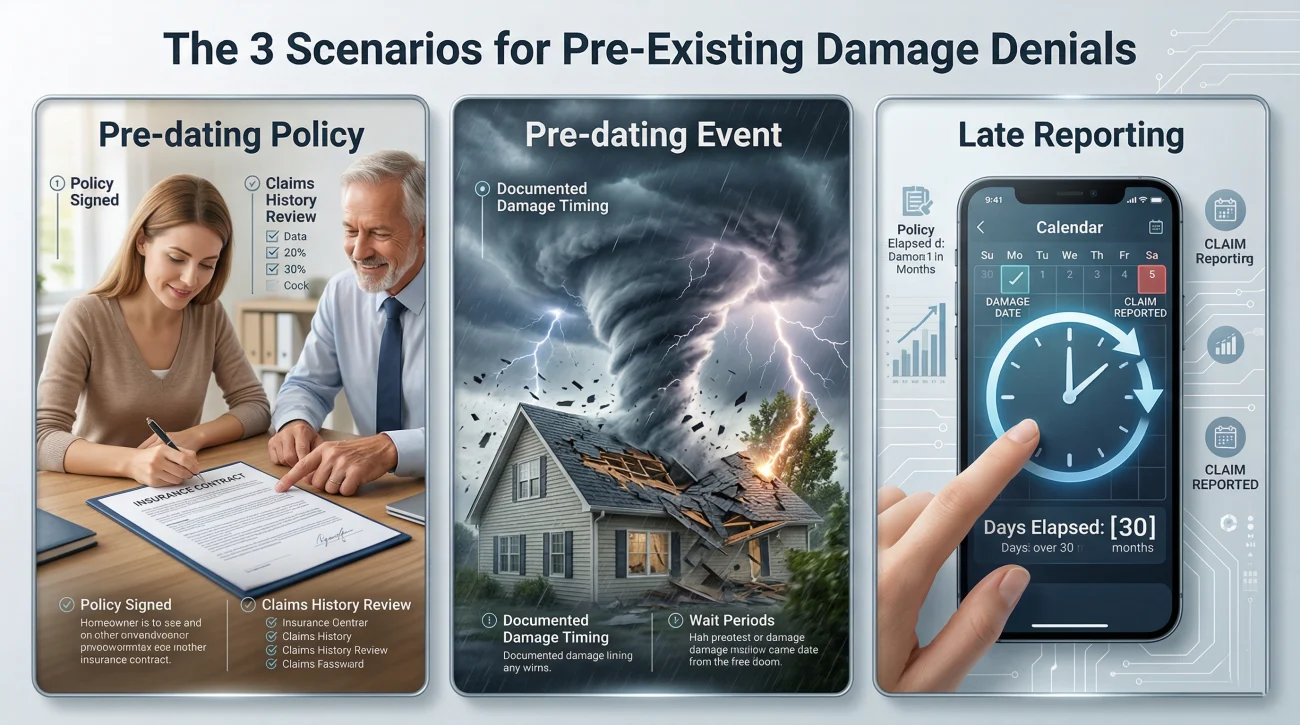
1. Damage Pre-Dating Policy Inception
This happens when an insurer claims the damage existed before you even signed your policy with them. This is most common when a homeowner files a claim shortly after switching carriers. The insurance company suspects that the homeowner switched policies specifically to get coverage for a problem they already knew about. This is a common focus in denials that occur immediately after an initial inspection.
2. Damage Pre-Dating the Covered Event
This is the more common scenario. Here, the insurer acknowledges you have a valid policy, but they argue the damage occurred before the specific storm or event you reported. For example, if you file for roof damage after a hurricane, the adjuster might claim the shingles were already lifted due to a storm from three years ago. They are saying the specific event didn’t cause the loss.
I once reviewed a claim where an insurer denied a basement flood claim, citing ‘pre-existing moisture’ in the floor joists. It turned out the adjuster was looking at marks left by the original construction crew’s chalk lines, misinterpreting them as old water levels.
3. The Late-Reporting Pre-Existing Argument
Sometimes damage occurs during your policy period, but you do not notice or report it for several months. Insurers often use the pre-existing argument here, asserting that since the damage is now “old” or has developed secondary issues like mold, it no longer qualifies as a sudden loss. While technically within your coverage window, the delay gives the adjuster room to claim the damage pre-dated your reported event.
Identifying which timeline the insurer is using allows you to focus your research on a specific date range, rather than trying to prove your home’s entire history at once.
How Insurers “Prove” Damage Is Pre-Existing
Insurance companies do not just guess. They use several digital and historical tools to establish a baseline for your property. When you are hit with a pre-existing condition denial, it was likely triggered by one of the following sources of evidence.
| Evidence Source | What They Are Looking For | Common Flaws |
|---|---|---|
| Satellite Imagery | Photos from Google Earth or proprietary services comparing your roof before and after the loss. | Low resolution, shadows misidentified as damage, or outdated images that do not reflect recent repairs. |
| CLUE Reports | A database of prior claims filed at your address by you or previous owners. | May list “inquiries” as claims, or describe damage that was already fully repaired. |
| Material Aging | Rust on nails, oxidation of wood, or the “weathering” pattern of shingles. | Corrosion can happen much faster in coastal environments than adjusters assume. |
| Pre-Policy Inspections | Photos taken by the insurer’s inspector when you first bound the policy. | Inspectors often miss interior areas or attic spaces during a quick drive-by inspection. |
In my experience, satellite imagery is the most frequently contested evidence. I have seen denials based on “dark spots” on a roof that were actually just wet leaves. If your insurer cites satellite photos, you have the right to request copies of those images to see exactly what they are seeing.
Signs Your Pre-Existing Damage Denial May Be Incorrect
It is one thing for an insurer to claim damage is old. It is another for them to prove it. In many cases, an insurer issues a denial hoping the homeowner will simply give up rather than challenging the evidence. If your situation matches any of the patterns below, the denial might be a misapplication of the policy language.
- 🛑 Remote-Only Adjusting: The denial was issued based on satellite photos or a “desk adjust” without a physical person ever stepping foot on your property. This is a weak basis for a denial, as remote photos cannot verify the pliability or moisture content of materials.
- 🛑 Incorrect Date Stamps: The “evidence” photos the insurer is using are actually from a date after your reported loss occurred.
- 🛑 Contradictory Professional Opinions: Your licensed contractor has provided a written statement that the damage is fresh, but the adjuster ignored it. When an insurer ignores a professional assessment without a detailed counter-explanation, it is a red flag.
- 🛑 No Baseline Inspection: The insurer claims damage existed before the policy started, yet they never performed an interior or roof inspection when you signed up.
- 🛑 Misinterpreted Maintenance: The insurer is calling a previous repair “unrepaired pre-existing damage” because they do not see receipts in their file.
Key Point: A pre-existing damage denial requires proof of when the damage happened. If the insurer cannot produce a specific photo or record from before your date of loss that clearly shows the exact same damage, their position is significantly weakened.
If you recognize these patterns in your claim, the next step is to evaluate your options for fighting a denial. The “pre-existing” label is often just an invitation for you to provide better documentation than the insurer currently has. Do not assume the letter is the final word.
How to Challenge a “Pre-Existing” Determination
Successfully disputing a denial requires you to establish a clear timeline of your home’s condition. To win this fight, you need to provide what I call a “snapshot in time” that proves the area was in good condition before the loss occurred. I always tell homeowners to look for specific documents, as they are the “silver bullets” in pre-existing damage disputes.
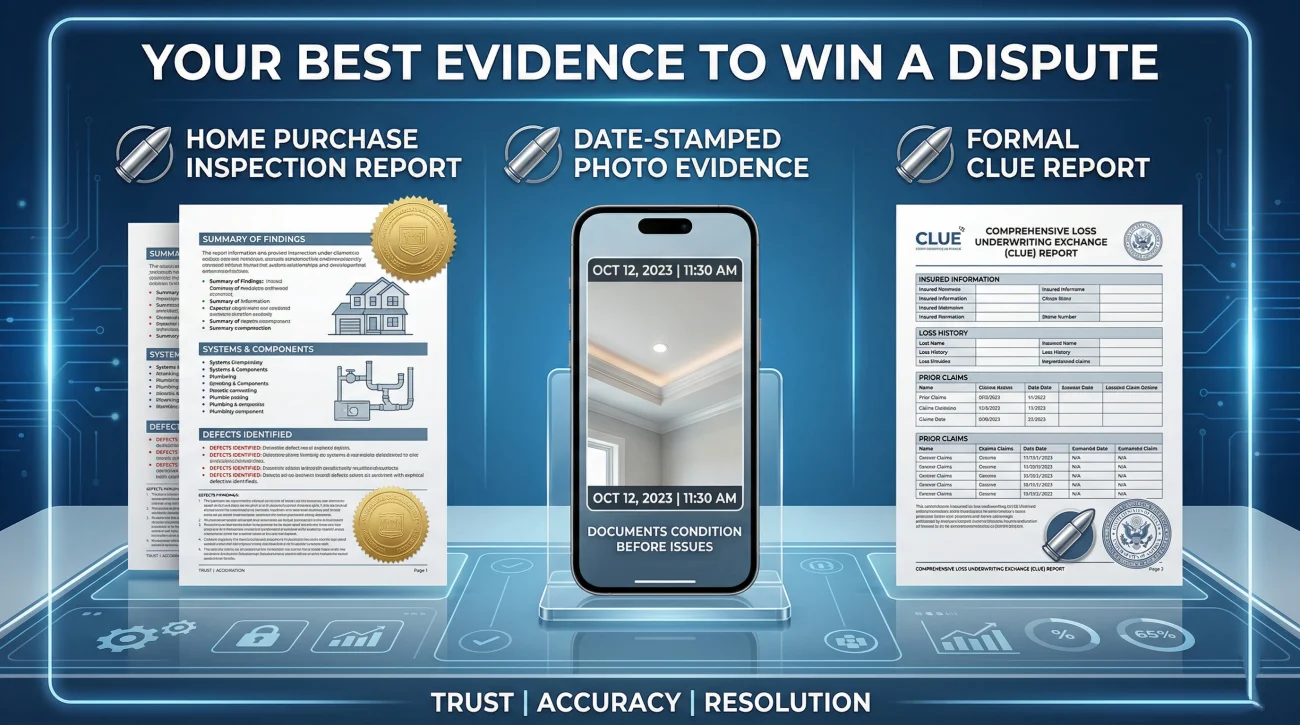
1. The Home Purchase Inspection Report
If you bought your home within the last few years, your purchase inspection report is your best friend. These reports are usually incredibly detailed. If your report from two years ago says “Roof in good condition with no signs of leaks,” and the insurer is now claiming the leaks are pre-existing, that report is powerful counter-evidence.
2. Personal Photo History
I often ask homeowners to look through their phone’s photo library for background shots. Did you take a photo of your living room six months ago? Check the background. If the ceiling is clean and white in that photo, but now it has a water stain, you have date-stamped proof that the damage is new.
3. Check Your Own CLUE Report
You do not have to wait for the insurer to tell you what is on your record. You can pull your own CLUE (Comprehensive Loss Underwriting Exchange) report for free once a year through the official reporting agency. If the insurer is citing a “prior claim” as the reason for your denial, your report will show if that claim was actually for a different area of the house or if the prior issue was fully resolved and paid out.
Sample Documentation Email Opener:
Verbally arguing with the adjuster over the phone that “it wasn’t there before” without providing any physical evidence.
Submitting a written formal response with attached date-stamped photos or professional inspection reports that create a factual timeline.
Requesting a Formal Re-Inspection

Once you have gathered your evidence, the next step is to request a formal physical re-inspection of the property. Sending an email with photos is a start, but forcing the insurance company to put “boots on the ground” again is how you move the needle. In your written request, state specifically that the initial inspection relied on incomplete data (such as remote satellite imagery) and that you have physical evidence that contradicts the adjuster’s findings.
When the second adjuster arrives, you must manage the visit differently than the first time. Do not let them walk around alone. Have your contractor present to point out the specific differences between weathered materials and the fresh damage from your reported loss. Professionals frequently use moisture meters to detect trapped water that an adjuster’s eyes might miss. If your contractor has found elevated readings, ensure the adjuster documents the “opening of walls” to verify that the damage is internal rather than just surface-level staining. This professional-to-professional dialogue often forces the insurer to acknowledge scope items they misinterpreted during a rushed first visit.
When to Seek Professional Help
Sometimes, no matter how many photos you provide, the insurer refuses to budge. They might claim your photos aren’t clear enough or that their “expert” engineer’s opinion overrides your home inspection. This is the point where the DIY process usually breaks down. The insurer is often betting that you will eventually give up and walk away to avoid further stress.
This confidence often stems from the fact that their “pre-existing” determination was likely based on a very thin inspection. If an adjuster spent only 20 minutes at your house, they likely missed the specific nuances that prove the damage is new, and they assume you will not have the professional evidence to prove otherwise. At this stage, having a second set of professional eyes on the claim can change the entire dynamic of the negotiation.
A licensed public adjuster can perform a forensic-level inspection to document the difference between the old weathering and the new damage. If the insurer is refusing to acknowledge your evidence, you should consider whether getting a free claim review from a licensed public adjuster can help you identify exactly where the adjuster’s timeline went wrong. They know how to speak the “language” of the insurance company and can often force a re-evaluation of a pre-existing damage denial.
❓ FAQ
🛰️ Can an insurance company use Google Earth to deny a claim?
Yes, insurers frequently use satellite imagery to check the condition of a roof prior to a loss. You can challenge these often low-resolution images by providing high-resolution, close-up photos of your own from the same time period.
📅 How far back can an insurance company go for pre-existing damage?
There is no specific legal limit, but insurers typically focus on the last 3 to 5 years of the home’s history through CLUE reports and satellite data to establish a baseline of condition.
🏠 What if I didn’t know the damage was there?
Unfortunately, your knowledge does not change the coverage. If the insurer can prove the damage happened before your policy started, it is excluded, even if you were unaware of it when you bought the home.
🧐 Is wear and tear the same as pre-existing damage?
No. Wear and tear is gradual deterioration over time. Pre-existing damage refers to a specific event or condition that occurred before the current claim. While they overlap, they are different exclusions.
📸 Do I need before photos of every room in my house?
No. Everyday photos, real estate listing photos, or your home purchase inspection report usually provide enough evidence to establish the condition of most areas before the loss.
🕵️ Can the insurer see my old claims from a previous house?
Yes. The CLUE report follows both the property address and the individual policyholder for the last seven years, regardless of which insurance company you were with at the time.
📜 What if my policy says it covers hidden damage?
Some policies have endorsements for hidden seepage or similar issues, but these issues usually have strict limits. The insurer will still try to determine if the damage started before your policy began.
🏗️ Does a home inspection from when I bought the house count as proof?
Absolutely. A professional home inspection report is excellent evidence for establishing the condition of the property at a specific point in time.
🧾 Can I fix the damage first and then fight the denial?
I advise against this. If you repair the damage before the insurer can re-inspect it, you might destroy the evidence needed to prove the damage was new. Always document everything before making repairs.
⚖️ Is a pre-existing damage denial the same as insurance fraud?
Not necessarily. A denial just means the insurer believes the loss is not covered. However, intentional misrepresentation of old damage as new can lead to a fraud investigation.
A denial sits inside a larger picture. These explain the parts around it.
- How the settlement process works after damage is reported
- Which parts of your policy apply when damage is involved
- How your damage type affects what the insurer is required to pay
- Whether the damage you have is actually worth filing for
- What happens when the claim you filed gets rejected
- How independent representation changes what gets documented
- When a disputed claim moves into legal territory
Not all denials are final. The path forward depends on why it happened.
- Whether your damage assessment left money on the table
- What the inspector who came to your home was actually there to do
- The parts of water damage that standard inspections routinely miss
- What fire and smoke assessments leave out of the scope
- Why the insurer's roof estimate is almost always lower than the roofer's
- When the denial crosses from a dispute into something that needs legal leverage
- Four options to fight back, including one most homeowners never use
Disclosure: I'm sharing my personal industry experience, but I am not an attorney or a licensed insurance agent. The guides on this site are for informational purposes to help you understand the operational side of property claims: process, organization, and documentation. Every policy is unique, so please defer to your specific policy language. For legal interpretation, contested situations, or binding advice, always consult a licensed professional in your jurisdiction.