
- “Wear and tear” is one of the most common reasons home insurance claims are denied, but it is also one of the most frequently misapplied by insurers.
- Standard policies do not cover gradual deterioration. Disputes typically arise when a storm impacts an already-aging roof or component.
- Insurers often rely on the age of materials or aerial satellite imagery to label damage as wear and tear, sometimes ignoring evidence of recent physical impact.
- If your contractor’s physical assessment directly contradicts the adjuster’s desk review, the gap between those two findings forms the basis for your appeal.
The “Gradual Deterioration” Trap
You file a claim after a severe windstorm tears through your neighborhood, expecting your insurance to cover the missing shingles and water damage. Instead, you receive a letter stating your claim is denied due to “wear and tear.” The insurer is telling you the damage wasn’t caused by the storm; it was caused by the simple passage of time.
In my daily reviews of denied claim files, I see the “wear and tear” exclusion cited more often than almost any other provision. It is a legitimate policy rule. Insurance is designed to cover unexpected incidents, not the cost of maintaining an aging house. However, it is also the exclusion I see misapplied most frequently.
The line between gradual decay and storm impact is rarely clear-cut. Insurers know this, and when a roof is older, they often default to the wear and tear label to avoid a massive payout. Understanding exactly how adjusters make this determination, and how to spot when they are getting it wrong, is the first step in figuring out if your denial is legitimate or challengeable.
What the Wear and Tear Exclusion Actually Says
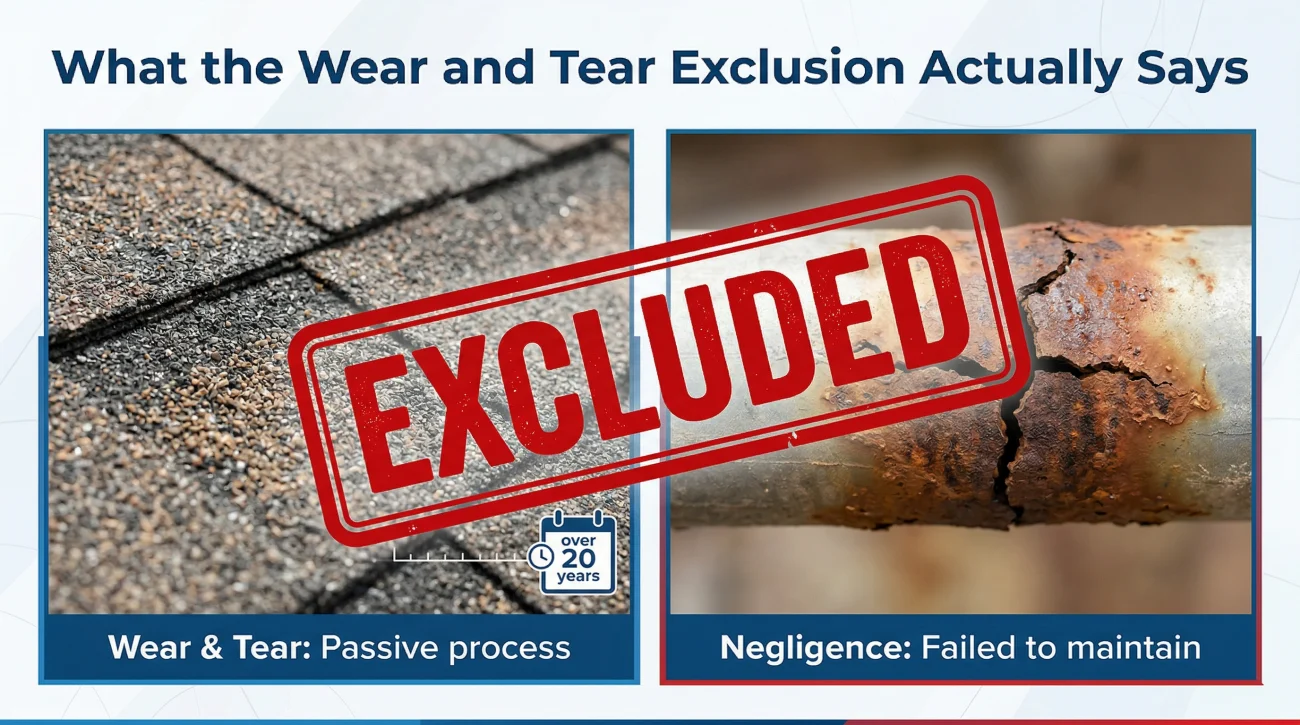
To effectively challenge this decision, you first have to understand the exact policy language being used against you. If you look closely at your standard HO3 policy, you will find a section explicitly stating that the policy does not cover loss caused by “wear and tear, marring, or deterioration.”
This exclusion exists because homeowners insurance is not a maintenance contract. If your 25-year-old asphalt shingle roof finally starts leaking because the granules have baked off in the sun over two decades, that is a passive, gradual process. The insurer expects you to replace the roof as part of normal homeownership.
It is important to note that this is distinct from a negligence or failure-to-maintain denial. Wear and tear implies a passive aging process that happens naturally. Negligence implies you actively knew about a specific problem and failed to fix it. Both result in denials, but they require very different types of evidence to challenge.
How Insurers Decide Damage is Wear and Tear
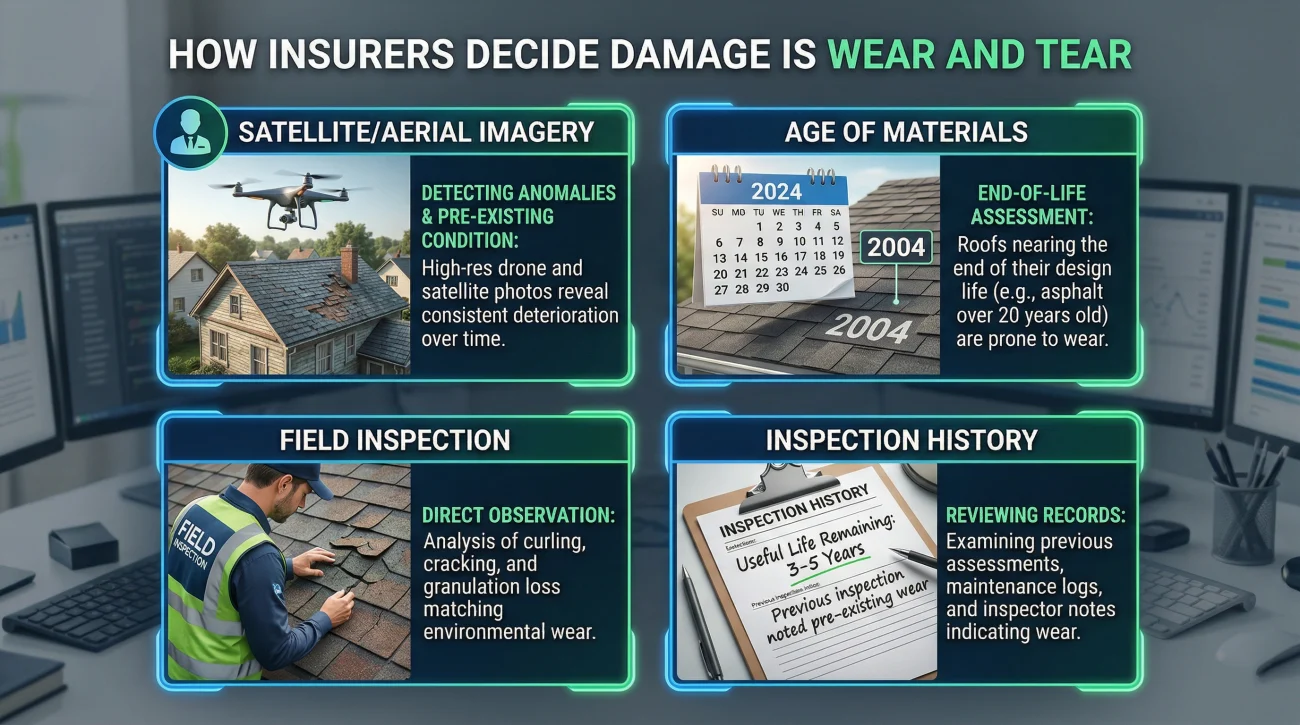
Desk adjusters do not just guess. They build a file to justify the “deterioration” label. When I review a carrier’s internal notes on these denials, they almost always rely on a specific combination of evidence.
Satellite and Aerial Inspection Tools
You might assume an adjuster has to climb your roof to claim it has deteriorated. Today, many desk adjusters rely on aerial measurement tools like EagleView or satellite imagery to estimate the age and condition of a roof. They can issue a wear and tear denial from a desk miles away, without ever sending someone up a ladder to check for actual hail strikes or wind creases.
The Age of the Materials
If public records or permits show your roof is 15 or 20 years old, the insurer immediately views any damage through the lens of deterioration. Age creates a heavy presumption that the materials simply failed on their own.
The Field Adjuster’s Visual Inspection
When they do send a field adjuster, that person is looking for specific weathering patterns. For a roof, they look for “cupping” (shingle edges curling up), “clawing” (shingle edges curling down), heavy granule loss in the gutters, or blistering. If they document these signs, they will argue the structure was already compromised.
Building Inspection History and Prior Claims
Insurers frequently pull data from the time you purchased the home. If your original home buyer’s inspection report from five years ago noted “roof has 3 to 5 years of useful life remaining,” and you never replaced it, the insurer will immediately pull that report to justify closing the case without looking much deeper.
The Gray Area: Storm Damage vs. Wear and Tear
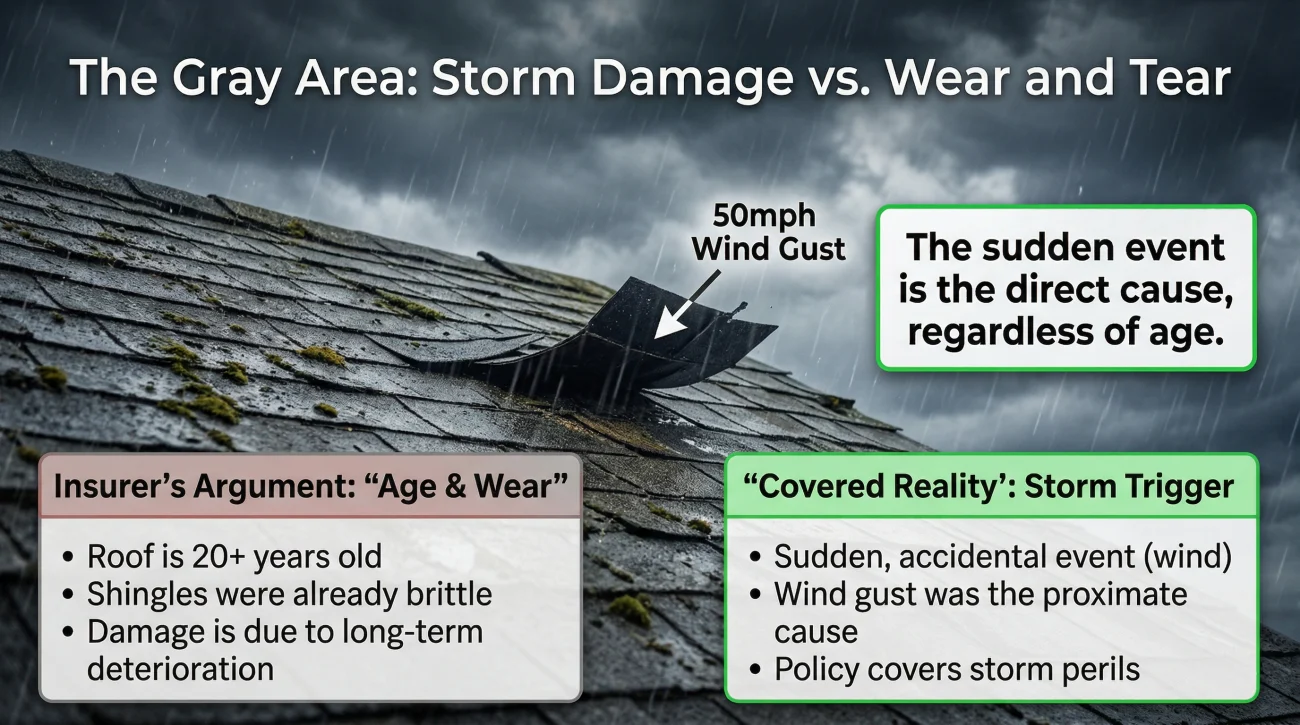
The dispute almost never happens when a brand-new roof is hit by a tornado, or when a 30-year-old roof slowly leaks on a sunny day. The fight happens in the gray area: severe weather hits an already-aging component.
I frequently see insurers take an “all or nothing” approach. They claim the damage is entirely due to age, while the homeowner argues the storm was the sole culprit. The reality is often that both things are partially true: the roof was old, but the storm was the direct trigger that caused the immediate failure.
“The shingles blew off because the adhesive had deteriorated over 15 years. The wind was a factor, but the root cause is age.”
If 50mph winds tear shingles off a 15-year-old roof, it is still wind damage. The sudden event was the direct cause of the loss, regardless of the roof’s prior condition.
Signs Your Wear and Tear Denial is a Misapplication
Receiving this denial letter is incredibly frustrating because it feels like the insurance company is blaming you for living in an older house. It is easy to feel defeated when a professional tells you it is just “old age.” But do not assume the adjuster’s initial assessment is the final, objective truth.
When I sit down to evaluate a file, I am specifically looking for shortcuts. I want to see if the adjuster actually investigated the cause of loss, or if they simply looked at the installation date and checked a box. I consider a wear and tear denial highly suspect if it aligns with any of these operational red flags:
- 👉 The field adjuster spent less than 30 minutes inspecting the damage, or relied entirely on drone or satellite imagery without a close-up physical inspection.
- 👉 The denial letter cites the “age of materials” but completely ignores the fact that adjacent areas of the exact same age survived intact, pointing to a localized physical impact.
- 👉 The adjuster failed to investigate the interior of the home for corresponding damage (like water stains directly under a suspected hail strike), looking only at exterior weathering.
- 👉 Your independent contractor physically inspected the property and explicitly noted signs of sudden impact that the adjuster’s report omitted entirely.
I watched an insurer deny a roof claim for wear and tear based solely on the installation date. They never sent an adjuster up a ladder. When the homeowner hired an independent roofer, the roofer found distinct, sharp hail strikes that had clearly broken the shingle matting. The age was irrelevant; the hail was the undeniable trigger.
💡 Pro Tip: If your roofer’s assessment contradicts the insurer’s finding, do not try to argue the technical points yourself. A licensed public adjuster can cross-reference your roofer’s physical findings with your policy’s specific language, translating contractor jargon into a formal coverage argument. Get a free claim review to see if your denial can be overturned.
Your Action Plan: Countering the Denial
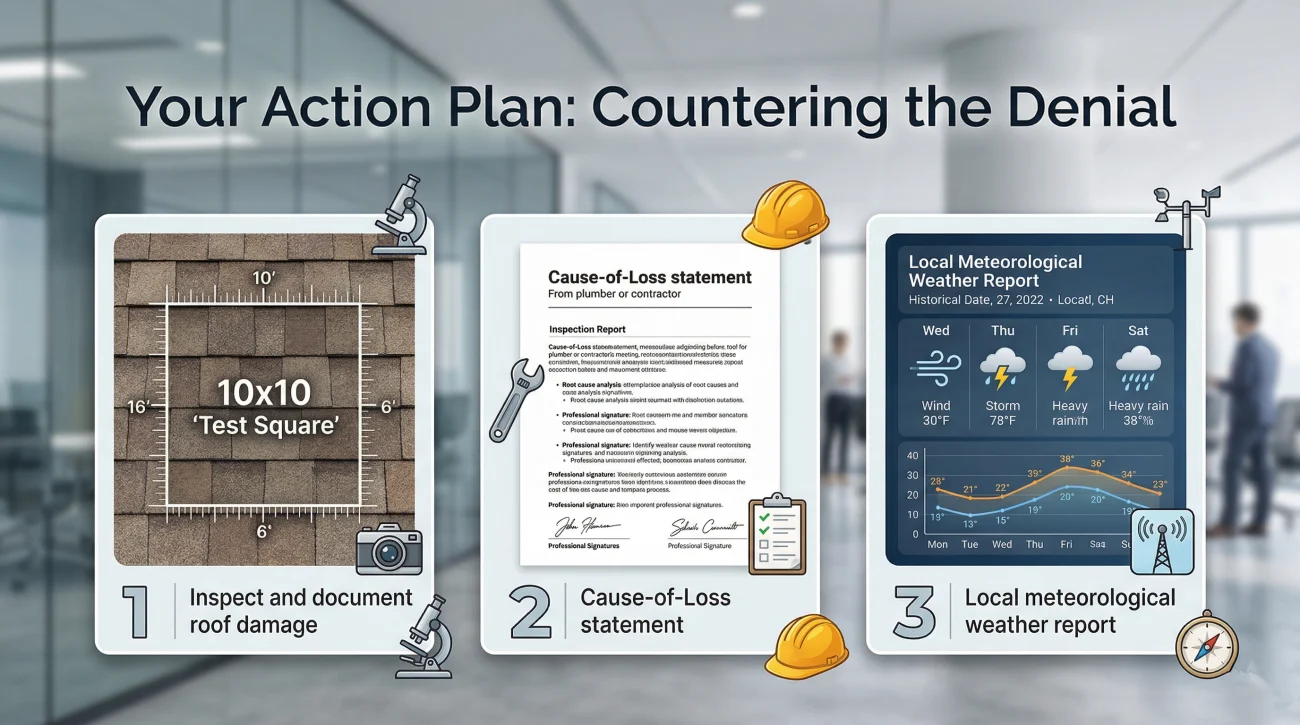
The engineer or adjuster sent by the insurance company works for them, and their reports are naturally framed to highlight age. To push back, you need specific, targeted evidence. Here is what to do next:
- 👉 Request a “Test Square” for Roof Claims: Don’t just ask a roofer for a quote. Ask them to document a 10×10 foot test square and take close-up, high-resolution photos of sharp hail strikes or fresh wind creases that definitively break the shingle matting.
- 👉 Get a Cause-of-Loss Statement: If it’s a pipe burst, you need a plumber to write a formal statement documenting that a sudden pressure spike caused the failure, rather than gradual corrosion over time.
- 👉 Check the Weather Data: Pull local meteorological reports showing wind speeds or hail size in your exact zip code on the specific date of loss.
Once you gather this evidence, you should review how to accurately interpret your denial letter to make sure your documentation directly attacks the exact policy exclusion they cited.
Final Thoughts on Gradual Deterioration
A “wear and tear” denial is a powerful tool for insurance companies because it successfully shifts the burden of proof onto you. They have cited age, and now you must prove otherwise.
The key is removing emotion from the dispute and replacing it with undeniable, physical documentation. The existence of older plumbing or aging shingles does not give an insurer a free pass to ignore legitimate storm impact. Gather the right technical evidence, understand your options, and decide exactly how to fight the denied home insurance claim with confidence.
❓ FAQ
❓ What does the wear and tear exclusion mean in home insurance?
It means your policy does not cover damage caused by the natural aging, gradual deterioration, or normal use of your property’s materials over time. Insurance covers sudden accidents, not inevitable decay.
🛑 Can I dispute a wear and tear denial?
Yes. You can dispute it by providing independent evidence, usually from a licensed contractor or engineer, proving that a covered event (like a storm) was the direct cause of the failure, rather than just age.
🌧️ How do insurers tell the difference between storm damage and wear and tear?
Adjusters look for specific patterns. For example, wind damage often leaves sharp creases or completely torn shingles, while wear and tear usually presents as smooth granule loss, curling edges, and generalized fading across the entire surface.
📅 Does the age of my roof automatically mean my claim will be denied?
No. While an older roof faces heavier scrutiny, if a severe storm physically breaks or tears the aging materials, it is still considered covered wind or hail damage under most standard policies.
⚖️ What is the difference between wear and tear and negligence?
Wear and tear is passive, natural aging (like shingles losing granules over 15 years). Negligence is an active failure to maintain the property (like knowing you had a missing shingle for two years and ignoring it until the ceiling collapsed).
📸 What evidence do I need to fight a wear and tear denial?
You need date-stamped photos from before the damage occurred (showing the area was intact), weather data confirming a severe storm, and a written report from an independent contractor diagnosing the exact cause of failure.
🕵️♂️ Will the insurance company send a second adjuster if I disagree?
Sometimes. If you submit new, compelling evidence from your own contractor that contradicts the initial finding, the insurer may send a different adjuster or an independent engineer to re-inspect the property.
💧 Is water damage from an old pipe considered wear and tear?
It depends. The cost to repair the corroded pipe itself is usually excluded as wear and tear. However, the resulting sudden water damage to your drywall and floors is often still covered, depending on your policy language.
🤝 Should I hire a public adjuster for a wear and tear denial?
If you have strong evidence that a storm caused the damage and the insurer refuses to budge, a public adjuster can provide the technical expertise needed to document the loss and argue the cause effectively.
⏳ How long do I have to appeal a wear and tear denial?
The appeal window varies heavily based on state regulations and the specific language in your policy. You must check your denial letter and policy documents immediately to confirm your exact deadline.
A denial sits inside a larger picture. These explain the parts around it.
- How the settlement process works after damage is reported
- Which parts of your policy apply when damage is involved
- How your damage type affects what the insurer is required to pay
- Whether the damage you have is actually worth filing for
- What happens when the claim you filed gets rejected
- How independent representation changes what gets documented
- When a disputed claim moves into legal territory
Not all denials are final. The path forward depends on why it happened.
- Whether your damage assessment left money on the table
- What the inspector who came to your home was actually there to do
- The parts of water damage that standard inspections routinely miss
- What fire and smoke assessments leave out of the scope
- Why the insurer's roof estimate is almost always lower than the roofer's
- When the denial crosses from a dispute into something that needs legal leverage
- Four options to fight back, including one most homeowners never use
Disclosure: I'm sharing my personal industry experience, but I am not an attorney or a licensed insurance agent. The guides on this site are for informational purposes to help you understand the operational side of property claims: process, organization, and documentation. Every policy is unique, so please defer to your specific policy language. For legal interpretation, contested situations, or binding advice, always consult a licensed professional in your jurisdiction.