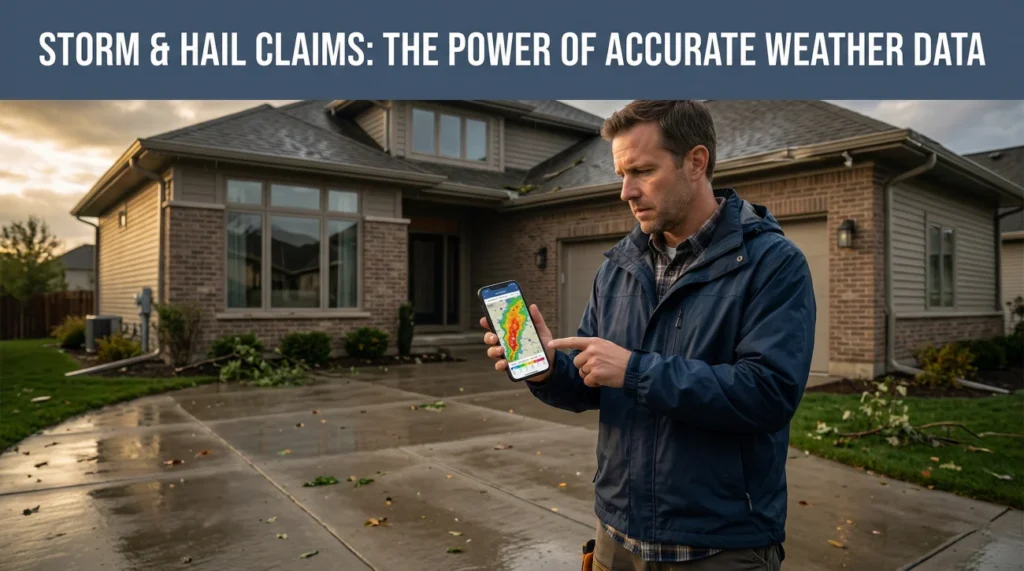
- Insurers use historical weather maps and meteorological data to verify your storm date; getting this “date of loss” right is the foundation of a successful claim.
- Hail assessment relies heavily on soft metal impacts (gutters, AC fins, vents) because they show undeniable proof of sudden damage versus normal aging.
- Storms rarely damage just one part of a house. The most common reason these claims are underpaid is that the scope is limited to the roof, ignoring siding, windows, and HVAC units damaged in the exact same event.
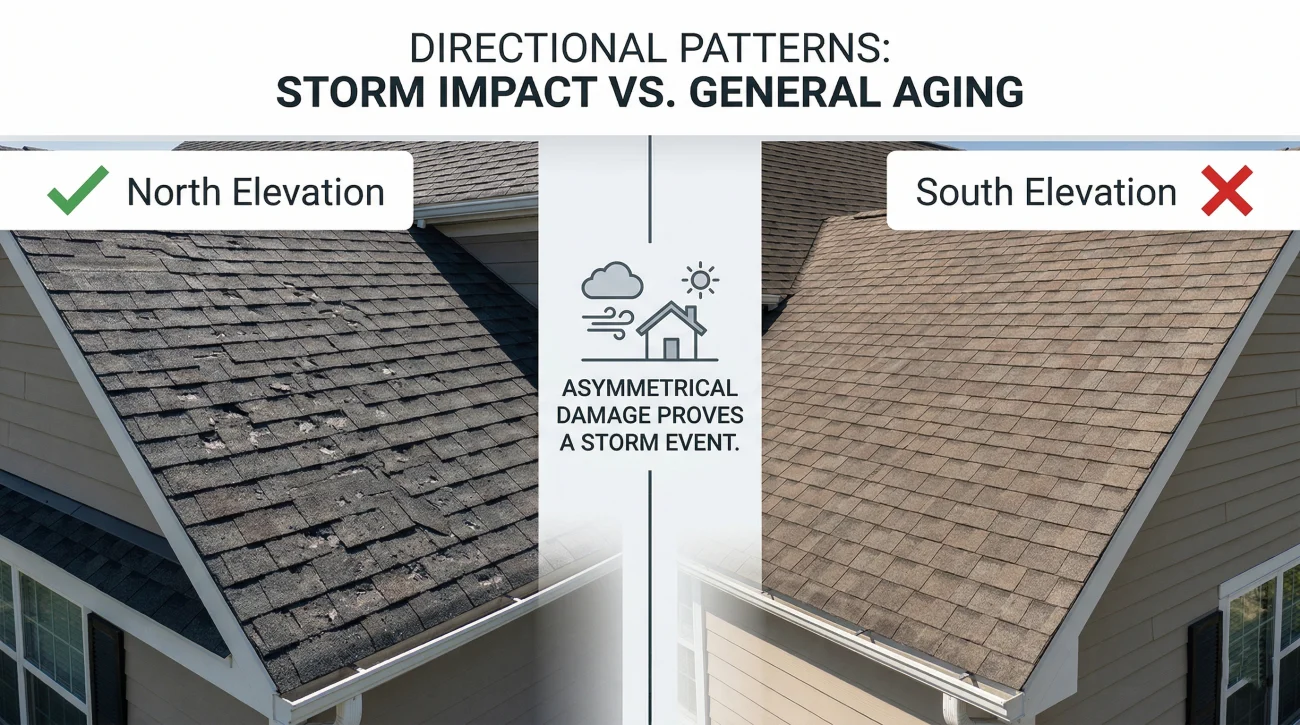
- Directional damage patterns matter: storm damage usually hits specific elevations based on wind direction, whereas pre-existing wear looks uniform across the entire property.
- If your adjuster’s settlement seems incomplete, securing a free reinspection from a licensed professional can identify multi-system components that were left off the original scope.
How Hail Damage is Actually Assessed in the Field
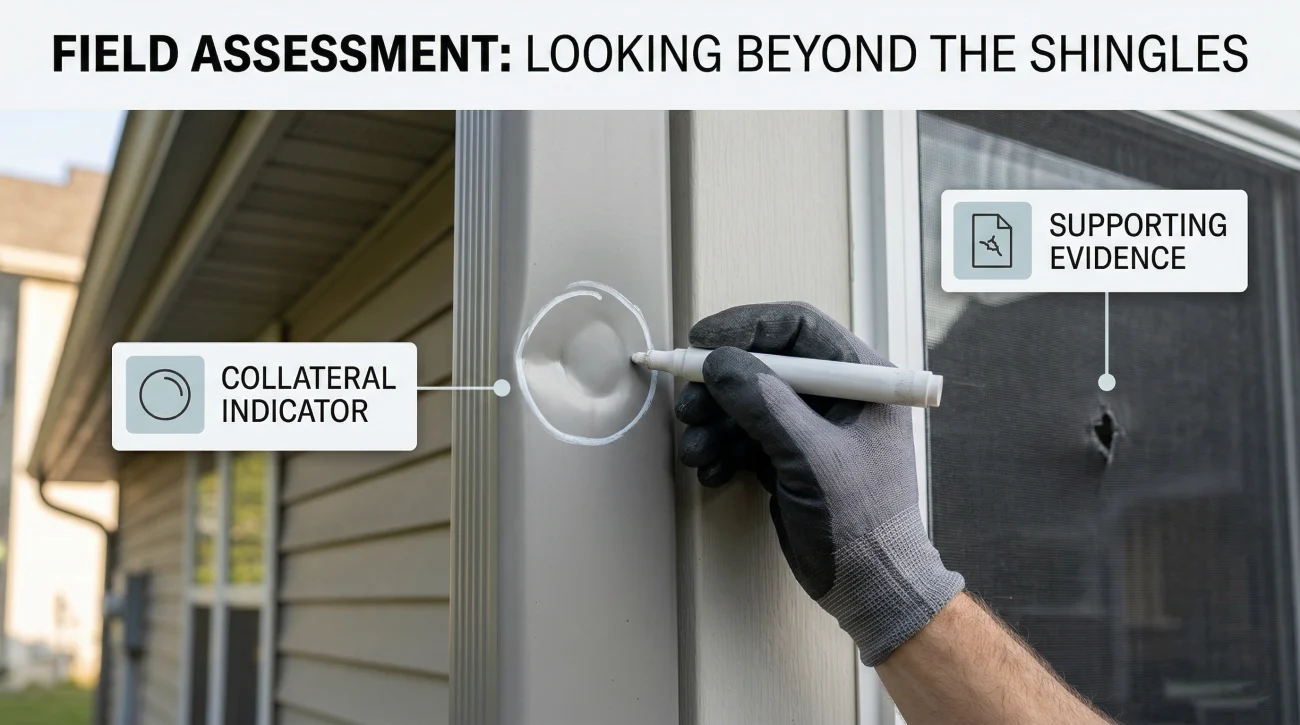
When an adjuster arrives to inspect hail damage, many homeowners assume the entire focus will be on the asphalt shingles. While the roof surface is important, experienced adjusters actually look for collateral indicators first. They inspect exterior fixtures that show clear indentations.
Hail impacts on soft exterior materials, like aluminum gutters, fascia wrap, window screens, exhaust vents, and air conditioner condenser fins, are the most reliable initial indicators of a hail occurrence. An asphalt shingle can lose granules over time due to age and sun exposure, leading to debates about wear and tear. But a sharp, circular dent in a copper flashing or an aluminum vent cap is undeniable physical evidence of sudden impact.
In my experience, the first 10 minutes of an inspection often dictate the outcome. I always advise homeowners to look at their downspouts and AC units before the adjuster arrives. If I see clear hail spatter on the oxidation of a downspout, I know we have a strong argument for recent impact, regardless of what the shingles look like.”
For the roof itself, hail damage on asphalt shingles typically presents as bruising or granule displacement directly at the impact points. It feels like a soft spot or a small crater when pressed. Adjusters are trained to mark off a “test square” (a 10-foot by 10-foot area) on each directional slope of the roof and count the number of verifiable hail hits within that square. If the count meets their internal threshold, that slope may qualify for replacement.
⚠️ Warning: Be extremely cautious of an adjuster who conducts a “ground-level only” inspection. Unless your roof is too steep or wet to safely walk, a thorough assessment of granule loss and bruising cannot be accurately completed from the driveway with a camera zoom lens.
The Directional Assessment Problem
One of the most frequent reasons a storm damage claim is underpaid or denied is the confusion between storm damage and pre-existing wear. Insurers frequently argue that the deterioration on your property existed long before the storm rolled through.
The distinction often comes down to directionality. Hail and wind events are highly directional based on the storm’s movement. Damage that appears predominantly on the north and west slopes of a roof, or siding damage isolated to a single elevation, is highly consistent with a specific storm path.
Assuming that because your roof is older, all damage will automatically be classified as wear and tear. Homeowners often give up without pushing for a directional pattern review.
Pointing out to the adjuster that the damage is asymmetrical. If the south-facing siding is pristine but the north-facing siding looks like it was hit by buckshot, that directional pattern is a classic signature of a localized storm event, not general aging.
Pre-existing wear, sun damage, and thermal cracking generally appear uniformly across all similarly exposed surfaces of the home. Adjusters who fail to document the directionality of the damage may inadvertently conflate a legitimate storm impact with normal aging. Understanding the typical steps for documenting general roof wear versus sudden impact is part of a broader homeowners insurance roof claim strategy, but the directional test is uniquely crucial for wind and hail events.
The Multi-System Scope Gap
If there is one systemic issue I see in hail claims above all others, it is the multi-system scope gap. A significant hail or wind storm rarely isolates its wrath to just your shingles. In reality, it often damages multiple systems simultaneously: the roof, gutters, vinyl or aluminum siding, window frames, screens, and the outdoor AC condenser.
The problem arises because homeowners, and sometimes rushed adjusters, become hyper-focused on the roof. Homeowners sometimes file a claim specifically for the roof without realizing that other systems were compromised in the exact same event and belong on the exact same claim.
| Commonly Missed Component | Where to Look for Damage |
|---|---|
| HVAC Condenser Unit | Look at the delicate aluminum fins on the exterior of the unit. Hail flattens these fins, severely restricting airflow and damaging the unit’s efficiency. |
| Window Screens & Beading | Check for small tears in the mesh or dents in the metal framing around the glass, especially on the elevation that faced the storm. |
| Fascia and Soffit | Look upward from the exterior walls. High winds can displace ventilated soffit panels, and hail can dent the aluminum wrap covering the fascia boards. |
| Garage Doors | Inspect metal or fiberglass garage doors in bright daylight from an angle to spot shallow impact craters that are easy to miss head-on. |
All systems damaged in the same storm event should be covered under a single deductible. If your settlement only addresses the roof while ignoring the secondary exterior damage, the scope is fundamentally incomplete.
The Ticking Clock on Filing Deadlines

Unlike a sudden kitchen fire or a burst pipe, storm damage is not always discovered the morning after it happens. Many homeowners only realize their roof was compromised months later when a heavy rain causes a leak, or when a local contractor knocks on their door offering an inspection.
This delay brings the filing deadline into sharp focus. Most standard homeowners policies have a strict claim filing window following a storm event, which commonly ranges from one to two years depending on your specific policy text. However, there is a critical distinction between a Notice of Loss and a Proof of Loss. The Notice of Loss simply informs the insurer that an event occurred; you can and should file this promptly even before you have a fully itemized repair estimate. The formal Proof of Loss detailing the exact costs usually comes later.
Furthermore, the claim process does not permanently lock once the initial repair starts. A common scenario is the “supplement window.” Often, a contractor will begin tearing off the damaged roof only to discover rotting decking or code upgrades that were not visible during the initial inspection. As long as you are within your policy’s time limits, you can file a supplement for these newly discovered issues.
Because insurers use weather records to pinpoint storm dates, filing your initial notice after your specific policy window has closed usually results in an automatic denial. If you suspect storm damage after a major weather event rolls through your area, reviewing the fundamentals of navigating the standard documentation requirements is a smart move; you can read more about the home insurance claim process to ensure you don’t miss a critical procedural step.
Signs Your Storm Claim Was Undervalued

The frustration of a storm claim usually peaks when the settlement letter arrives and the numbers simply do not match reality. Because storms cover wide geographical areas, adjusters are often overworked following a major weather event, leading to rushed inspections. Before you accept a check or sign a release, watch for these universal warning signs that your claim has been unfairly disputed:
- 🛑 The single-system approval: The insurer approved a partial or full roof replacement, but completely ignored the gutters, siding, or windows that were battered by the same hail.
- 🛑 The wear and tear dismissal: Your claim was denied due to “pre-existing wear and tear,” despite obvious, fresh impact marks on soft metals like downspouts or exhaust vents.
- 🛑 The date of loss dispute: The denial letter claims there was no significant storm activity on the date you reported, even though your immediate neighbors have approved claims from the exact same date.
- 🛑 The drive-by inspection: The adjuster’s visit lasted less than 20 minutes, or they conducted the assessment entirely from ground level without physically walking the roof or getting a close look at the shingles.
- 🛑 The mismatched scope: Your local contractor’s repair estimate includes line items for drip edges, starter strips, and code upgrades, but the insurer’s Xactimate estimate only accounts for basic shingle replacement.
If you are staring at a settlement document and experiencing any of these scenarios, your claim is likely suffering from a severe scope gap. The issue isn’t that you lack coverage; the issue is that the adjuster’s documentation simply failed to capture the physical reality of your property’s condition.
Documenting What the Adjuster Missed
When you encounter a scope gap, the burden shifts to you to provide the documentation that proves the adjuster wrong. You cannot simply call the desk adjuster and argue about the price; you must present physical evidence of the missing line items.
This means getting back outside with a camera. Take wide shots that show the directional nature of the damage. Take macro (close-up) shots of bruised shingles and chipped paint on window beading. If the insurer is disputing the date of the storm, you can even request historical weather reports from independent meteorological services to confirm the hail swath over your address.
While you are gathering this evidence, it is crucial to preserve the physical proof.
💡 Pro Tip: Never throw away damaged window screens or broken outdoor fixtures while the claim is still open. Adjusters need to see the physical evidence. If you must remove debris for safety, take extensive photographs and store the items in your garage.
Here is a practical way to communicate a multi-system gap to your desk adjuster when requesting a reinspection:
Hello [Adjuster Name],
I am writing to review the initial estimate provided for the storm damage on [Date of Loss]. While I see the roof surface has been partially addressed, the current scope completely omits the collateral damage sustained in the exact same weather event.
Specifically, the estimate does not include the hail impacts on the HVAC condenser fins (east elevation), the torn window screens (north and east elevations), and the dented aluminum fascia wrap.
I have attached 12 photographs clearly documenting these impacts. Because this multi-system damage was caused by the same storm, it belongs on this claim. Please review these photos and advise when we can schedule a reinspection to capture these missing components so we can reach an accurate settlement.
Thank you,
[Your Name]
The winning formula for this communication is simple: clearly identify the missing system, provide the photographic evidence, and formally request a reinspection in writing.
If the desk adjuster rejects your photographic evidence or refuses to send someone out for a reinspection, your DIY options begin to narrow. This is typically the point where a claim stalls and professional intervention becomes necessary to force a proper scope review.
When the First Offer Isn’t the Final Word
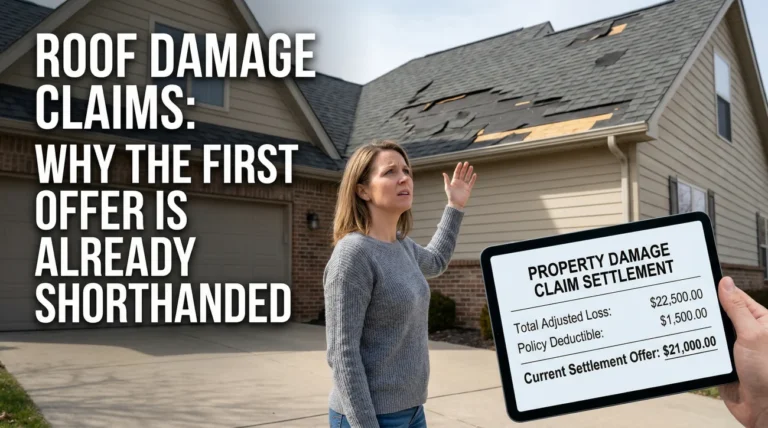
Storm and hail claims are historically the most common cause of insured property losses, yet they remain some of the most frequently underpaid. The root of the problem is almost always a limited scope of work, an inspection that looked at the roof but ignored the siding, or an assessment that conflated a directional hail strike with general aging.
You do not have to accept the first offer if it does not reflect the reality of the damage to your property. Reopening a claim for a supplement or requesting a reinspection is a normal, built-in part of the insurance process. If you feel overwhelmed by the process or if your insurer is firmly entrenched in a wear-and-tear denial, it is usually time to bring in an expert who speaks their language.
Having an independent professional identify missing storm-related components on your property can bridge the gap between a lowball offer and a fair settlement. Consider looking into a dedicated resource for roof and exterior damage to understand how a reinspection works. Furthermore, if you are unsure whether escalating the dispute to a dedicated claims advocate makes financial sense, you can explore getting a free initial claim review to see exactly what the adjuster left off the table.
❓ FAQ
🌪️ How long after a storm can you file an insurance claim?
It depends on your specific policy language, but most standard homeowners policies require you to file within one to two years from the actual date of the storm. Waiting too long can result in an automatic denial, so it is always best to file a Notice of Loss as soon as damage is suspected.
🧊 How does an adjuster prove hail damage on a roof?
Adjusters look for physical impact markers, typically starting with soft exterior metals like gutters and vents. On asphalt shingles, they look for circular bruising or spots where granules have been freshly displaced by impact, often using a 10×10 foot test square to count the hits.
⏱️ Can an insurance company deny a claim for pre-existing damage?
Yes. If the adjuster believes the deterioration is due to age, poor maintenance, or a prior unaddressed event, they will deny the claim. To fight this, you must show evidence of sudden, directional damage that aligns with recent weather data.
📋 What should I do if my storm damage claim is underpaid?
Do not sign a final release. Document the areas the adjuster missed (like siding, HVAC, or windows), get a detailed, itemized estimate from a reputable contractor, and submit these in writing as a request for a supplemental payment or reinspection.
🏠 Does homeowners insurance cover damage to my AC unit from hail?
Yes, standard policies generally cover the outdoor HVAC condenser if it is damaged by a covered peril like hail. However, you must explicitly point this damage out, as adjusters frequently overlook AC fins during roof-focused inspections.
🌧️ How do insurers know the exact date of the storm?
Insurance companies subscribe to advanced meteorological databases that provide historical wind swath and hail impact maps. They will check the date you report against this data to confirm a storm actually occurred at your specific address.
💸 Will my premium go up if I file a wind damage claim?
Insurance pricing is based on a complex pool of risk. If a major storm hits your entire region, base rates for your ZIP code may increase regardless of whether you filed an individual claim. However, because storms are considered an “Act of God,” filing a claim for wind or hail damage is generally treated differently than a negligence-based claim.
📸 Do I need to be home when the adjuster inspects the roof?
While you are not required to be present, it is highly recommended. Being present allows you (or your contractor/public adjuster) to point out multi-system damage like window screens and siding that the adjuster might miss if left to inspect the property alone.
🔎 What happens if the adjuster only looks at the damage from the ground?
A ground-level inspection is almost always insufficient for finding shingle bruising. If your adjuster refuses to safely access the roof, you should immediately request a reinspection with a different adjuster or hire an independent professional to document the roof properly.
🛑 Can I reopen a closed storm claim if I find more damage later?
In many cases, yes. If you discover hidden damage (like a leak that reveals itself weeks later) or if a contractor finds code upgrades required for the repair, you can usually file a supplement as long as you are still within the policy’s time limits.
Damage type affects coverage, documentation, and payout. These connect the dots.
- How the settlement process works after damage is reported
- Which parts of your policy apply when damage is involved
- How your damage type affects what the insurer is required to pay
- Whether the damage you have is actually worth filing for
- What happens when the claim you filed gets rejected
- How independent representation changes what gets documented
- When a disputed claim moves into legal territory
Each damage type has its own patterns. See what adjusters commonly miss.
- Whether your damage assessment left money on the table
- What the inspector who came to your home was actually there to do
- The parts of water damage that standard inspections routinely miss
- What fire and smoke assessments leave out of the scope
- Why the insurer's roof estimate is almost always lower than the roofer's
- When a denial crosses into bad faith and needs legal leverage
- The four options after a denial, including one most homeowners skip
Disclosure: I'm sharing my personal industry experience, but I am not an attorney or a licensed insurance agent. The guides on this site are for informational purposes to help you understand the operational side of property claims: process, organization, and documentation. Every policy is unique, so please defer to your specific policy language. For legal interpretation, contested situations, or binding advice, always consult a licensed professional in your jurisdiction.