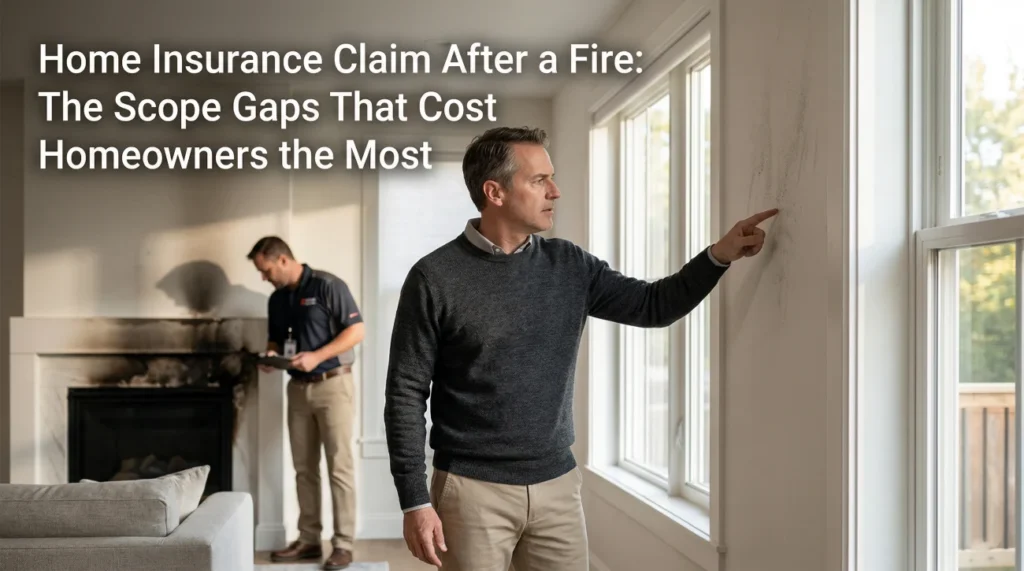
- A fire claim involves three distinct layers of loss: structural damage, smoke and soot contamination, and the cost of temporary displacement.
- Smoke damage is the most frequently undervalued component of a fire claim, especially regarding HVAC system contamination and non-visible soot in wall cavities.
- Insurance adjusters often label non-visible smoke damage as “cosmetic” to limit payouts to surface cleaning rather than material replacement.
- A complete personal property inventory requires a meticulous, room-by-room line-item list, not just a brief walkthrough by the adjuster.
- Independent testing by an industrial hygienist is the standard method for proving hidden smoke contamination that visual inspections miss.
Navigating the Aftermath of a House Fire
Standing outside a home after a fire is one of the most disorienting experiences a homeowner can face. When you file a home insurance claim fire damage report, you expect the process to be straightforward. You assume the insurance adjuster will arrive, look at the charred framing, smell the smoke, and write an estimate that covers putting everything back exactly as it was. However, in my experience reviewing hundreds of property claims, I can tell you that a fire claim is rarely that simple.
A house fire actually produces three distinct types of loss. There is the structural damage from the flames and heat. There is the smoke and soot contamination that travels far beyond the fire’s origin. Finally, there are the displacement costs incurred while you cannot live in the home. Most homeowners understandably focus on the visible fire damage. They point the adjuster to the burned kitchen cabinets or the collapsed roof. But the structural fire damage is rarely where the financial shortfall occurs.
💡 Pro Tip: Before any mitigation crews begin hauling away debris or tearing out drywall, aggressively photograph the scene. Document entry points, unaffected rooms showing soot traces, the condition of your HVAC vents, and piles of damaged personal property. Your claim relies on this initial snapshot.
The gap between what the insurance company offers and what the repairs actually cost almost always hides in the smoke and soot scope. The visible damage is easy to photograph and quantify. The invisible contamination that has embedded itself into your ductwork, your insulation, and your soft goods is much harder to prove. Adjusters document what they can see. If they do not see soot on a surface, they often assume that area is unaffected.
I have sat across from adjusters on countless claims where the initial settlement offer looked substantial at first glance. It is only when we dig into the line items that we realize entire rooms, major mechanical systems, and thousands of dollars in personal property were completely omitted from the scope. Understanding the standard sequence of a property claim is helpful, but fire claims require a specific focus on hidden variables.
Why Smoke Damage is Systematically Underscoped
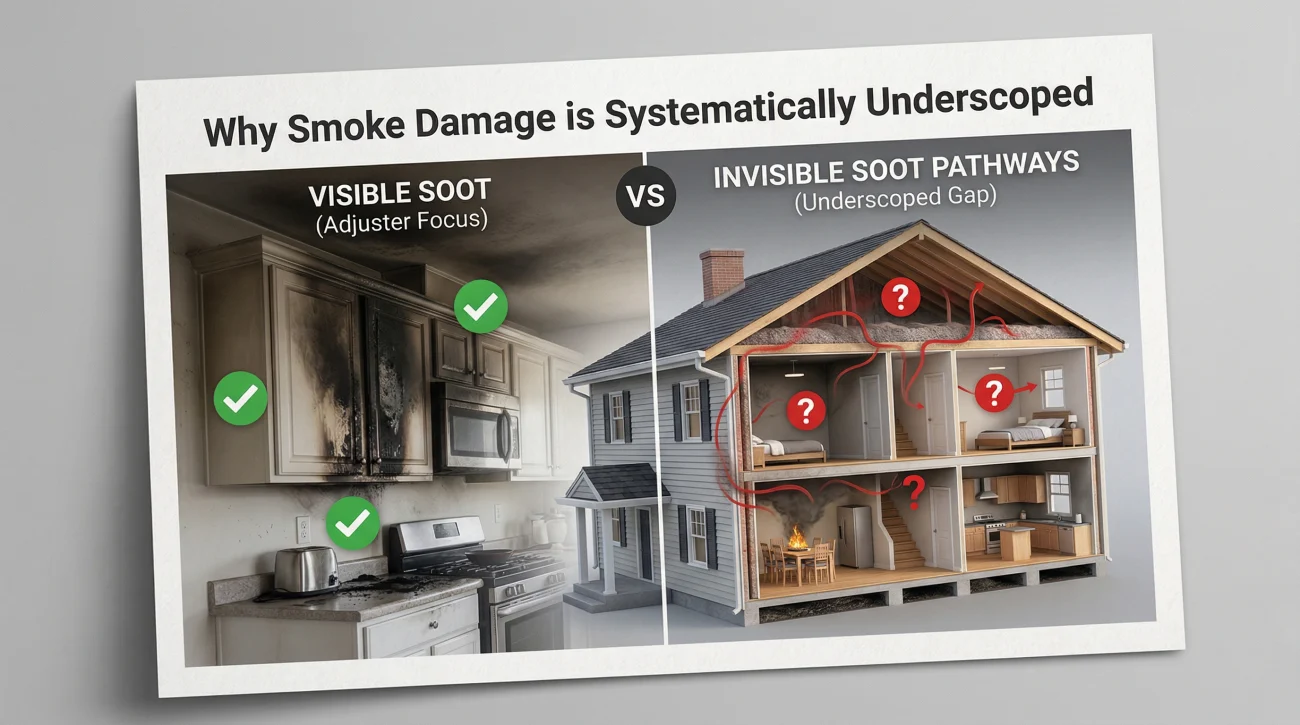
The fundamental issue with smoke is that its most expensive path through a home is often the one adjusters dismiss during a standard visual walkthrough. Because it is driven by heat and air currents, particulate matter penetrates plumbing chases, slides behind baseboards, and settles into completely separate zones that look perfectly untouched by the flames.
I frequently review claims where a kitchen fire was contained within minutes, yet the homeowners report a strong smoke odor in the second-floor bedrooms. The adjuster’s initial estimate almost always excludes the second floor because there is no visible soot. Proving that the smoke traveled upstairs requires specific testing, not just a visual walkthrough.
When comparing how different property damage events are categorized, fire is unique because of this pervasive secondary damage. Water travels downward and outward, but smoke expands in all directions, finding the path of least resistance. If your settlement estimate only includes painting and cleaning for the room of origin, but your entire house smells like a campfire, you are looking at a fundamental scope gap.
The HVAC Contamination Problem
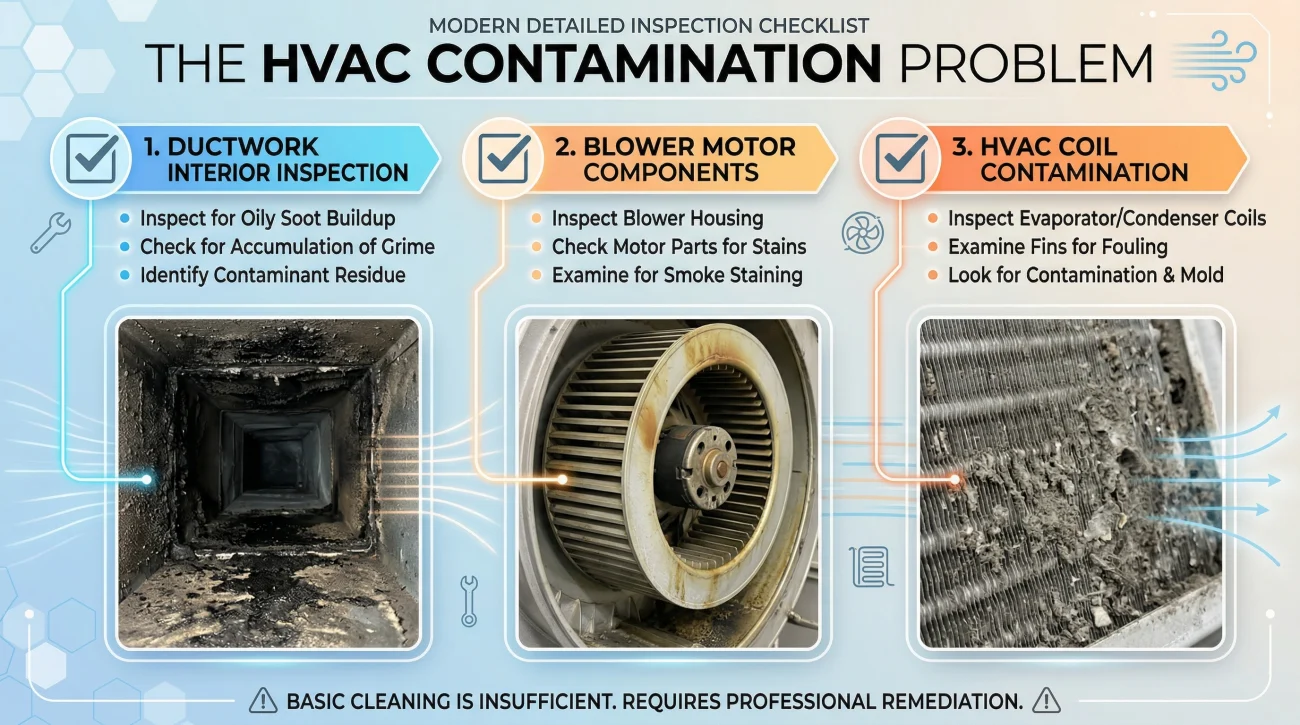
The most expensive path smoke takes through a home is one most adjusters never consider: the ductwork. If your heating or air conditioning system was running when the fire broke out, the return vents actively pulled smoke, soot, and chemical byproducts directly into your ductwork. The blower motor then distributed those contaminants throughout the entire house.
Insurance adjusters often include a line item for “cleaning vent covers” or perhaps a basic duct cleaning service. However, professional remediation for a severely smoke-contaminated HVAC system usually requires much more. The coils, the air handler, the blower motor, and the interior lining of the ductwork must all be addressed. In many cases, standard duct cleaning cannot remove oily soot that has baked onto interior components. The system may require complete replacement to prevent it from circulating toxic particulate and odor every time it turns on.
Immediate Action: Do not turn on the HVAC system. Photograph the vent conditions, and formally request a specialized HVAC inspection before any cleaning begins.
You cannot rely on the insurance adjuster to be an HVAC expert. You need a licensed HVAC technician to inspect the system and provide a written report detailing the extent of the smoke contamination and the required remedy. If you need to request this formally from your adjuster, keep the communication brief and focused on the facts.
Hello [Adjuster Name],
I am reviewing the initial scope of work. I noticed there is no provision for a specialized inspection of the HVAC system. The system was running during the fire, and we are concerned about soot contamination in the ductwork and air handler.
Please confirm if the insurance company will be sending an HVAC specialist to test the system, or if I should arrange for an independent HVAC technician to provide an assessment and estimate for the claim file.
Thank you,
[Your Name]
Non-Visible Smoke Damage and the “Cosmetic” Dispute
Even when insurers acknowledge that smoke reached other areas of the house, they frequently characterize the resulting damage as “cosmetic.” They might agree that the walls in the hallway smell like smoke, but they will argue that a coat of odor-blocking primer and a layer of paint is sufficient to fix it.
Smoke that has penetrated porous materials like drywall, untreated wood framing, and attic insulation is not merely a cosmetic issue. It is a structural contamination issue. Odor-blocking primer can fail over time, especially when humidity levels change, causing the smoke smell to return months after the claim is closed. Insulation acts like a sponge for smoke odor and cannot be cleaned; it must be removed and replaced.
💡 Pro Tip: When speaking with your adjuster, use the correct terminology. An industrial hygienist will typically perform air quality sampling, surface swab testing, and bulk material sampling. Including these specific testing terms in your written correspondence makes it harder for the insurer to dismiss your concerns as purely aesthetic.
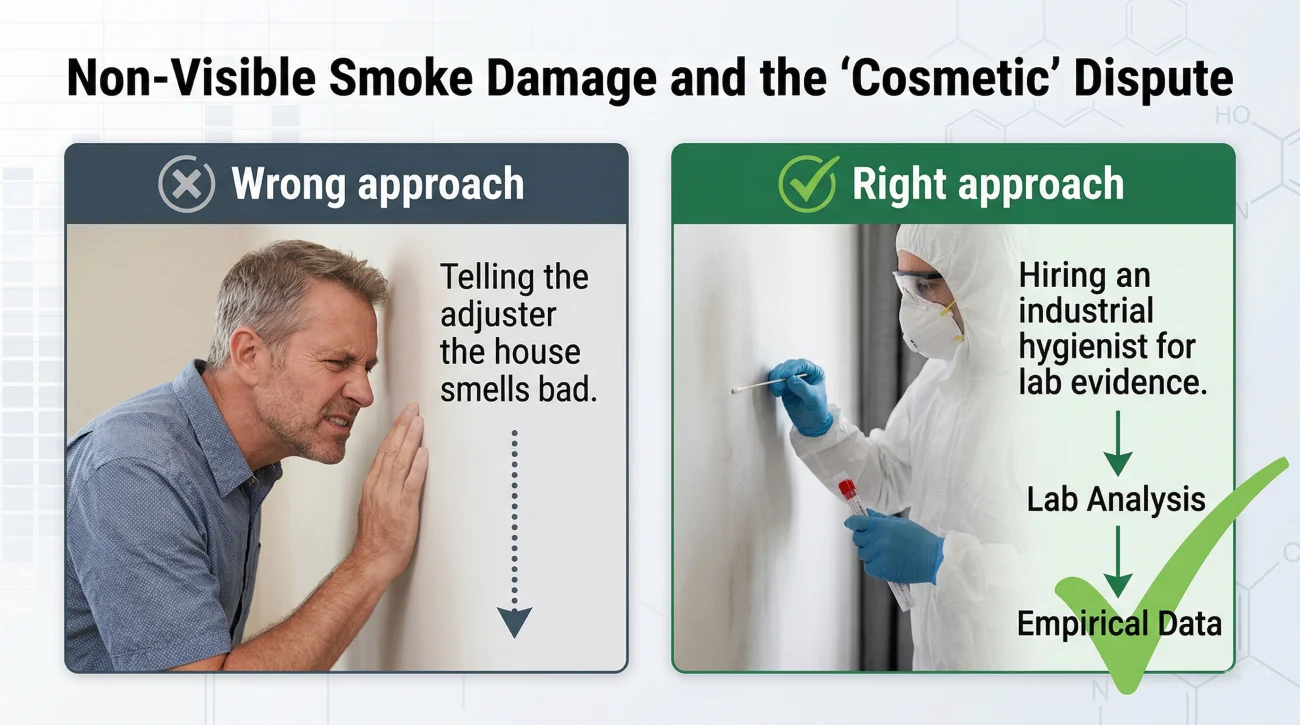
To overcome the “cosmetic” label, you cannot just argue with the adjuster about how bad the house smells. You need empirical data. This is where an independent industrial hygienist becomes essential. Industry testing can detect and measure contamination levels that a visual inspection misses entirely.
Telling the adjuster that the back bedroom still smells terrible and asking them to come back and smell it again.
Hiring an industrial hygienist to take air quality samples and surface swabs in the back bedroom, then submitting their lab results and written remediation protocol to the adjuster.
When you provide scientific evidence of particulate contamination, it becomes very difficult for the insurer to dismiss the damage as a simple cosmetic issue requiring only a sponge and some paint.
The Personal Property Inventory Trap
Fire damage to your home’s contents requires a complete, room-by-room inventory of everything that was damaged or destroyed. This is the most exhausting part of a fire claim for a homeowner. You are essentially asked to remember every single item you owned, down to the half-empty bottles of shampoo and the specific brand of socks in your drawer.
Adjusters sometimes conduct a walkthrough, take a few wide-angle photos of a burned room, and later produce a summarized list. They might group items together, like “men’s clothing, average quality, $500.” This generalized approach almost always results in a massive underpayment.
Homeowners also frequently make the mistake of only listing items that were visibly burned. They do not realize they can, and should, claim for smoke-damaged items in rooms the fire never reached. Upholstered furniture, mattresses, clothing, and electronics are highly susceptible to smoke and soot. If a television ingests smoke particulate, the acidic soot can corrode the internal circuit boards over time. If your clothing smells like smoke even after heavy laundering, it is a covered loss.
Warning: Never throw away damaged personal property without the adjuster’s explicit written permission. Even if a pile of clothes is completely ruined, leave it on site or store it safely until the adjuster has thoroughly documented it.
To capture the full value of your personal property, you must create a meticulous spreadsheet. It needs to include the item description, brand, approximate age, estimated replacement cost, and a link to a comparable item online.
| Room | Item Description | Brand / Model | Age (Approx) | Replacement Cost |
|---|---|---|---|---|
| Master Bedroom | Mattress (Queen size, pillow top) | Sealy Posturepedic | 3 Years | $1,200.00 |
| Living Room | Television (65-inch OLED) | LG C2 Series | 1 Year | $1,599.00 |
| Kitchen | Stand Mixer | KitchenAid Artisan | 5 Years | $450.00 |
Total Loss vs. Partial Loss Dynamics
The severity of the fire dictates the type of disputes you will encounter. In a total loss scenario, where the home is burned to the foundation, the focus shifts away from microscopic soot testing and toward policy limits. The key disputes in a total loss involve whether your building coverage limit is adequate to cover the actual reconstruction cost in today’s market.
If you have Replacement Cost Value (RCV) coverage, remember the depreciation holdback trap: your first check is Actual Cash Value (depreciated). The remaining recoverable depreciation is only released after you prove the repairs or replacements are complete. Many homeowners stall out here because they do not realize they must initiate the repairs to unlock the rest of their funds.
Additionally, in older homes, rebuilding after a severe fire often triggers mandatory code compliance requirements that add significant cost beyond the base reconstruction estimate. This is covered under a separate policy component. For a full breakdown on how this works, see how ordinance or law coverage applies to code upgrades.
For partial losses, however, the smoke and soot scope gap is the primary battleground. The house is still standing, which means the insurer wants to clean and salvage as much as possible, while the homeowner wants to ensure no hidden contamination is left behind. A partial loss requires intense vigilance regarding the scope of work. You have to ensure that the estimate accounts for the demolition of materials that cannot be salvaged and the proper cleaning techniques for the materials that remain.
Displacement and Additional Living Expenses (ALE)
If your home is uninhabitable due to fire or severe smoke damage, your policy’s Additional Living Expenses (ALE) coverage applies. This is sometimes called Loss of Use. This coverage is designed to pay for the increased costs of living away from home, such as hotel bills, short-term rental leases, and increased food costs.
What qualifies as an increased cost? Meal upgrades (for instance, eating at a restaurant because your hotel room lacks a kitchen) are typically covered. However, purchasing a brand new gym membership because your temporary rental lacks a fitness center is generally not covered. The core rule is that ALE covers the increased cost necessary to maintain your normal standard of living. You must track these expenses meticulously using a spreadsheet and save every single receipt.
A common friction point in fire claims is the timeline. The adjuster may approve a hotel for a month, estimating that repairs will be quick. However, fire restoration is notoriously slow. Getting permits, clearing the site, waiting for materials, and mitigating the smoke odor often takes months longer than the initial projection.
If your repairs are delayed and your ALE timeline is expiring, do not wait until the last day. For a comprehensive breakdown of what Loss of Use covers and how long it applies, review the specific limits on your declarations page. You should request an ALE extension in writing, providing your contractor’s updated schedule and a detailed explanation of the delays, such as permit holds or material backorders.
Signs Your Fire Damage Claim Scope May Be Incomplete
The stress of a fire often causes homeowners to accept the first estimate simply to get the process moving. Unfortunately, accepting a flawed initial scope usually locks you into a budget that will not cover the true cost of restoration. You need to be able to identify when the insurer’s assessment is falling short of reality.
Based on standard claim operations, here are the most common signs that your fire damage scope is incomplete:
- 🔥 Your fire restoration contractor’s written estimate is more than 15 to 20 percent above the insurance scope of work.
- 🔥 The adjuster scoped the visible fire damage but did not inspect or test the HVAC system.
- 🔥 Rooms far away from the fire clearly show smoke odor, but they were entirely excluded from the repair estimate.
- 🔥 The personal property inventory was summarized based on a brief walkthrough, rather than documented room-by-room with individual line items.
- 🔥 The insurer is disputing smoke damage as merely “cosmetic” without having conducted any professional air quality testing to prove it.
- 🔥 The timeline approved for Additional Living Expenses (ALE) is significantly shorter than the actual timeline your contractor needs to complete the fire restoration.
These signs indicate that the insurance company is treating your loss as a surface-level problem rather than a comprehensive contamination event. If you see these patterns in your claim documents, it is highly likely that substantial funds are being left on the table.
Closing the Gap on Your Fire Claim
Fire damage claims involve more individual line items than almost any other type of property loss. The most expensive components to fix out of pocket are precisely the ones that require aggressive documentation and professional testing. You cannot afford to absorb these costs.
If your settlement offer feels light, or if your contractor is telling you that the insurance estimate is completely unrealistic for the required scope of work, you do not have to accept the insurer’s word as final. Whether your specific claim has these critical gaps is exactly what a professional reinspection is designed to determine. Before you sign a final release or agree to a settlement that leaves you underfunded, look into getting a second set of eyes on your fire claim scope from a licensed public adjuster. They understand how to find and document the hidden damage that standard adjusters routinely overlook.
Final Thoughts
Recovering from a house fire requires absolute documentation discipline. The insurance claim process is a marathon that dictates your financial recovery, and success depends on treating the adjuster’s initial estimate as exactly what it is: an opening offer, not the final word.
❓ FAQ
🏠 How long does a fire insurance claim usually take to settle?
A partial fire loss can take a few months to settle, while a total loss can take over a year. The timeline depends on the complexity of the smoke damage, the speed of the contractor estimates, and how quickly you complete your personal property inventory.
💨 Does home insurance cover smoke damage if there was no fire in that specific room?
Most standard homeowners policies cover smoke damage that migrates from the fire’s origin, but coverage depends on your specific policy terms. You must prove the smoke reached those rooms, often requiring professional testing if there is no visible soot on the walls.
👕 What should I do with my smoke-damaged clothes?
Do not throw them away. Document them in your personal property inventory. The insurer may pay to have them professionally dry-cleaned by a textile restoration company, or they may pay the replacement value if the odor cannot be removed.
🛏️ Will my insurance pay for a hotel while my house is being repaired?
Yes, under your Additional Living Expenses (ALE) or Loss of Use coverage. This covers the increased cost of living away from home while your property is uninhabitable, subject to the time and monetary limits in your policy.
🌬️ How do I prove my HVAC system is contaminated with smoke?
Do not rely on a visual inspection. Hire a licensed HVAC technician to inspect the internal components and an industrial hygienist to take air quality samples inside the ductwork to document the particulate levels.
📋 Do I have to list every single item destroyed in the fire?
To get fully compensated, yes. You need a room-by-room spreadsheet listing every item, its age, and replacement cost. Grouping items together usually results in a lower payout from the insurance company.
💸 Can the insurance company force me to use their preferred fire restoration contractor?
Most insurers cannot require you to use a specific contractor, though your policy terms will govern this. Review your policy’s contractor provisions before making this decision. Insurers recommend preferred vendors because they have pre-negotiated pricing agreements, but you should always choose a contractor who works for your best interests.
🧪 What is an industrial hygienist and why do I need one for a fire claim?
An industrial hygienist tests for environmental hazards. In a fire claim, they conduct air quality and swab tests to prove hidden smoke and soot contamination, preventing the insurer from labeling the damage as merely cosmetic.
📉 Why is the first check from the insurance company so low?
The first check is typically the Actual Cash Value (ACV), which is the depreciated value of the damaged items. It also reflects only the visible damage the adjuster saw during the initial, often brief, inspection.
✍️ Can I reopen my fire claim if I find more smoke damage later?
In many cases, yes, provided you have not signed a final release and your policy’s deadline for supplements has not passed. Policy terms vary, so check your specific policy language. You can submit new contractor estimates or testing reports for newly discovered damage.
Damage type affects coverage, documentation, and payout. These connect the dots.
- How the settlement process works after damage is reported
- Which parts of your policy apply when damage is involved
- How your damage type affects what the insurer is required to pay
- Whether the damage you have is actually worth filing for
- What happens when the claim you filed gets rejected
- How independent representation changes what gets documented
- When a disputed claim moves into legal territory
Each damage type has its own patterns. See what adjusters commonly miss.
- Whether your damage assessment left money on the table
- What the inspector who came to your home was actually there to do
- The parts of water damage that standard inspections routinely miss
- What fire and smoke assessments leave out of the scope
- Why the insurer's roof estimate is almost always lower than the roofer's
- When a denial crosses into bad faith and needs legal leverage
- The four options after a denial, including one most homeowners skip
Disclosure: I'm sharing my personal industry experience, but I am not an attorney or a licensed insurance agent. The guides on this site are for informational purposes to help you understand the operational side of property claims: process, organization, and documentation. Every policy is unique, so please defer to your specific policy language. For legal interpretation, contested situations, or binding advice, always consult a licensed professional in your jurisdiction.