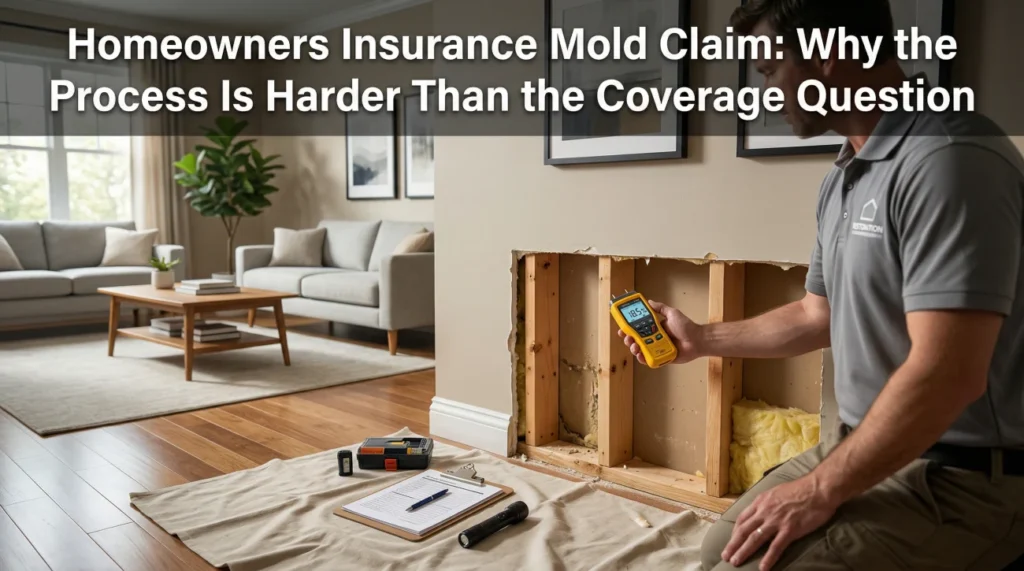
- Getting a mold claim approved is only the first hurdle; the most expensive disputes revolve around how the adjuster categorizes the source of the moisture and the scope of the cleanup.
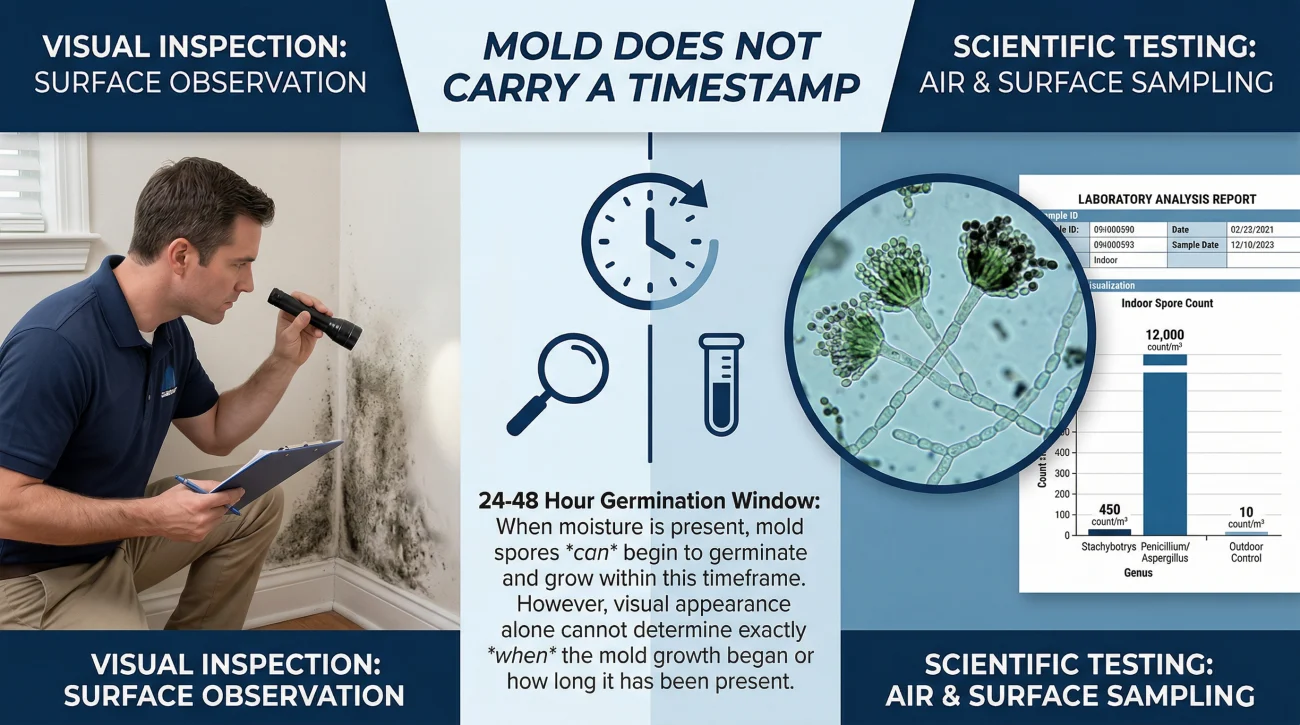
- Adjusters frequently rely on visual inspections to label mold as “gradual” or “long-standing,” but mold does not carry a timestamp. Independent testing is often necessary to push back.
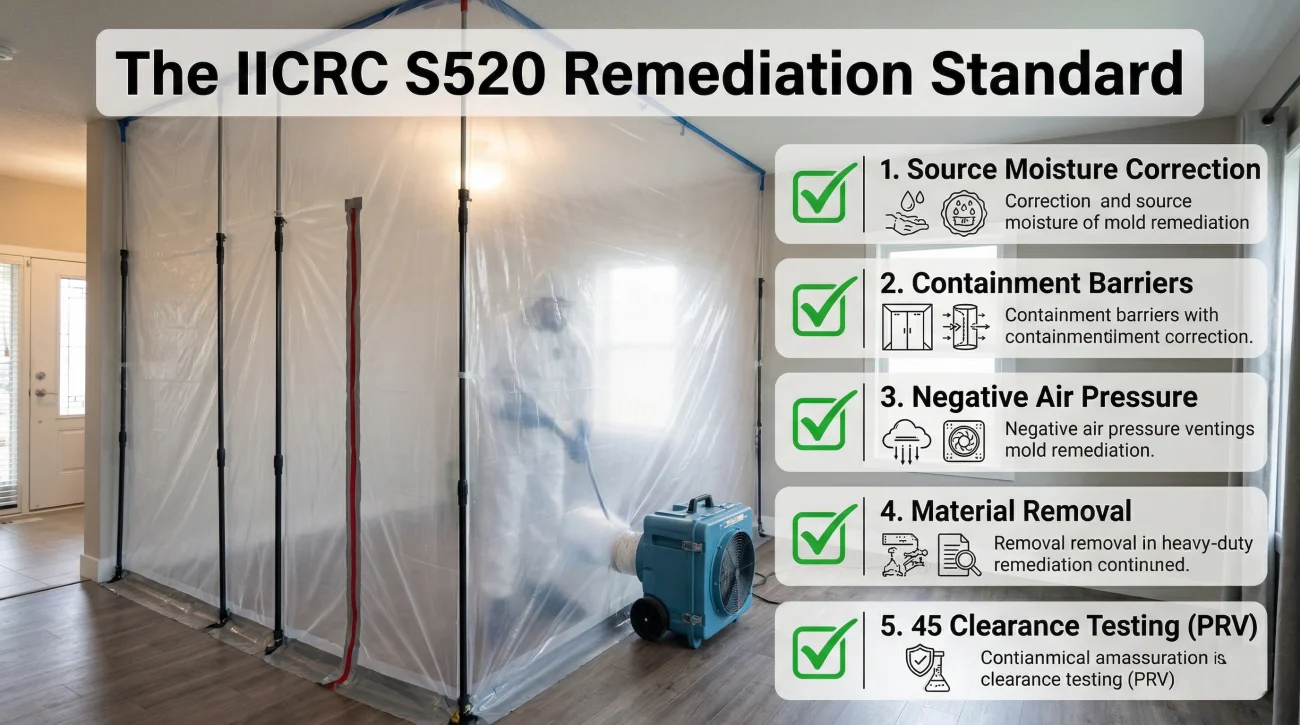
- Proper mold remediation requires containment, negative air pressure, and material removal according to IICRC S520 standards, not just surface cleaning or bleach.
- Insurers often try to re-categorize legitimate sudden water damage repair costs under your policy’s strict (and much lower) mold sub-limit to save money.
The Reality of Managing a Mold Claim
In my years of reviewing property claims and sitting across the table from insurance adjusters, I have seen homeowners breathe a sigh of relief when they hear their mold claim is “covered.” They assume the hard part is over. Unfortunately, that is rarely the case. A mold claim is almost never straightforward, even when the underlying event that caused it is clearly covered by your policy.
If you are wondering whether mold is covered at all based on your specific peril, that is a coverage interpretation question (which you can explore in our broader guide on what standard homeowners insurance covers). This guide, however, is for what comes next. Once you are in the active claim process, you are going to face a very specific set of hurdles.
I want to walk you through exactly how causation gets determined during the adjustment process, why remediation scopes are so frequently disputed, and the subtle ways your settlement can lose thousands of dollars even after coverage applies. When you understand the mechanics of how adjusters view mold, you can document your file to protect your payout.
Field Note: The most common failure point I see in mold claims is not the initial denial. It is a homeowner accepting a ‘cleaning-only’ settlement because it sounds fast and easy, only to discover weeks later that the mold has returned because the contaminated drywall was never actually removed.
How Causation Is Actually Determined (and Disputed)
When an adjuster walks into your home to inspect a mold issue, their primary job is to determine the source event. Their characterization of that source is the single factor that drives the direction of your claim. Here is the operational reality: the line between “sudden and accidental” and “gradual maintenance issue” is not a hard fact that the mold carries with it. It is a subjective determination made by the adjuster based on what they observe.
That determination can be wrong. In fact, it often is.
Mold Does Not Carry a Timestamp
One of the most persistent myths is that mold takes weeks or months to form, automatically proving that a leak was gradual. This is simply not true. Under the right conditions of moisture, temperature, and food source (like the paper backing on your drywall), mold can begin to germinate within 24 to 48 hours of a water event.
If you have a sudden pipe failure that you do not discover immediately because it occurred behind a wall, the resulting mold might be extensive by the time you find it. An adjuster who visually inspects that heavy mold growth might immediately characterize the moisture source as “long-standing” or “gradual seepage” without gathering any independent evidence. This is the most common causation dispute in mold claims. For a deeper look at how pipe failures specifically trigger these disputes, you can review our breakdown of the burst pipe insurance claim process.
Arguing with the adjuster on-site about how fast the mold grew based on your memory of when it started smelling musty.
Requesting the adjuster’s independent hygiene testing data and providing plumber documentation that confirms the sudden nature of the pipe failure.
The Role of Independent Testing
When causation is disputed based purely on a visual inspection, the playing field is not level. A visual inspection cannot reliably determine the timeline of spore amplification. If your adjuster is claiming a sudden event is actually a long-term maintenance failure, you should ask for the data supporting that claim.
Script: Requesting Basis for Gradual Characterization
Subject: Request for documentation regarding claim [Claim Number]
Hello [Adjuster Name],
I received the partial denial letter stating the mold was caused by a long-term, gradual leak. My plumbing professional has documented this as a sudden component failure that occurred recently. Could you please provide the independent industrial hygiene reports, moisture mapping logs, or materials testing data your team used to determine the exact timeline and age of this moisture event?
Please add this request to my claim file.
Thank you,
[Your Name]
The HVAC Contamination Dispute
Mold inside your HVAC ductwork represents a distinct battleground. Adjusters frequently deny these claims by categorizing duct condensation as a maintenance issue. However, if the moisture source was a covered event—such as a major pipe burst, a prolonged roof leak, or severe indoor flooding that raised humidity levels significantly—the resulting mold in the ductwork should be claimable. Insurers often try to approve a simple surface cleaning for the vents, but proper protocol requires complete duct remediation if contamination is confirmed.
What a Proper Mold Remediation Scope Looks Like
If you get past the causation hurdle, the next battleground is the scope of work. Insurers want to close claims efficiently, and that sometimes translates to approving the cheapest possible remediation method. I frequently review estimates where the adjuster has approved “cleaning and sealing” for materials that industry standards dictate must be completely removed.
The industry standard for professional mold remediation is the IICRC S520. This document defines the exact protocols required based on the contamination class. A proper mold scope is not just a guy with a spray bottle and a fan. If your estimate is missing the following elements, your scope is likely incomplete.
- ✅ Source Moisture Correction: You cannot fix mold without permanently stopping the water intrusion and thoroughly drying the structural materials.
- ✅ Containment: Erecting physical barriers (heavy plastic sheeting) to prevent microscopic mold spores from migrating to clean areas of your home during demolition.
- ✅ Negative Air Pressure: Using specialized HEPA-filtered air scrubbers to vent contaminated air outside the containment zone.
- ✅ Material Removal: Highly porous materials like drywall, insulation, and carpet padding generally cannot be cleaned of heavy mold growth. They must be cut out, bagged in containment, and removed.
- ✅ Post-Remediation Verification (PRV): Independent testing conducted after cleanup, but before reconstruction, to legally prove the environment has returned to normal fungal ecology.
Warning: Adjusters sometimes approve removal of the moldy material but refuse to pay for post-remediation clearance testing. Do not let your contractor rebuild the walls until a PRV test confirms the framing is clean. If you trap active spores behind new drywall, the mold will return, and the insurer will likely deny the subsequent claim as a “prior loss.”
| Common Adjuster Scope | IICRC S520 Standard Scope |
|---|---|
| Spray antimicrobial on visible mold | Physical removal of contaminated porous materials |
| Standard fans to dry the area | Containment barriers and HEPA negative air machines |
| Visual check to confirm it looks clean | Independent post-remediation air quality clearance testing |
The Sub-Limit Problem: How Your Payout Gets Capped
Most standard homeowners policies do not offer unlimited coverage for mold. Instead, they apply a “sub-limit.” This is a hard cap on how much the insurance company will pay for mold remediation, testing, and sometimes even the rebuilding of the torn-out materials. Commonly, these sub-limits range from $5,000 to $10,000.
Here is the operational reality: professional remediation for a moderate to severe mold issue, including containment, tear-out, and clearance testing, can easily reach $15,000 to $40,000. If your policy has a $10,000 mold sub-limit, that cap applies regardless of whether your total claim is for $20,000 or $200,000. You are left paying the difference out of pocket.
Standard Policy Limits vs. Mold Endorsements
It is important to check your declarations page before negotiating. While standard policies enforce that low sub-limit, some homeowners have purchased a specific mold endorsement that expands this coverage to $20,000, $50,000, or even full policy limits. Knowing which one you have dictates your strategy.
The Subtle Shift: Re-categorizing Water Damage as Mold
Because the mold sub-limit is so strict, the line between what is billed as “water damage repair” and what is billed as “mold remediation” becomes a high-stakes financial dispute. I see this specific pattern in hundreds of files.
Imagine a sudden water line break floods your kitchen. The water ruins the cabinets, the drywall, and the flooring. Because you were out of town, mold grows on the wet drywall before it can be dried. The cost to tear out the wet cabinets and drywall should technically fall under your base policy limit for sudden water damage. Why? Because that material was ruined by the water and had to be replaced anyway, regardless of whether mold grew on it later.
However, insurers will sometimes re-categorize the tearing out of those wet materials as “mold remediation costs” simply because mold is present. By shifting these legitimate water damage expenses into the mold category, they rapidly exhaust your $5,000 mold sub-limit, leaving you severely underpaid for the broader water damage claim.
This is why understanding the mechanics of a water damage insurance claim is so tightly linked to surviving a mold claim. The two are intertwined, and how the line items are categorized makes or breaks your settlement.
💡 Pro Tip: Always separate your base water damage scope from the specialized mold remediation scope. Challenging an adjuster who tries to re-categorize standard water damage tear-out into your strict mold sub-limit is often the most effective way to protect your payout.
Warning Signs Your Mold Claim Is Being Mishandled
When you are living in a home with torn-up walls and air scrubbers running, the stress can cloud your judgment. It is easy to assume the insurance company is following standard procedure. However, based on how these claims operate in the field, there are distinct red flags that indicate your claim is being actively undervalued or improperly processed.
If you are experiencing any of the following frustrations, your claim is likely off track:
- 🚩 The Causation Leap: The adjuster characterized a recent, verifiable sudden water event as “long-standing gradual moisture” without producing any independent hygiene testing or moisture mapping to prove it.
- 🚩 The Cleaning Shortcut: The approved remediation scope authorizes surface cleaning and painting only, even though highly porous materials like drywall or insulation are heavily contaminated and require physical removal under industry standards.
- 🚩 The Sub-Limit Shift: The insurer is actively applying your strict mold sub-limit to the tear-out of materials that were primarily destroyed by the covered water event, exhausting your mold cap prematurely.
- 🚩 The Missing Clearance: The approved estimate does not include line items for Post-Remediation Verification (PRV) testing, leaving you exposed to future liability if the mold returns.
- 🚩 The Visual Guess: The causation determination was made purely by an adjuster eyeballing the damage, without any involvement from an industrial hygienist or environmental professional.
These patterns appear repeatedly across all types of home insurance claims where secondary damage is involved. Mold claim disputes typically boil down to two things: how the causation was characterized on paper, and whether the remediation scope actually meets safety standards. If your adjuster is cutting corners on either of these, the financial burden will ultimately fall on you.
When you encounter these roadblocks, arguing with the desk adjuster over the phone rarely changes the outcome. You need someone who speaks their language and understands exactly how to read a structural estimate. If your settlement is being suffocated by a misapplied sub-limit or an incorrect gradual denial, bringing in a public adjuster who specializes in water damage scoping can force the insurer to look at the actual documented evidence.
Final Steps and What Happens After Settlement
Managing a mold claim requires an incredible amount of documentation discipline. You must maintain a precise log of every conversation, photograph the progression of the damage, and secure written reports from your plumbers and remediation contractors.
Never accept a verbal explanation for a denial or a sub-limit application. Always request it in writing so there is a permanent record in your claim file.
Can You Reopen a Closed Mold Claim?
Many homeowners read this after they have already signed a settlement and discovered the mold has returned. In many cases, you can supplement or reopen a claim if the original adjuster’s scope missed hidden damage or failed to authorize proper clearance testing. A signed release on a partial payment does not always close the door permanently, especially if the insurer failed to scope the remediation correctly the first time.
Remember that the first offer you receive is based on a snapshot taken by someone whose job is to protect the insurer’s bottom line. Mold is tricky. It hides inside wall cavities, and its remediation is highly regulated by industry standards. If the adjuster’s estimate feels light, or if your contractor is telling you that the approved scope is unsafe or incomplete, you do not have to just sign the release.
Whether it is challenging a sudden-versus-gradual determination or auditing an estimate to ensure water damage line items are not being stuffed into your mold sub-limit, getting a second set of eyes is crucial. If you are stuck in this process, I highly recommend looking into whether you should hire a public adjuster for a free scope review.
Additionally, if the insurer is acting in bad faith regarding clear coverage, knowing when to escalate to a home insurance claim lawyer can be your ultimate safety net.
❓ FAQ
💧 Will my insurance drop me if I file a mold claim?
Insurers evaluate risk based on claim frequency and severity. While a single mold claim tied to a sudden covered event usually will not trigger immediate cancellation, filing multiple water or mold claims in a short period can lead to non-renewal. Always weigh the cost of remediation against your deductible and sub-limits before filing.
⏱️ How fast does mold grow after a water leak?
While initial germination happens quickly, the visible spread depends heavily on your home’s temperature, moisture levels, and whether the HVAC system is actively circulating the spores. An adjuster cannot accurately determine the exact age or timeline of the leak purely by looking at the size of the mold colony.
📸 What pictures should I take for the adjuster?
Take wide shots showing the entire affected room, medium shots showing the source of the water if visible, and extreme close-ups of the mold growth. Most importantly, photograph any failed plumbing components or appliance hoses before they are repaired or discarded, as this proves the sudden nature of the event.
🧪 Do I need to pay for my own mold testing?
Often, yes. If the insurer denies the claim based on a visual inspection, hiring an independent industrial hygienist to conduct air sampling and write a causation report is usually your responsibility upfront. However, this documentation is frequently the only way to successfully dispute a wrongful denial.
💰 What happens if remediation costs more than my sub-limit?
If the cleanup exceeds your policy cap, you must cover the difference. This is why you must strategically prioritize what the sub-limit pays for, such as professional tear-out, HEPA air scrubbing, and clearance testing, while ensuring standard water damage repairs stay under your main dwelling limit.
🏗️ Does insurance cover rebuilding the walls after mold removal?
It depends on how the sub-limit is written. In many policies, the mold sub-limit is inclusive, meaning the cap must cover the testing, the tear-out, the air scrubbing, AND the reconstruction of the removed materials. If the tear-out exhausts the limit, the rebuilding falls to you.
👃 Can I claim mold if I only smell it but cannot see it?
A musty odor indicates active microbial growth, often hidden inside wall cavities or HVAC systems. You can open a claim, but the adjuster will require tangible proof. You will likely need professional moisture mapping or air quality testing to locate and document the hidden mold before the insurer will approve a scope.
📄 What should my contractor’s estimate include?
A proper estimate must be itemized. It should separately list source correction, hours of HEPA negative air machine usage, linear feet of containment plastic, square footage of material removal, and the cost of post-remediation clearance testing. Lump-sum estimates are almost always rejected by adjusters.
🛑 Should I start cleaning the mold before the adjuster arrives?
You have a duty to mitigate further damage (like shutting off the water source and laying down towels), but you should not disturb heavy mold growth or throw away contaminated drywall before the adjuster inspects it. Disturbing mold without containment spreads spores, and destroying the evidence can lead to a claim denial.
📝 How do I prove the mold was sudden and not gradual?
The best proof is immediate documentation of a sudden failure. A detailed invoice from an emergency plumber stating “found burst supply line, replaced” carries immense weight. Combine this with regular maintenance records and your own testimony of exactly when the event was discovered.
Damage type affects coverage, documentation, and payout. These connect the dots.
- How the settlement process works after damage is reported
- Which parts of your policy apply when damage is involved
- How your damage type affects what the insurer is required to pay
- Whether the damage you have is actually worth filing for
- What happens when the claim you filed gets rejected
- How independent representation changes what gets documented
- When a disputed claim moves into legal territory
Each damage type has its own patterns. See what adjusters commonly miss.
- Whether your damage assessment left money on the table
- What the inspector who came to your home was actually there to do
- The parts of water damage that standard inspections routinely miss
- What fire and smoke assessments leave out of the scope
- Why the insurer's roof estimate is almost always lower than the roofer's
- When a denial crosses into bad faith and needs legal leverage
- The four options after a denial, including one most homeowners skip
Disclosure: I'm sharing my personal industry experience, but I am not an attorney or a licensed insurance agent. The guides on this site are for informational purposes to help you understand the operational side of property claims: process, organization, and documentation. Every policy is unique, so please defer to your specific policy language. For legal interpretation, contested situations, or binding advice, always consult a licensed professional in your jurisdiction.