

- Your home insurance claims history is tracked in a database called the CLUE report, which follows you and the property for up to seven years.
- Even phone calls to your insurer asking about coverage can sometimes be recorded as an “inquiry,” potentially impacting your record even if you never officially file a claim.
- Claims filed by the previous owner of your home stay on the property’s record and can cause your premiums to increase or limit your coverage options.
- LexisNexis provides consumers with one free CLUE report per year to check for errors, allowing you to dispute incorrect entries directly through their system.
The Hidden Database That Tracks Your Home’s Past
Most homeowners assume that once an insurance claim is closed and the repairs are finished, the matter is behind them. I have seen hundreds of homeowners shocked to discover that their claims history follows them – not just to their next policy renewal, but to every single insurance company they apply to for the next five to seven years. Your insurance record is rarely something you think about until you try to switch carriers and are suddenly declined or quoted an unexpectedly high premium.
The system that tracks this operates quietly in the background, logging every time you ask your carrier for money, every time an adjuster is dispatched, and sometimes even when you call to ask a hypothetical question. Knowing exactly what this database captures – and what it misses – is a critical part of protecting your insurability.
In my experience reviewing claim histories, the most common frustration homeowners face isn’t just a rate increase. It is finding out that a claim filed by the home’s previous owner, or a simple phone call they made to their agent two years ago, is now preventing them from getting affordable coverage today.
What Exactly Is the CLUE Report?
When insurance companies want to know your track record, they do not just take your word for it. They pull a report from the Comprehensive Loss Underwriting Exchange, universally known in the industry as the CLUE report. Maintained by a consumer reporting agency called LexisNexis, this database is essentially a credit report for property and casualty insurance.
Almost every major insurance carrier in the country subscribes to this database. When you file a claim, your insurer reports the details to LexisNexis. When you apply for a new policy, the prospective insurer pulls your CLUE report to assess how risky you are to insure. If the report shows multiple claims, specific high-risk claims like significant water damage, or a history of liability payouts, the new insurer will adjust your quote accordingly – or choose not to offer you a policy at all.
This exchange of information means you cannot simply outrun a bad claims history by switching to a new company. The record is tied to your name, your date of birth, and the physical address of the property itself.
What Actually Goes on Your Insurance Record?
The biggest misconception I see is the belief that only large, paid-out claims make it onto the record. The reality is that the database captures far more than just the checks your insurer writes. Knowing what gets reported can help you avoid accidental entries that damage your insurability.
Paid Claims
Any claim where the insurer paid out money to you or a contractor will appear on the report. This includes the date of the loss, the type of damage (such as wind, fire, or theft), the amount paid, and the status of the claim. This is the standard entry everyone expects.
Denied or Zero-Payout Claims
Does a denied claim show on your record? In many cases, yes. If you formally file a claim and an adjuster inspects the property, but the damage is denied due to lack of coverage, the event is still often recorded. Similarly, if you file a claim but the total repair cost falls below your deductible, resulting in a zero-dollar payout, that filing still usually appears on your CLUE report. This is why I always advise against officially filing a claim until you are reasonably certain the payout will justify the process.
The Inquiry Trap
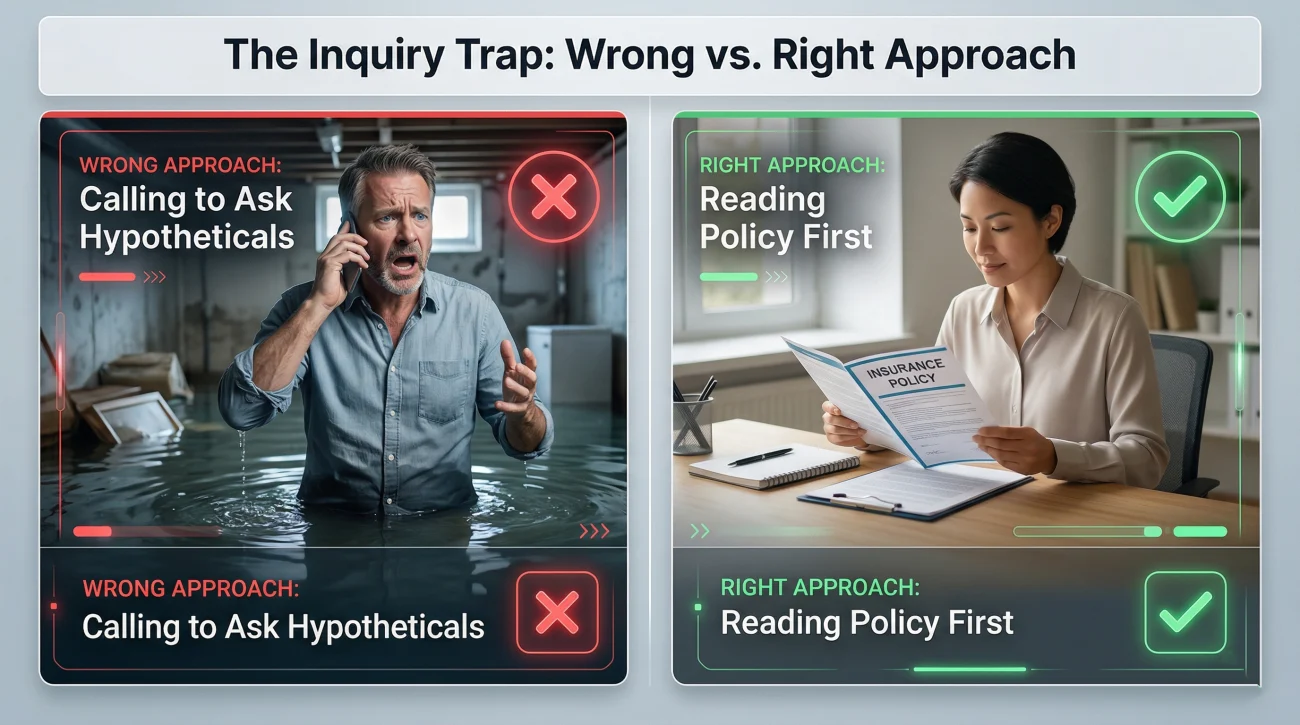
This is the element that catches the most homeowners off guard. Depending on the carrier’s specific reporting practices, simply calling your insurance agent or the company’s 1-800 number to ask if a specific incident would be covered can trigger a record entry. Even if you explicitly state, “I am not filing a claim, I just have a question,” the representative may log the call as an “inquiry” regarding potential damage, which can then be transmitted to the CLUE database.
Calling the main claims hotline and saying, “My basement has some water in it, would that be covered if I filed a claim?” (This often triggers an inquiry record).
Reading your policy documents yourself, or asking your agent a strictly hypothetical question: “Can you explain how the policy handles ground water seepage versus a burst pipe, purely for my understanding?”
What Does NOT Appear on the CLUE Report
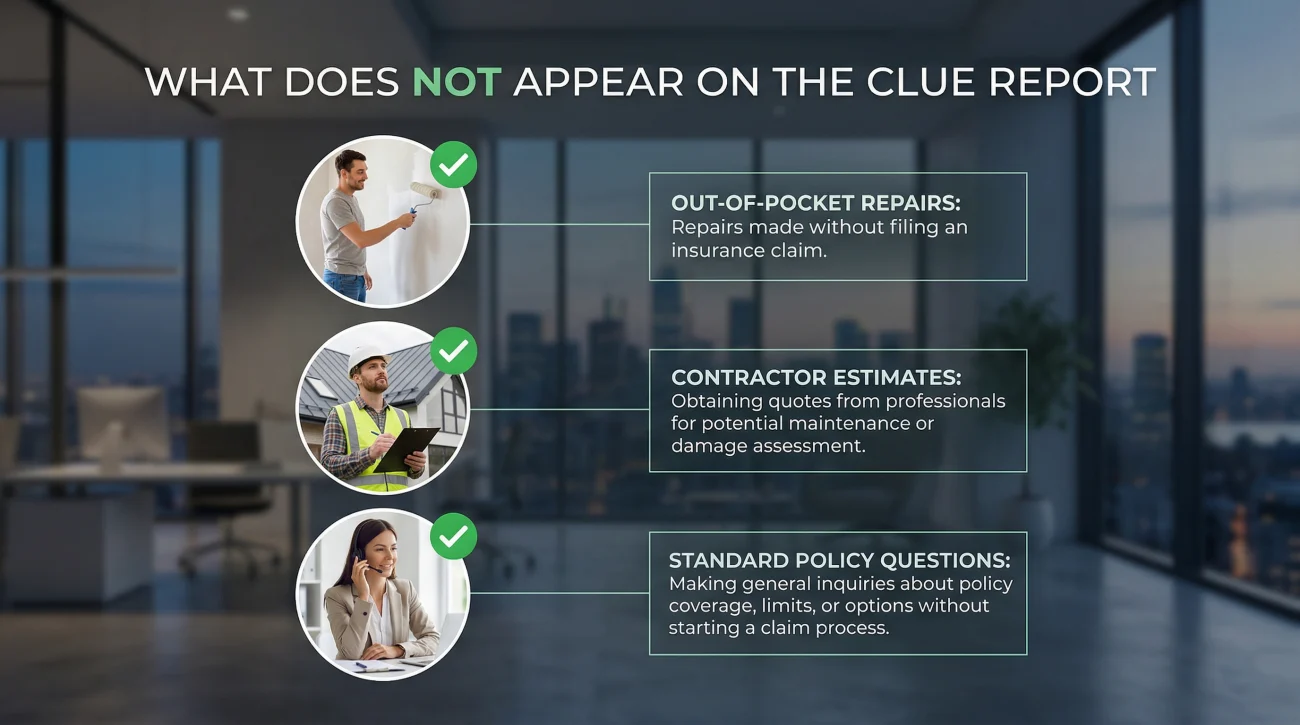
Just as important as knowing what gets tracked is knowing what flies under the radar. Understanding these boundaries allows you to manage home maintenance without unnecessarily penalizing your record.
- ✅ Repairs paid completely out of pocket: If you hire a plumber to fix a leak and replace the drywall yourself without ever involving your insurance company, there is no claim to report. The database only tracks events the insurers know about.
- ✅ Contractor estimates: Having a roofer or a restoration company come out to give you an estimate does not create a CLUE entry, provided the contractor does not directly contact your insurance company to open a claim on your behalf.
- ✅ Standard policy questions: Calling your agent to update your billing information or adjust your coverage limits does not trigger an inquiry entry.
How Long Do Home Insurance Claims Stay on Record?
Unlike a speeding ticket that might drop off your driving record in a couple of years, property claims have a longer lifespan. Typically, a claim will remain on your CLUE report for five to seven years from the date of the loss.
Date of Loss + 5 to 7 Years = CLUE Report Visibility Window
Notice that the clock starts on the date the damage actually occurred, not the date the claim was paid or closed. During this five-to-seven-year window, any insurer pulling your report will see the event. As the claim ages, its impact on your rates may decrease, but its presence remains a factor in underwriting decisions.
⚠️ Warning: The duration a claim stays on your CLUE report is entirely separate from how long your current insurer might apply a rate surcharge. While a surcharge might drop off after three years, the claim will still be visible to other companies on your CLUE report for up to seven years.
When a Previous Owner’s Claims Become Your Problem
Because the database ties claims to the physical property, the insurance footprint of a house transfers to the new buyer. If you purchase a home where the seller filed two water damage claims and a roof claim in the past four years, the property is statistically viewed as high-risk.
When you apply for a new policy on that home, the insurer will see those prior claims. Even though you had nothing to do with those events, the carrier may quote you a much higher premium, apply specific exclusions (like refusing to cover water damage), or decline to write the policy altogether. I routinely see new buyers blindsided by this during the closing process when their estimated insurance costs suddenly double.
If you are in the process of buying a home, you cannot pull the CLUE report for a property you do not yet own. However, you can make it a condition of your offer that the seller provides a recent copy of the home’s CLUE report. This simple step can save you thousands of dollars in unexpected insurance costs down the road.
The CLUE Report When Selling Your Home
If you are preparing to sell your property, a clean claims history is a valuable, though often overlooked, selling point. Savvy buyers are increasingly requesting claims histories before finalizing their offers to avoid the insurance shocks mentioned above.
Pulling your own report before listing the house allows you to verify its accuracy and provide it to potential buyers as a sign of transparency. If the report shows a major past claim – like a fully replaced roof or a resolved water issue – providing the report alongside the contractor warranties for the completed work can turn a potential red flag into proof that the home has been properly maintained.
How to Check and Dispute Your Claims History
LexisNexis offers a consumer process that allows you to review your claims history file. This means you can request one free copy of your CLUE report every 12 months to verify what insurers are seeing.
Obtaining Your Report
You can request your report directly through the LexisNexis consumer portal online or by mail. When you receive it, you will see a list of any claims or inquiries associated with your name and your property address over the last seven years. Review it carefully. I recommend doing this annually, just as you would check your financial credit score.
How to Remove an Incorrect Claim
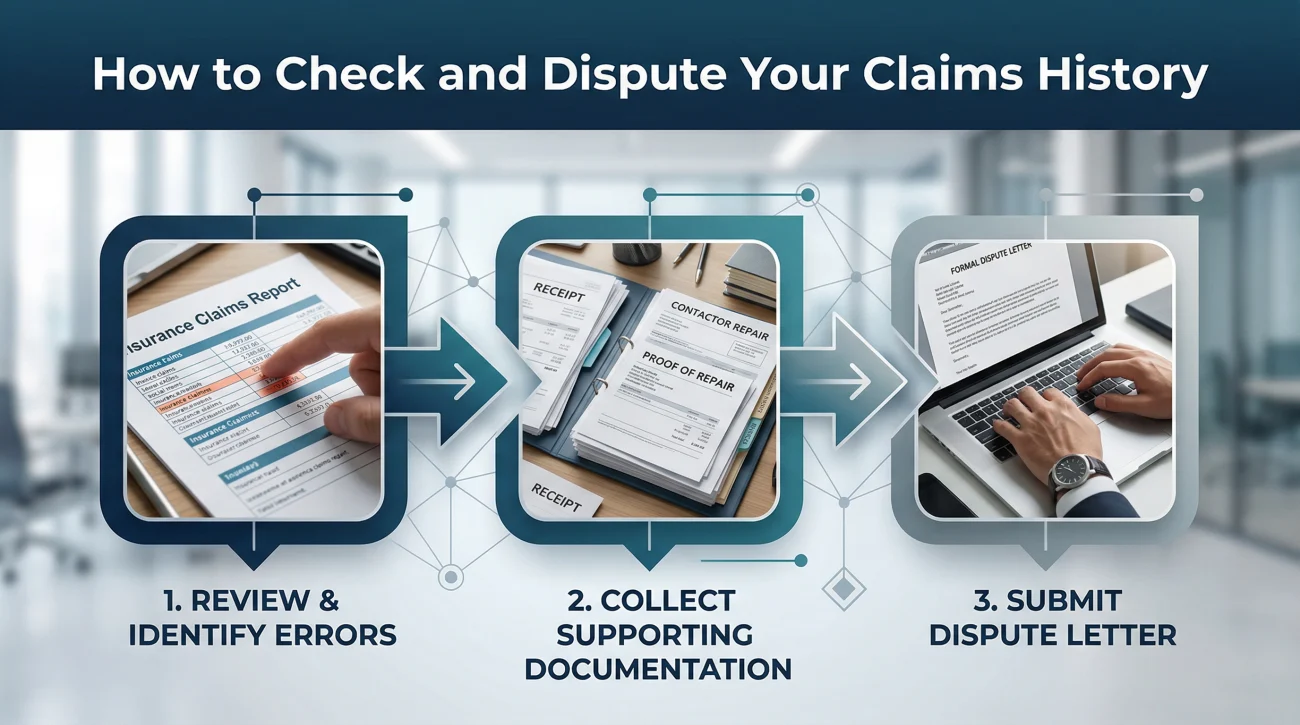
Databases contain errors. Sometimes a claim amount is reported as vastly higher than what was actually paid out. Sometimes a claim filed by someone else with a similar name gets attached to your file. If you find an error, LexisNexis provides a path to dispute it.
- 📝 Step 1: Identify the specific error (e.g., incorrect date, wrong payout amount, or a claim you never filed).
- 📝 Step 2: Gather your proof. If the report says a claim was paid out for $15,000 but you have the closure letter showing a $2,000 payout, find that letter.
- 📝 Step 3: File a formal dispute with LexisNexis directly. They will typically investigate the disputed information with the reporting insurance company, usually within 30 days.
If the insurance company cannot verify the entry, or if they admit the error, LexisNexis will generally remove or correct the item on your report. You can also add a personal statement to your file to explain a specific entry if it cannot be removed but requires context.
Sample Dispute Framing:
Signs Your Claims History Is Actively Working Against You
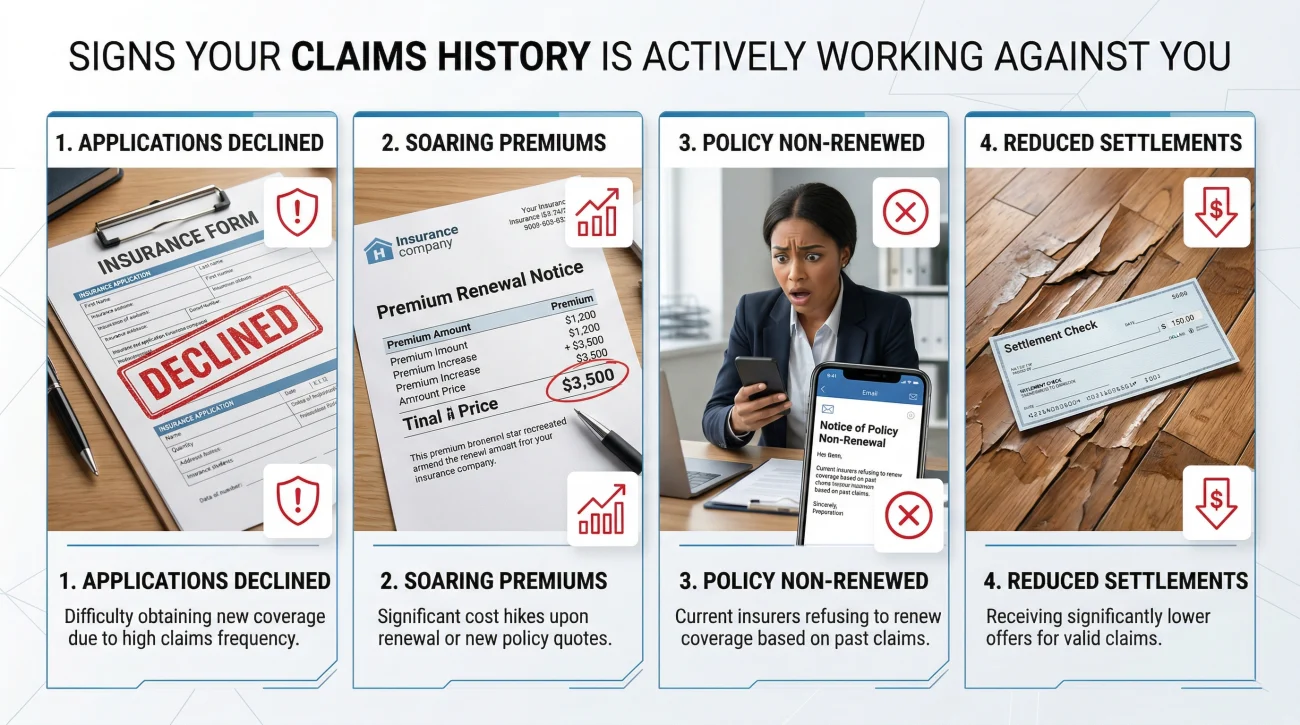
The impact of a bad claims history is rarely announced directly. Insurers do not always tell you why a rate went up or why a quote was denied. If you are experiencing any of the following scenarios, your CLUE report is likely the underlying cause:
- 🚩 Market rejections: You are actively shopping for new coverage and multiple standard carriers are declining to offer you a policy, forcing you to look at high-risk, non-standard markets.
- 🚩 Frequency warnings: An agent informs you that your property has a “frequency issue,” meaning there have been too many claims in a short window, even if some of them belonged to the prior owner.
- 🚩 Inquiry penalties: You recently called your insurer to discuss a potential issue, decided not to file, but your renewal premium still spiked unexpectedly.
- 🚩 The lowball trap: You filed a legitimate claim, but the payout you received was incredibly low. Now you are stuck with a permanent mark on your record for the next seven years, but you do not have enough money to actually fix your home.
Key Point: Filing a claim that results in a tiny payout (or worse, a denial) gives you all the long-term penalties of a damaged claims history with none of the financial benefits of an insurance settlement.
Why Your Record Should Guide Your Filing Decision
Understanding that a simple phone call or a zero-payout claim can linger on your record for up to seven years is a crucial step before you ever report damage. If you are currently debating whether to report a new incident, you have to weigh the immediate cost of repairs against the long-term cost of a CLUE entry. You also have to factor in how the rate surcharge applies over the next several years, and how your deductible affects your payout.
For the complete picture on navigating this choice, you can review our full framework for deciding whether to file. But the general rule of thumb is this: if the damage is minor, or if you are not certain it is covered, paying out of pocket is often cheaper than enduring a multi-year surcharge.
Final Thoughts Before You Accept a Settlement
All of the advice above applies to the pre-filing decision. But what if you are already past that point? If you have already filed a claim, the entry is on your record. The damage to your claims history is already done. At this stage, your only priority should be ensuring that the settlement you receive is adequate to cover your actual repair costs. I frequently see homeowners accept lowball offers just to get the process over with, not realizing they are taking a permanent mark on their CLUE report for a fraction of what they are owed.
If you have a claim open right now and the numbers from the adjuster do not look right, do not sign off on it blindly. Since your record has already taken the hit, you need to make sure the payout is accurate. If you are unsure if your settlement is fair, you can get a free claim review from a licensed public adjuster to see if the payout justifies the record impact.
❓ FAQ
🕵️ How do I check my home insurance claims history?
You can check your claims history by requesting a free copy of your CLUE (Comprehensive Loss Underwriting Exchange) report directly from LexisNexis online or by mail. You are entitled to one free report every 12 months.
⏳ How long do home insurance claims stay on record?
Home insurance claims typically remain on your CLUE report for five to seven years from the actual date of the loss, regardless of when the claim was finalized or closed.
❌ Does a denied claim show on my CLUE report?
Yes, in many cases. If you formally open a claim, it is usually reported to the database even if the insurance company ultimately denies coverage or determines the damage falls below your deductible.
📞 Will calling my insurance company count as a claim?
It can. Many insurers record calls discussing specific damage as an “inquiry.” These inquiries can show up on your CLUE report and affect how other insurers view your risk profile, even if no formal claim was ever filed.
🏠 Can a previous owner’s claims affect my insurance?
Yes. Because the CLUE report tracks both the person and the property address, claims filed by the previous homeowner remain attached to the house. This can result in higher premiums or coverage restrictions when you buy the property.
🗑️ How do I remove an incorrect claim from my CLUE report?
You can file a dispute directly through the LexisNexis consumer portal. Provide documentation proving the error, and they will typically investigate with the reporting insurer to correct or remove the inaccurate entry.
📈 Does a bad claims history mean I cannot get home insurance?
Not necessarily, but it does limit your options. If standard carriers decline you due to multiple claims, you may have to purchase a policy from a “non-standard” or surplus lines carrier, which generally comes with significantly higher premiums and stricter coverage limits.
💧 Are water damage claims worse on my record than others?
Often, yes. Insurers view water damage as highly likely to recur and prone to secondary issues like mold. Multiple water claims, or even a single large one, can make a property very difficult to insure with standard carriers.
💸 Can I just pay out of pocket to avoid the record?
Yes. If you manage the repairs entirely out of pocket without notifying your insurer or asking them if the damage is covered, no claim or inquiry is generated, keeping your CLUE report clean.
📝 What exactly is a Comprehensive Loss Underwriting Exchange report?
It is a centralized database maintained by LexisNexis where insurance companies share a seven-year history of property claims and inquiries associated with both the homeowner and the property address.
Filing is just the beginning. These cover what the rest of it looks like.
- How a claim moves from filing to final payment
- What your policy actually covers and what it does not
- Which damage types get paid and which get excluded
- When filing a claim makes sense and when it works against you
- What to do after a denial and what your actual options are
- What a public adjuster does and when you actually need one
- When legal help is the move that changes the outcome
That gap is common and usually closeable. These explain how.
- 5 patterns that signal your settlement is probably short
- Who the adjuster at your door actually works for
- Where water damage estimates most often fall short
- What fire damage settlements commonly leave out
- Why your roofer's number and the insurer's estimate do not match
- When a denial needs legal leverage, not just negotiation
- Four paths to fight a denial, including one most homeowners miss
Disclosure: I'm sharing my personal industry experience, but I am not an attorney or a licensed insurance agent. The guides on this site are for informational purposes to help you understand the operational side of property claims: process, organization, and documentation. Every policy is unique, so please defer to your specific policy language. For legal interpretation, contested situations, or binding advice, always consult a licensed professional in your jurisdiction.