

- Filing an insurance lawsuit moves your dispute out of the standard claims department and into the legal system, which operates on strict, formal timelines.
- The discovery phase is the longest and most intrusive part of the process, requiring you to produce extensive personal documentation and correspondence.
- You will likely have to give a deposition, which is a formal, sworn question-and-answer session with the insurance company’s defense attorney.
- The vast majority of property insurance lawsuits are resolved through negotiated settlements or mediation rather than going all the way to a jury trial.
- A typical litigated property claim takes between 12 and 24 months to resolve, meaning patience is just as important as legal strategy.
Entering the Legal Arena: What Litigation Actually Feels Like
Most homeowners who find themselves filing a lawsuit against their insurance company have never been involved in civil litigation before. The idea of taking a massive corporate entity to court is intimidating. You know your home is damaged, you know your claim was denied or underpaid, and you know you need professional help to fix it. But once the paperwork is filed, the actual day-to-day reality of a lawsuit is often a mystery.
I have watched many homeowners navigate this exact transition. When you move from standard claim negotiations into formal litigation, the rules of engagement change entirely. You are no longer dealing with a customer service representative or an independent adjuster. You are dealing with specialized defense attorneys whose job is to protect the insurer’s financial interests.
Knowing what to expect makes this process significantly less intimidating. It helps you stay on track, prevents you from making unforced errors, and allows you to pace yourself for a marathon rather than a sprint. This guide breaks down the timeline and the emotional reality of going through an insurance lawsuit from the homeowner’s perspective.
The Opening Moves: Filing, Service, and the Insurer’s Answer
The litigation process officially begins when your attorney files a formal complaint in civil court. If you want to understand the exact steps required to initiate this action, you can review the mechanics of how to sue your home insurance company. But once that complaint is filed, the first phase of your lawsuit timeline begins.
Serving the Complaint
After filing, the lawsuit must be formally delivered to the insurance company. This is known as “service of process.” The insurer is officially put on notice that they are being sued. Once served, a strict legal clock starts ticking. The insurance company generally has a set number of days (often 20 to 30 days, depending on the jurisdiction) to file their formal response.
Reading the Insurer’s Answer
The insurer’s response is legally called an “Answer.” When your attorney sends you a copy of this document, it can be a jarring experience. In their Answer, the insurance company will methodically deny almost every allegation you made. They will also list “affirmative defenses.”
An affirmative defense is a legal argument stating that even if your damage occurred, the insurer is not liable because of a specific policy condition or exclusion. Common affirmative defenses include claiming that you failed to mitigate the damage, that the damage is from long-term wear and tear, or that you missed a filing deadline.
Short field observation from claims experience: I always warn homeowners not to take the insurer’s Answer personally. When you read a document accusing you of ‘failing to maintain the property’ or ‘misrepresenting facts,’ it feels like a personal attack. It is not. It is standard legal posturing. The defense attorneys are simply throwing every possible policy exclusion at the wall to see what sticks. Your attorney expects this.
The Discovery Phase: The Core of Insurance Litigation
Once the initial documents are filed, the lawsuit enters the discovery phase. This is by far the longest, most tedious, and most intrusive part of the litigation process. Discovery is the formal procedure where both sides exchange evidence, documents, and information.
As a homeowner, this is where you will do the most heavy lifting. You cannot simply hand the case to your lawyer and walk away. You will be required to participate actively.
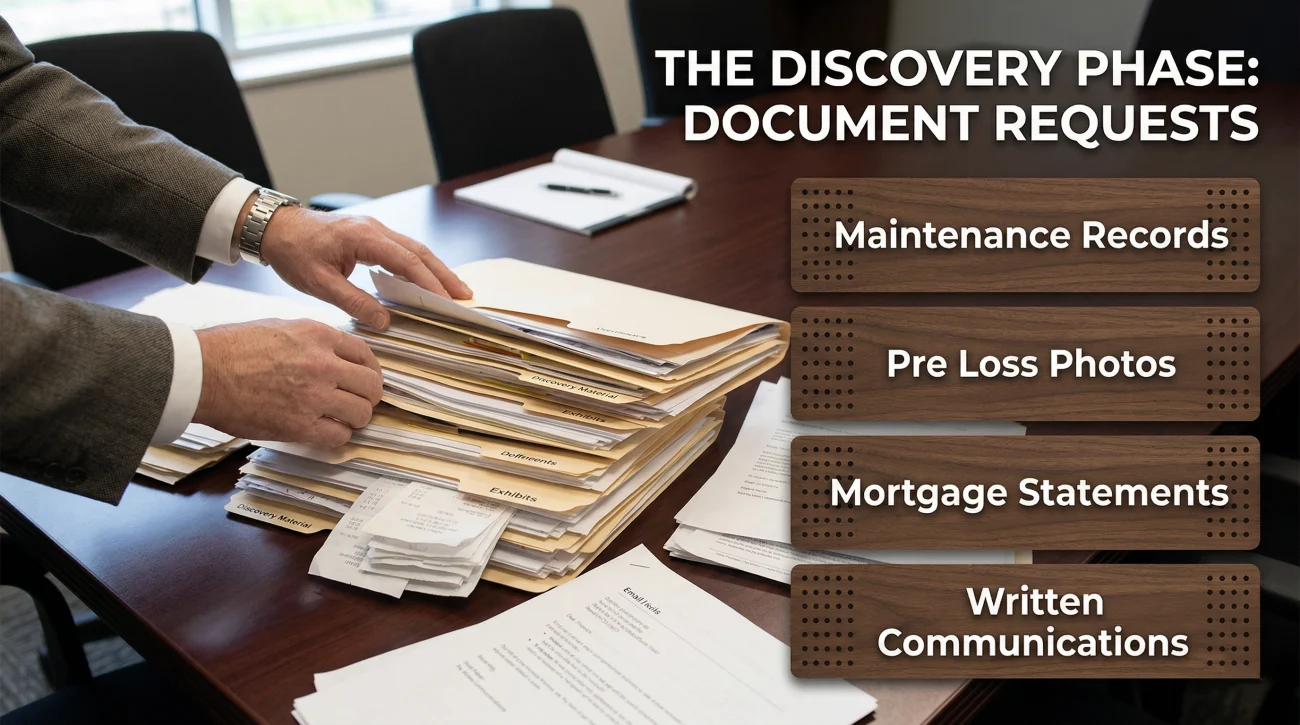
Document Requests
The insurance company will send a “Request for Production of Documents.” They will ask for everything remotely related to your home, your finances, and the damage. This often feels invasive, but it is a normal part of civil litigation. You will typically need to gather:
- 👉 Years of maintenance records and contractor invoices for your home.
- 👉 Pre-loss photos of the damaged areas, often pulled from old family photos or real estate listings.
- 👉 Mortgage statements, utility bills, and sometimes tax returns.
- 👉 Every text message, email, and written communication you had with contractors, mitigation companies, and the adjuster.
⚠️ Warning: Never delete texts or discard documents once a lawsuit is anticipated. Destroying evidence, even accidentally, is called “spoliation” and can severely damage or completely ruin your legal case.
Answering Interrogatories
You will also receive “Interrogatories,” which are formal written questions you must answer under oath. Your attorney will help you draft these answers, but they rely on you for the facts. The questions will ask you to detail a chronological timeline of when you discovered the damage, who you called first, and exactly what repairs have been made.
The Deposition: Your Turn on the Record
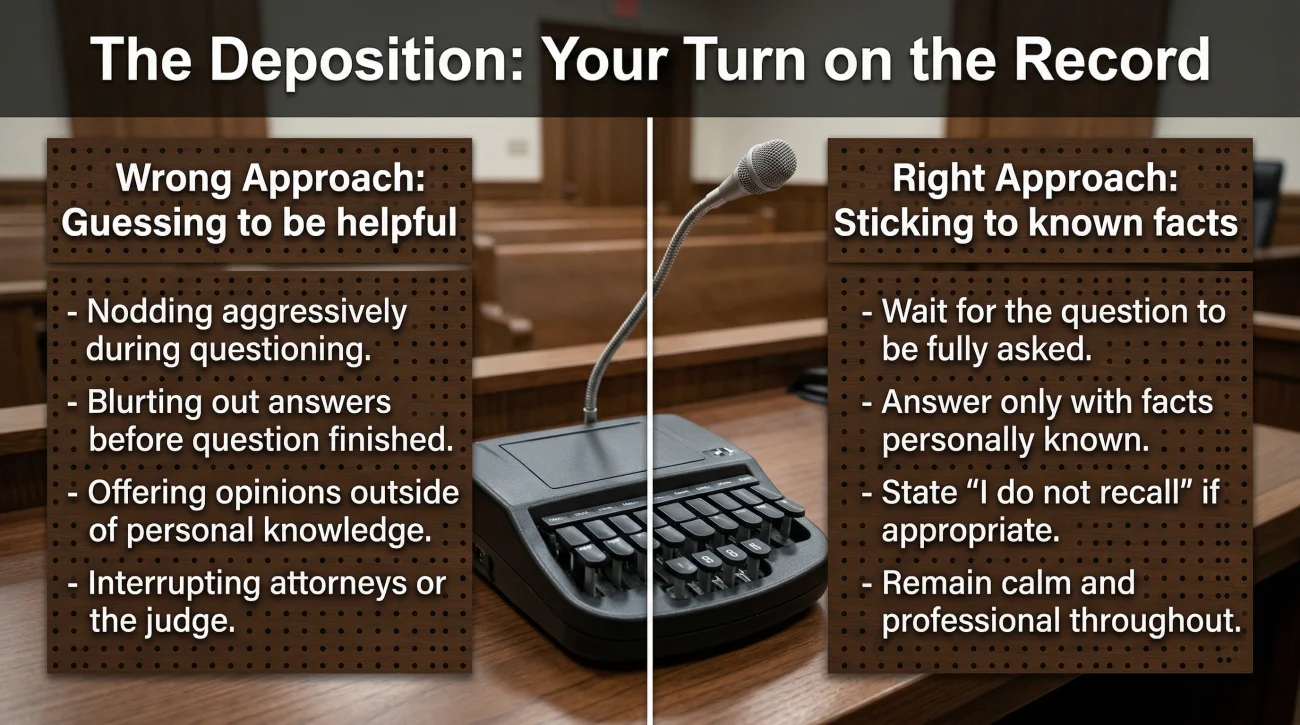
After months of gathering documents and exchanging written answers, the litigation will eventually demand your physical presence. You will likely have to sit for a deposition, which for most homeowners is the single most stressful day of the entire lawsuit.
A deposition is an in-person or virtual question-and-answer session. You are sworn in under oath, just as you would be in a courtroom, and a court reporter types down every word spoken. The insurance company’s defense attorney will ask you questions about your claim, your property history, and the damages you are seeking. Your own attorney will be sitting right next to you to protect your rights and object to improper questions, but your attorney cannot answer the questions for you.
The golden rule of a deposition is simple: only answer the question asked, and never guess.
Guessing an answer to be helpful. “I think the roof was probably 15 years old when the storm hit, but I’m not totally sure.”
Sticking to known facts. “I do not know the exact age of the roof. It was already installed when I purchased the home in 2018.”
Remember that “I do not know” and “I do not recall” are complete, valid, and legally acceptable answers if they are the truth. The defense attorney is looking for inconsistencies between your recorded statement from day one, your written interrogatories, and your deposition testimony. Thorough preparation with your attorney beforehand is essential.
The Painful Reality: What You Are Responsible For During Litigation
Many homeowners assume that once they hire a law firm, their involvement ends until a settlement check arrives. The reality of litigation is quite different. The frustration of an insurance lawsuit often stems from the silent burdens placed directly on the policyholder.
Once you are represented by counsel, you lose direct control over the day-to-day dialogue. You can no longer call the insurance company to demand answers or vent your frustration. All communication must flow formally through the lawyers, which can make you feel entirely disconnected from the fate of your own home.
Then comes the physical burden of the property itself. A question I hear constantly is whether a homeowner can proceed with repairs while the lawsuit is ongoing. The grueling reality is that you must preserve the damaged property as evidence until the insurer’s legal experts have had a chance to inspect it. While emergency safety mitigations (like tarping a roof or extracting standing water) are required, completing full, permanent reconstruction can destroy the very evidence your case relies on. This means you may be living in a partially damaged, construction-zone environment for months on end.
Finally, there is the burden of documentation. Your attorney handles the legal procedure, the court filings, and the strategy. But they cannot build the factual foundation without your active participation. Only you know where your receipts, photos, and maintenance records are kept. Digging through years of paperwork is entirely your responsibility.
If your situation involves clear bad faith conduct by the insurer, you might also be navigating the mechanics of a homeowners insurance bad faith lawsuit, which requires even more documentation regarding exactly how the adjuster treated you. If you do not yet have legal representation to guide you through this heavy lifting, exploring a free claim review from an insurance attorney is the required first step.
Timeline Reality: How Long Does an Insurance Lawsuit Take?
If there is one aspect of litigation that universally frustrates homeowners, it is the timeline. The legal system moves at a glacial pace. While you might expect a quick resolution after taking formal action, a standard property insurance lawsuit requires immense patience from the day the complaint is filed.
| Litigation Phase | Typical Duration | What Happens |
|---|---|---|
| Pleadings | 1 to 2 Months | Filing the complaint, serving the insurer, waiting for the Answer. |
| Discovery | 6 to 12 Months | Exchanging documents, written questions, and taking depositions of all parties. |
| Mediation & Negotiation | Month 9 to Month 18 | Formal attempts to settle the case with a neutral third-party mediator. |
| Trial Preparation & Trial | Month 18 to Month 24+ | Preparing expert witnesses, filing pre-trial motions, and presenting the case in court. |
What extends these timelines? Court backlogs are the primary culprit. Getting hearing dates for simple procedural disputes can take weeks. Additionally, if the claim requires complex engineering reports or expert testimony to prove structural damage, coordinating the schedules of multiple experts significantly slows the process down.
Resolution: Settlement vs. Trial
The vast majority of property insurance lawsuits never see the inside of a courtroom for a jury trial. Statistically, most civil cases are resolved through negotiated settlements. Litigation forces both sides to evaluate their risk, and as discovery uncovers the strengths and weaknesses of the case, settlement becomes the most logical outcome.
The Role of Mediation
Before a judge will allow a case to go to trial, they will almost always order the parties to attend mediation. Mediation is a confidential settlement conference overseen by a neutral third party (the mediator, often a retired judge or senior attorney). You, your attorney, the defense attorney, and an insurance company representative with the authority to write a check will all be present.
The mediator does not make a ruling. Instead, they shuttle back and forth between the two rooms, highlighting the risks of going to trial for both sides and attempting to broker a financial compromise. Many cases settle on the day of mediation.
If Settlement Fails: Proceeding to Trial
If the insurance company refuses to make a reasonable offer, or if the dispute involves a fundamental disagreement over policy interpretation, the case will proceed to trial. A trial is highly structured. Your attorney will call expert witnesses, present the documentation gathered during discovery, and argue your case before a judge or jury.
Trials are expensive, public, and unpredictable. While a successful verdict can result in a full payout plus attorney fees, losing means walking away with nothing and having spent years in the process. This is why experienced attorneys aggressively pursue a fair settlement first.
The Final Step: Disbursing the Settlement
When the mediator announces a deal or the insurer finally agrees to a fair number, the lawsuit does not end instantly. The physical disbursement of funds is a process of its own.
Once settlement documents are signed, the insurance company typically has a set window (often 15 to 30 days) to issue the settlement check. This check is usually sent directly to your attorney’s trust account. From there, your attorney will deduct their agreed-upon contingency fee and any case expenses they advanced on your behalf, such as expert witness costs or court filing fees.
There is one final hurdle that catches many homeowners off guard: the mortgage lender. If you have an active mortgage on the property, the insurance company is legally required to include your lender as a payee on the settlement check. This means the check must be endorsed by your mortgage company before the net recovery can be released to you. This can add additional weeks of administrative back-and-forth before you finally have the funds to complete your permanent repairs.
Final Thoughts on the Litigation Journey
Walking away from an insurance lawsuit with a fair settlement is a victory, but the journey to get there tests your endurance. It requires opening your life to discovery, sitting under the intense pressure of a deposition, and having the stamina to wait out a deliberately slow legal system.
Having a realistic picture of what this process entails makes it much easier to evaluate whether your specific claim dispute is truly worth the battle. If you are still weighing your options, review our comprehensive guide on when to hire a home insurance claim lawyer.
If you have exhausted all internal appeals, your documentation is in order, and you are ready to take this necessary step, finding the right representation is critical. To connect with a professional who can navigate this grueling timeline for you, request a free consultation with a vetted property damage attorney.
❓ FAQ
🕰️ How long does a home insurance lawsuit usually take to settle?
A typical property insurance lawsuit takes between 12 and 24 months to resolve. The timeline depends heavily on court backlogs, the complexity of the damage, and the willingness of the insurer to negotiate a fair settlement during mediation.
🧑⚖️ Will I actually have to go to court for my insurance claim?
It is highly unlikely. The vast majority of property insurance lawsuits are resolved through negotiated settlements or mediation long before a trial date is reached. Trials are expensive and risky for both sides.
🗣️ What happens during a deposition in an insurance lawsuit?
A deposition is a formal question-and-answer session under oath. The insurance company’s lawyer will ask you questions about the damage, your maintenance history, and your claim, while a court reporter records every word.
📄 What documents will the insurance company ask for in discovery?
They will request extensive documentation, including years of maintenance records, pre-loss photographs of your home, contractor invoices, utility bills, and all written communications regarding the repairs.
🤝 How are most home insurance lawsuits resolved?
Most are resolved through mediation, a confidential settlement conference where a neutral mediator helps both sides reach a financial compromise before going to trial.
💰 Do I have to pay my lawyer while the lawsuit is happening?
Usually, no. Most property insurance attorneys work on a contingency fee basis, meaning they do not get paid by the hour. They only collect a fee as a percentage of the final settlement or verdict they recover for you.
🤐 Can I still talk to my insurance adjuster after filing a lawsuit?
No. Once you are represented by an attorney and a lawsuit is filed, all communication must go through legal channels. You should not speak directly with the insurance adjuster or the insurer’s defense attorneys.
⏱️ What extends the timeline of an insurance lawsuit?
Delays are usually caused by backed-up court schedules, difficulties in scheduling depositions for multiple expert witnesses, and disputes over the production of documents during the discovery phase.
🕵️♀️ What is an affirmative defense in an insurance lawsuit?
It is a legal argument used by the insurance company stating that even if the damage happened as you claim, they are not responsible because of a specific policy exclusion, such as your failure to mitigate the damage.
🛑 Can the insurance company drop my policy because I sued them?
An insurance company cannot cancel your policy mid-term simply for filing a lawsuit. However, they may choose not to renew your policy when your current term expires.
Most disputes start with a payout disagreement. These cover the earlier stages.
- The claim lifecycle a PA or attorney works inside
- The policy language that determines what professional help can recover
- How damage classification affects what an expert can negotiate
- Whether the situation you have justifies bringing in outside help
- When a denial is the outcome a PA could have prevented
- What a public adjuster actually does inside a claim
- When the dispute has moved past what a PA can handle
Two paths, two different situations. These clarify which one fits yours.
- How to tell if your situation actually warrants hiring one
- The difference between the adjuster you hired and the one who showed up
- When water damage scope gaps make independent review necessary
- When fire damage complexity makes independent representation worth it
- When the gap between estimates is large enough to bring in a PA
- When bad faith makes legal action the only path that works
- PA, attorney, or appraisal clause: which path fits your denial
Disclosure: I'm sharing my personal industry experience, but I am not an attorney or a licensed insurance agent. The guides on this site are for informational purposes to help you understand the operational side of property claims: process, organization, and documentation. Every policy is unique, so please defer to your specific policy language. For legal interpretation, contested situations, or binding advice, always consult a licensed professional in your jurisdiction.