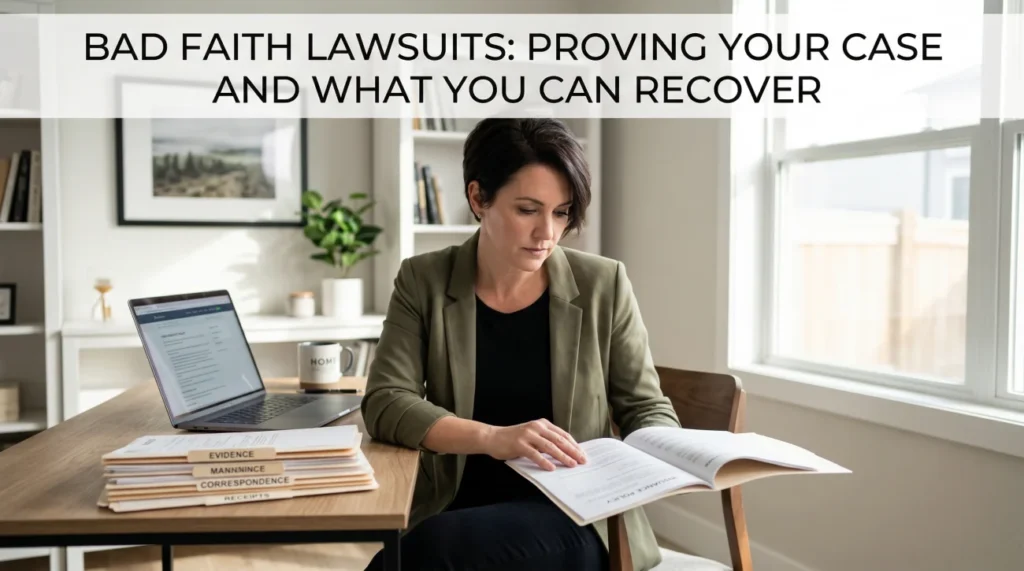
- A standard breach of contract lawsuit asks the insurer to pay what the policy covers. A bad faith lawsuit asks the court to penalize the insurer for acting unreasonably during the claim process.
- Proving bad faith requires meeting a two-part standard: you must show that the insurer failed to pay a covered benefit and that their refusal or delay was without a reasonable basis.
- Successful bad faith claims can unlock additional recovery beyond your policy limits, including attorney fees, consequential damages, and potentially punitive damages.
- The strongest bad faith cases are built on documentation of the insurer’s internal handling, such as ignored engineering reports, fabricated denial reasons, or unexplained delays.
- If your insurer is demanding endless documentation without resolution or denying a claim without conducting a physical investigation, a professional legal evaluation is usually the safest next step.
The Difference Between a Wrong Decision and an Unreasonable One
When homeowners feel cheated by their insurance company, the phrase “bad faith” gets thrown around very quickly. But in the legal world, a bad faith insurance lawsuit is a highly specific, powerful mechanism that requires much more than just a disagreement over repair costs. A standard insurance lawsuit asks the insurer to pay what the policy says. A bad faith lawsuit asks something fundamentally different. It puts the insurer’s behavior under a microscope.
Adjusters can and do make honest mistakes. A miscalculated measurement or a misunderstood policy clause is frustrating, but it is typically just an error. Bad faith occurs when the insurer actively looks for ways to avoid paying a legitimate claim, ignores clear evidence, or uses their financial leverage to force you into a low settlement.
To understand whether your situation qualifies, you must look at how the decision was made. If you need help identifying the everyday signs of this behavior before considering a lawsuit, reviewing the operational definition of what insurance bad faith looks like in practice is a helpful starting point. If you are already at the point where litigation seems inevitable, understanding how this specific type of lawsuit works will change how you approach your claim file entirely.
What Makes Bad Faith Different From Breach of Contract?
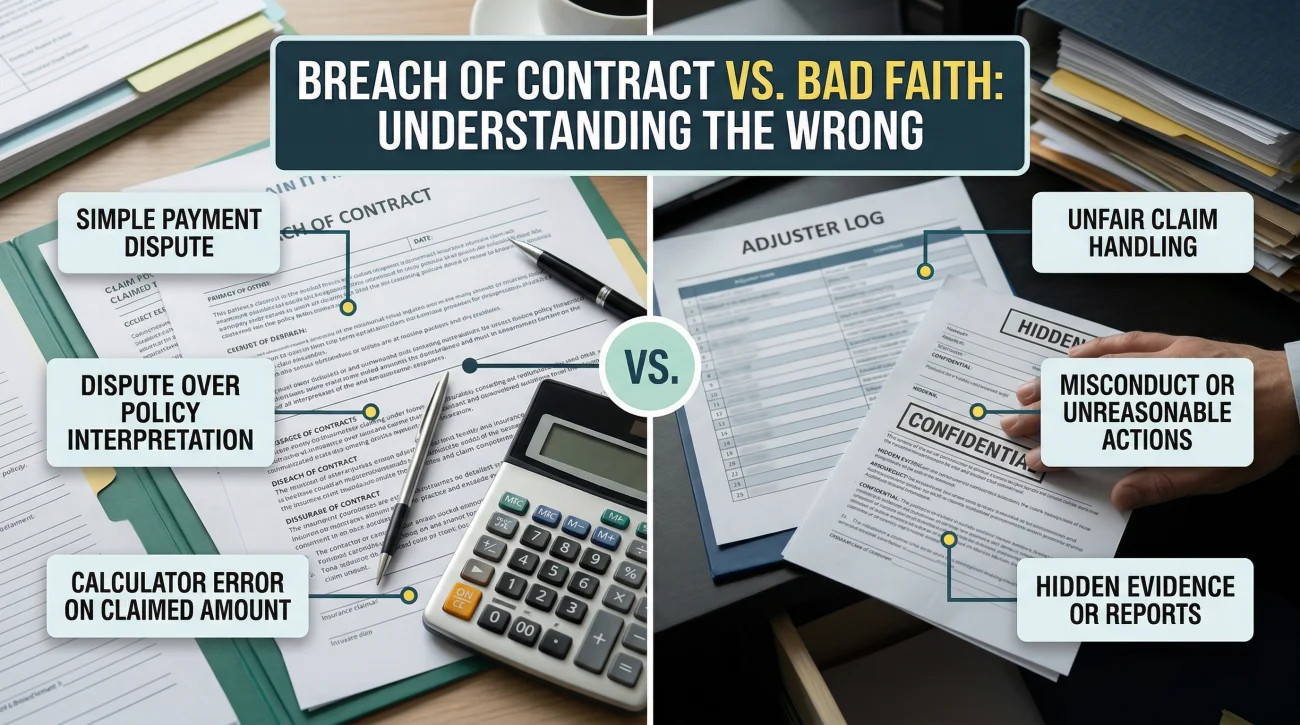
If you take an insurance company to court, you are usually looking at two potential legal theories. The first is a breach of contract. The second is bad faith. They are often filed together, but they address different wrongs.
A breach of contract claim simply states that you had a valid policy, you suffered a covered loss, and the insurer failed to pay what they owed. The court’s job is to enforce the contract. The remedy is almost always limited to the policy benefits you should have received in the first place, plus standard interest.
A bad faith claim elevates the dispute. It argues that the insurer violated their implied duty of good faith and fair dealing. It focuses on the fact that an insurance policy is not a normal commercial contract where two equal parties negotiate. You bought a safety net, and the insurer used their superior power to unreasonably deny you that safety net. For a deeper dive into how courts separate these two concepts, you can explore the nuances of a breach of contract versus a bad faith insurance claim to see which theory best fits your documentation.
The insurer sends an engineer who concludes your roof damage is from age. Your engineer says it is from a recent storm. The insurer denies the claim based on their engineer’s report. They may be wrong, but they relied on a professional opinion.
The insurer’s own engineer concludes the damage is from a recent storm. The desk adjuster hides that report, does not send it to you, and issues a denial letter citing wear and tear anyway.
What You Can Actually Recover in a Bad Faith Lawsuit
Understanding what makes bad faith different matters because it directly determines what you can recover. The primary reason bad faith lawsuits are taken so seriously by the insurance industry is that they expose the insurer to financial risk far beyond the limits of your policy. When an insurer acts unreasonably, the damages available to the homeowner multiply.
| Type of Recovery | What It Covers |
|---|---|
| Policy Benefits | The original amount the insurer should have paid to repair your home or replace your property under the terms of the contract. |
| Attorney Fees | In many states, if you prove bad faith, the court will force the insurance company to pay your legal fees, meaning your settlement is not reduced by legal costs. |
| Consequential Damages | Financial losses caused directly by the insurer’s delay or denial. Examples include lost rental income, ruined credit from unpaid repair loans, or secondary mold damage caused by a delayed water extraction approval. |
| Punitive Damages | Awarded in egregious cases, these are designed solely to punish the insurance company and deter future bad behavior. These are state-dependent and represent the highest financial risk to the insurer. |
Because consequential and punitive damages are not capped by the coverage limits on your declarations page, a $50,000 house fire claim that is handled in bad faith can potentially result in a lawsuit worth hundreds of thousands of dollars. This is exactly why building a strong evidentiary case is critical.
What You Must Prove: The Two-Part Standard
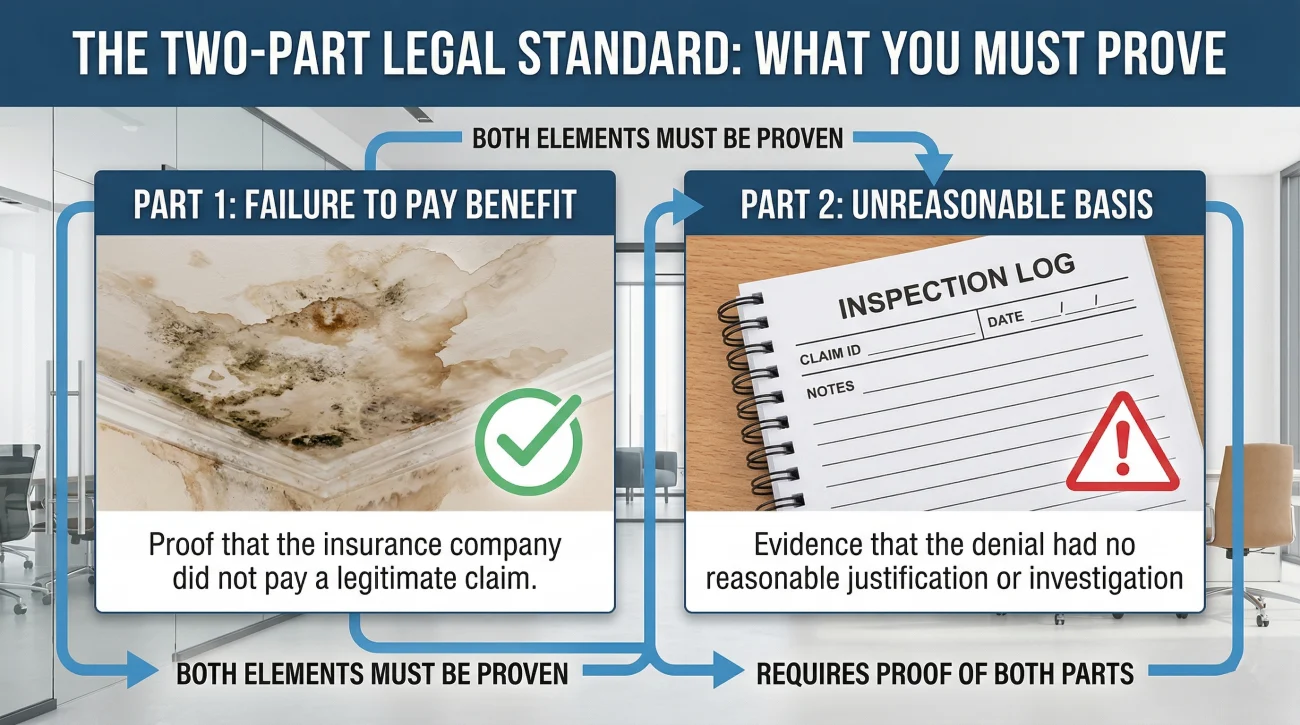
Winning a bad faith lawsuit is significantly harder than winning a standard breach of contract claim. The burden of proof rests entirely on the homeowner. While specific legal definitions vary by jurisdiction, courts generally require you to prove two distinct elements.
First, you must prove that the insurer failed to pay a benefit that was owed under the policy. If the damage was legitimately excluded (for example, a flood claim on a policy that strictly excludes flooding), there can be no bad faith, regardless of how poorly the adjuster communicated with you.
Second, and most importantly, you must prove that the insurer’s refusal to pay was unreasonable. This means they lacked a “fairly debatable” reason for denying or delaying the claim. If the insurer conducted a thorough investigation, evaluated all evidence fairly, and simply came to a different conclusion than you did, courts will rarely classify that as bad faith.
When I review a claim file for potential bad faith, I do not just look at the final denial letter. I look for the gaps. If an adjuster denies a $100,000 structural claim but their inspection log shows they were only on the property for 15 minutes and never took a single photograph of the attic framing, that is not an investigation. That is a predetermined outcome.
The Documentation That Builds a Bad Faith Case
Insurance companies maintain massive, detailed internal logs for every claim. Every phone call, every email, and every internal decision is recorded. When an attorney files a bad faith lawsuit, their primary target during the discovery phase is this internal claim file. But you must lay the groundwork before a lawsuit is ever filed.
To prove unreasonableness, you need a documented paper trail showing that you provided the insurer with everything they needed, and they still failed to act appropriately. This means saving more than just emails. You should preserve timestamped photographs, contractor quotes with visible dates, and screenshots of the insurer’s online portal if your claim status suddenly changes without explanation.
💡 Pro Tip: Never rely on phone conversations during a disputed claim. If a desk adjuster tells you over the phone that they will not accept your contractor’s structural report, follow up immediately with an email stating, “To confirm our phone conversation today at 2 PM, you stated you are rejecting the independent engineering report without sending your own engineer to the property.”
Here is an example of how a homeowner can document an unreasonable delay in writing to build a paper trail:
Subject: Formal Request for Claim Status & Explanation of Delay – Claim #[Your Claim Number]
Dear [Adjuster Name],
I am writing to formally request an update on my claim. I submitted the requested contractor estimates and photographic evidence of the water damage on [Date], which was over 45 days ago.
Since that time, I have left three voicemails and sent two emails without receiving any response or explanation for the delay. My home remains exposed to secondary damage while I await your coverage decision.
Please provide a written update on the status of my claim and an explanation for why this file has not been processed within a reasonable timeframe by [Date].
Thank you,
[Your Name]
What NOT to Do While Building Your Case
Homeowners often unknowingly sabotage their own bad faith cases by making administrative missteps during the negotiation process. If you suspect your insurer is acting unreasonably, avoid these common traps:
- 🛑 Signing a partial release blindly: Never sign a document to receive an undisputed partial payment without reading it thoroughly. Insurers sometimes bury final release language in these checks, forfeiting your right to pursue the rest of the claim.
- 🛑 Relying on verbal agreements: A phone call does not exist in a bad faith lawsuit. If it is not confirmed in an email, it did not happen.
- 🛑 Starting repairs before the second inspection: If you are disputing a denial, do not alter the evidence. Wait until the independent adjuster or engineer has fully documented the scene.
- 🛑 Stopping your communication log: Do not assume the case is handled just because a manager takes over the file. Continue documenting every single interaction.
Patterns Courts Recognize as Bad Faith
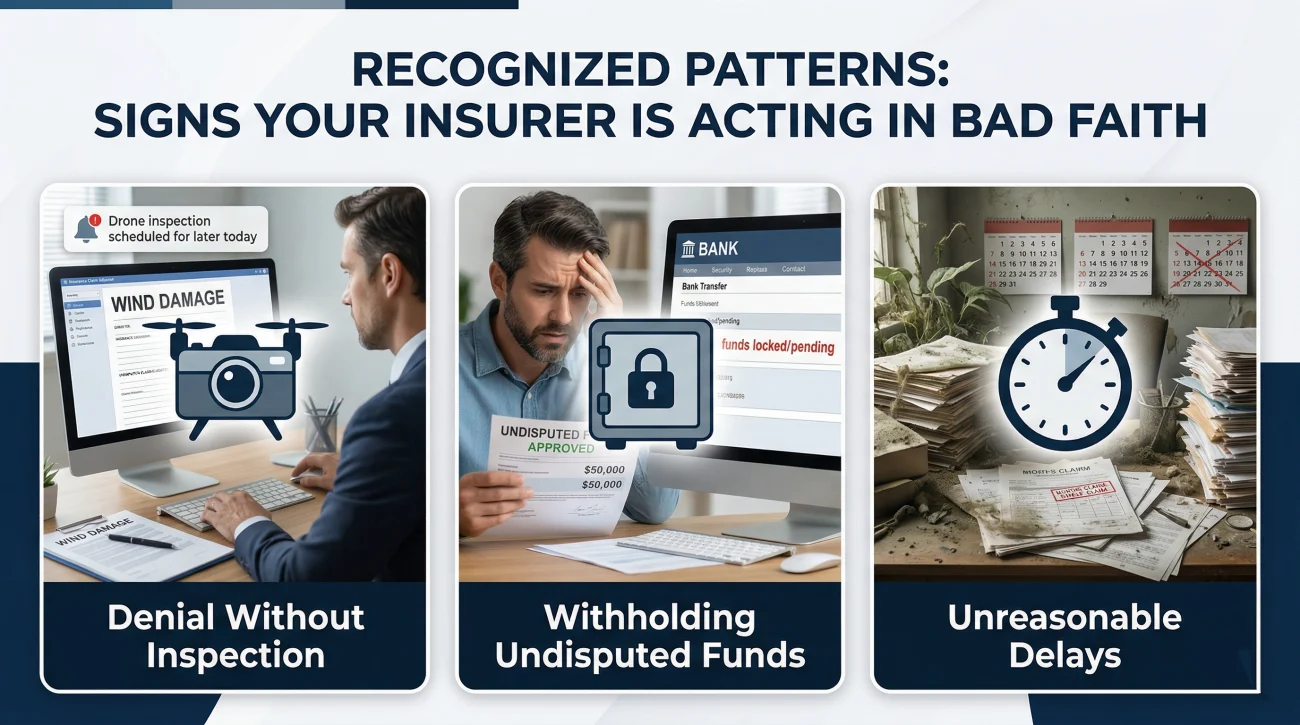
Not every frustrating delay is legally actionable. However, courts across the country have consistently recognized specific patterns of insurer conduct that cross the line from poor customer service into bad faith. A quick checklist can help you evaluate your situation:
Did the insurer deny your claim without ever sending anyone to the property?
Did they cite a policy exclusion that clearly does not apply to your situation?
Are they withholding an undisputed partial payment to force you to drop the rest of your claim?
If any of these apply, your claim has likely moved past a simple negotiation problem. Specific behaviors to watch for include:
- 🛑 Denial without physical investigation: The insurer denies a complex claim, such as hail damage or a plumbing leak, based entirely on a desk review or a drone photo, without conducting a proper field inspection.
- 🛑 Withholding undisputed funds: The insurer agrees that $20,000 of damage is covered, but refuses to release that payment unless you sign a full release dropping your demand for the remaining $50,000 in disputed funds.
- 🛑 Excessive and abusive investigative demands: The insurer forces you to submit to multiple rounds of interrogations or requires you to sit for an examination under oath (EUO) without a clear reason, simply to exhaust you financially and emotionally.
If these patterns match your experience, a licensed insurance attorney can evaluate whether your insurer’s conduct meets the bad faith threshold. Insurers rarely change these behaviors simply because a homeowner complains. It usually requires legal leverage to shift their stance.
Realistic Outcomes: Settlement vs. Trial
The media often highlights bad faith trials resulting in multi-million dollar punitive damage awards. While those cases exist, they represent a tiny fraction of bad faith litigation. It is vital to set realistic expectations if you choose to pursue this legal path.
The reality is that the vast majority of bad faith lawsuits settle out of court. Insurance companies are risk-averse institutions. Once an experienced policyholder attorney files a well-documented bad faith complaint and demands the internal adjuster logs during discovery, the insurer must calculate their risk. If their internal file looks embarrassing or legally indefensible, they will almost always opt to negotiate a confidential settlement rather than risk a public trial and a potential punitive damage verdict.
A typical negotiated bad faith settlement will usually cover your full original repair costs, reimburse your attorney fees, and provide compensation for the delays. In exchange, insurers almost always require a strict confidentiality clause. This keeps the settlement details private, preventing you from sharing the amount publicly and ensuring the insurer does not set a legal precedent for future claims. Understanding the broader mechanics of how to sue your home insurance company will give you a clearer picture of the discovery process required to force a fair resolution.
When to Escalate Your Claim
When an insurance company uses their structural advantage to force intentional delays, fabricate denial reasons, or refuse to investigate fairly, the law provides a mechanism to hold them accountable. If your claim has stalled indefinitely, or if you hold a denial letter that completely misrepresents the facts of your damage, you need to shift the balance of power.
Your correspondence and complaints will only go so far when the insurer knows you do not pose a legal threat. Because the legal standard for bad faith is complex, this is not a path you should navigate alone. The most critical step is having a professional review your claim file to see if the insurer’s actions meet the legal definition of bad faith. For a comprehensive look at how to secure this kind of professional review and force the insurer to take your claim seriously, explore the options for bringing in legal representation for a denied or mishandled claim.
❓ FAQ
🏛️ What is a bad faith insurance claim?
A bad faith claim is a legal action taken when an insurance company unreasonably delays, underpays, or denies a valid claim, violating their implied legal duty to treat the policyholder fairly.
⏳ How long does a bad faith lawsuit typically take?
Timelines vary widely based on whether the case goes to trial or settles early during discovery. See the Realistic Outcomes section above for a full breakdown of the timeline expectations.
💰 Can I sue for emotional distress in a bad faith claim?
In some cases, yes. If the insurer’s unreasonable actions caused documented financial hardship and emotional distress, those consequential damages can sometimes be included.
📝 What evidence do I need to prove bad faith?
You need a clear paper trail. This includes your communication logs, ignored independent expert reports, denial letters citing incorrect policy language, and eventually, the insurer’s internal adjuster notes obtained during legal discovery.
🛑 Is a low settlement offer automatically considered bad faith?
No. A low offer is usually just a valuation dispute or a breach of contract. It only becomes bad faith if the insurer intentionally ignored evidence or used deceptive practices to arrive at that low number.
⚖️ How much does a bad faith insurance attorney cost?
Most attorneys handling these cases work on a contingency fee basis, meaning they do not charge upfront hourly rates. They take a percentage of the final settlement or court award only if they successfully recover money for you.
🔍 Does my insurance company have to explain why they denied my claim?
Yes. Insurers are expected to provide a prompt, written explanation of a denial, specifically citing the exact policy language or exclusion they are using to deny coverage. If they refuse to put their reasoning in writing, that is a major red flag.
📄 Can an insurer cancel my policy if I sue them for bad faith?
Insurers generally cannot cancel an active policy mid-term simply in retaliation for a lawsuit. However, they may choose not to renew your policy when your current annual term expires, which is a standard industry practice after litigation.
📅 Is there a time limit to file a bad faith lawsuit?
Yes. There are strict statutes of limitations for these claims, but timelines and requirements vary significantly depending on where you live. An attorney can confirm what exact deadlines apply to your specific situation.
🧑⚖️ Do these cases usually go to court or settle?
The vast majority settle out of court to avoid public trials and unpredictable jury awards. See the Realistic Outcomes section above for a detailed look at how these settlements are structured.
Most disputes start with a payout disagreement. These cover the earlier stages.
- The claim lifecycle a PA or attorney works inside
- The policy language that determines what professional help can recover
- How damage classification affects what an expert can negotiate
- Whether the situation you have justifies bringing in outside help
- When a denial is the outcome a PA could have prevented
- What a public adjuster actually does inside a claim
- When the dispute has moved past what a PA can handle
Two paths, two different situations. These clarify which one fits yours.
- How to tell if your situation actually warrants hiring one
- The difference between the adjuster you hired and the one who showed up
- When water damage scope gaps make independent review necessary
- When fire damage complexity makes independent representation worth it
- When the gap between estimates is large enough to bring in a PA
- When bad faith makes legal action the only path that works
- PA, attorney, or appraisal clause: which path fits your denial
Disclosure: I'm sharing my personal industry experience, but I am not an attorney or a licensed insurance agent. The guides on this site are for informational purposes to help you understand the operational side of property claims: process, organization, and documentation. Every policy is unique, so please defer to your specific policy language. For legal interpretation, contested situations, or binding advice, always consult a licensed professional in your jurisdiction.