
- Receiving a notice that your home insurance claim is under investigation is usually standard procedure, not an immediate accusation of fraud.
- Most investigations are routine reviews triggered by large claim amounts, complex damage, or a policy that was recently purchased.
- A routine home insurance claim investigation process typically takes 30 to 60 days, though complex cases or catastrophe events can extend this timeline.
- There is a distinct difference between a routine adjuster review and an SIU (Special Investigations Unit) investigation, which looks for material misrepresentation.
- If your investigation drags on with repeated requests for the same documents, it may be a delay tactic, signaling it is time to escalate your claim.
When Your Claim Status Changes to “Under Investigation”
You filed your property damage claim, submitted your photos, and expected a straightforward settlement offer. Instead, you received an email or a letter stating that your home insurance claim is under investigation. If you are like most homeowners I speak with, your immediate reaction is likely a mix of anxiety and defensiveness. You might wonder if the insurance company thinks you are lying, or if this is the first step toward a complete denial.
I have reviewed hundreds of property claim files from both sides of the desk, and I can tell you this: the word “investigation” sounds incredibly alarming to a homeowner, but in the insurance industry, it is often just an administrative label. Every claim is investigated to some degree. However, when a claim is formally flagged for a deeper review, it means the insurance company needs more time and information before they can release a payment.
In my experience, the vast majority of homeowners who receive an investigation notice have done absolutely nothing wrong. They simply triggered an algorithm, perhaps because the loss was expensive, the damage involved multiple categories, or the claim was filed shortly after the policy was purchased.
The key to navigating this phase is understanding what the adjuster is actually looking for, how long the home insurance claim investigation timeline should realistically take, and how to spot the difference between a legitimate fact-finding mission and an intentional delay tactic. In this guide, I will walk you through exactly what this status means, what you need to provide, and how to protect your settlement while the insurer does their work.
The Two Types of Insurance Claim Investigations
Not all investigations are created equal. When a homeowner tells me their claim is being investigated, my first question is always: who is conducting the review? Identifying the type of investigation you are facing is the most critical step in determining how you should respond.
The Routine Adjuster Investigation
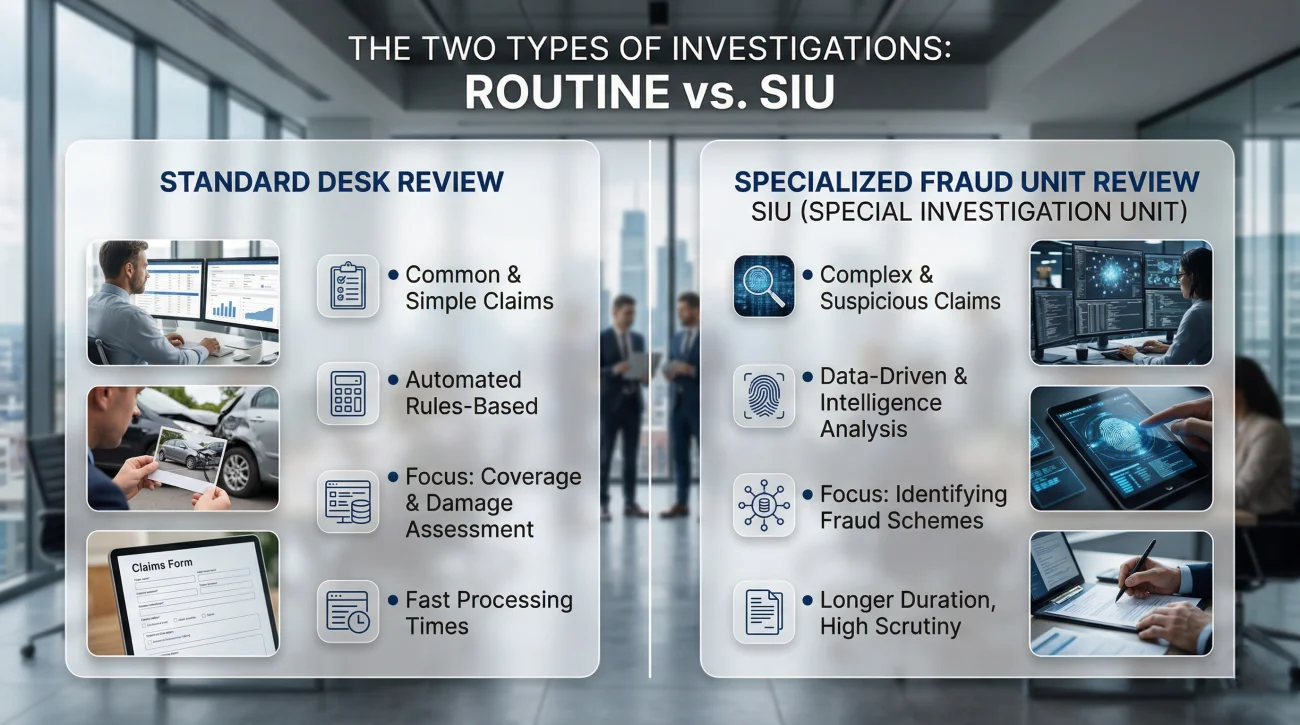
The vast majority of claims fall into this category. A routine investigation is simply a deeper dive conducted by the standard desk adjuster or field adjuster assigned to your case. They are not looking for fraud; they are looking for clarity. They need to confirm that the cause of the loss is covered under your specific policy wording, and they need to verify the exact scope of the damage.
For example, if you claim extensive water damage from a burst pipe, a routine investigation might involve sending a plumber to verify that the pipe burst suddenly, rather than leaking slowly over six months. They are investigating the cause to confirm coverage, not investigating you.
The SIU (Special Investigations Unit) Investigation
This is the type of investigation that makes homeowners nervous, though it is far less common for standard property claims. Every insurance company has an SIU department. Their sole job is to identify material misrepresentation, exaggerated claims, or outright fraud.
If your file is transferred from a standard adjuster to an SIU investigator, the tone of the process will change. SIU investigators are specially trained, often with law enforcement backgrounds. They will look deeply into your financial history, your past claims record, and they may request a formal Examination Under Oath (EUO).
An EUO is a formal legal proceeding where an attorney hired by the insurance company questions you under oath, usually with a court reporter present, about the loss and your background. It is an intense interrogation designed to lock in your testimony. If your claim reaches the EUO stage, the insurer has found a specific red flag that makes them question the legitimacy of the loss.
Conducted by your assigned adjuster. Focuses on coverage limits, causes of damage, and repair estimates. Usually resolves when documentation is provided.
Conducted by a specialized fraud unit. Focuses on your background, the sequence of events, and potential misrepresentation. Often involves an Examination Under Oath.
Why Is My Home Insurance Claim Being Investigated?
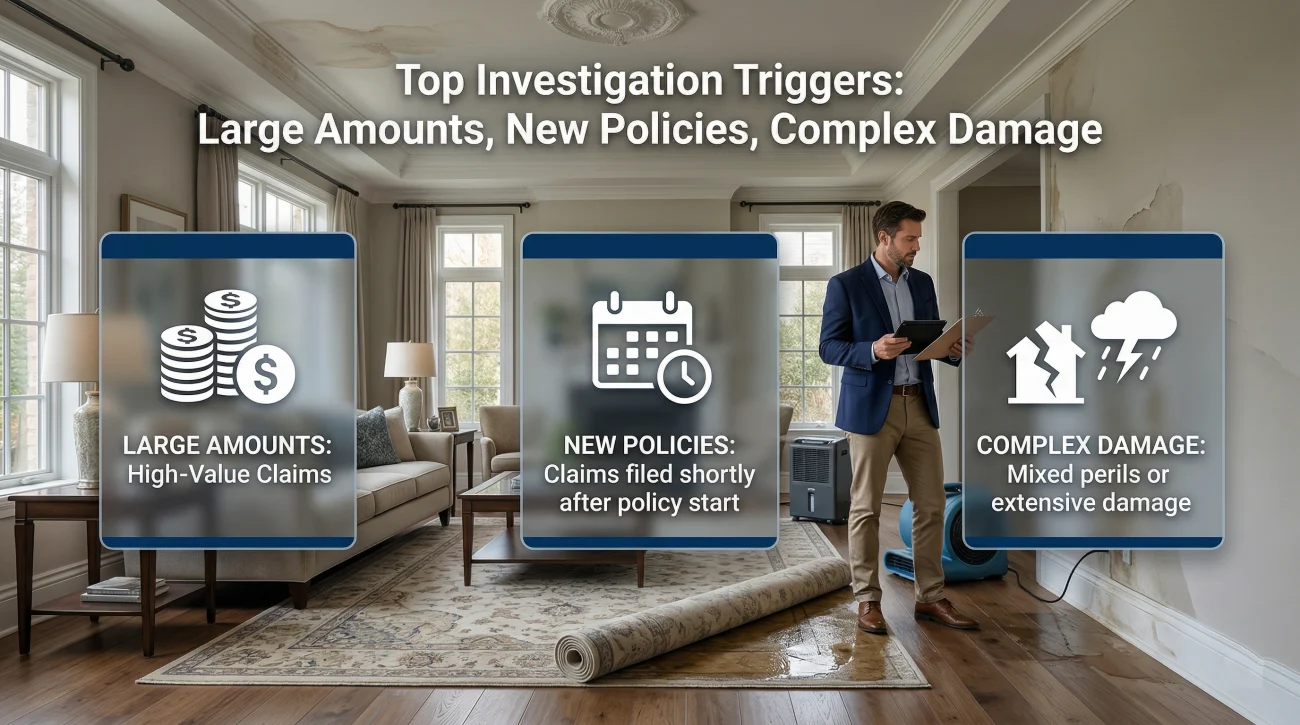
Homeowners often take an investigation personally, assuming the adjuster dislikes them or doesn’t believe their story. In reality, most files are flagged automatically by claims management software when certain parameters are met. Knowing what triggers a home insurance claim investigation process can help you understand what the insurer is trying to resolve.
Here are the most common triggers I see in the field that push a standard claim into an investigation status:
- 📌 Large Dollar Amounts: Every insurance company has a threshold. If your preliminary estimate crosses $30,000, $50,000, or $100,000 (depending on the carrier’s specific internal threshold), the file automatically triggers a managerial review and a deeper investigation before funds can be released.
- 📌 New Policies: If you file a significant claim within the first 30 to 60 days of purchasing or renewing your policy, it is almost guaranteed to be investigated. The insurer wants to ensure the damage did not pre-date the coverage.
- 📌 Complex or Mixed Damage Types: Claims involving both wind and flood water (like in a hurricane), or claims involving a fire followed by severe water damage from firefighting efforts, require extensive investigation to separate which peril caused which specific damage.
- 📌 Lack of Pre-Loss Documentation: If you are claiming a high-value item was destroyed, but you have no receipts, photos, or appraisals from before the event, the adjuster must investigate the item’s existence and value.
- 📌 Inconsistent Statements: If you told the first phone representative that the roof leaked on Tuesday, but you tell the field adjuster the storm hit on Thursday, that discrepancy will trigger an investigation.
💡 Pro Tip: If your claim is large or complex, expect an investigation from day one. Mentally preparing for this extra layer of review helps you maintain patience and organize your documents methodically.
What to Do in the First 72 Hours After Being Notified
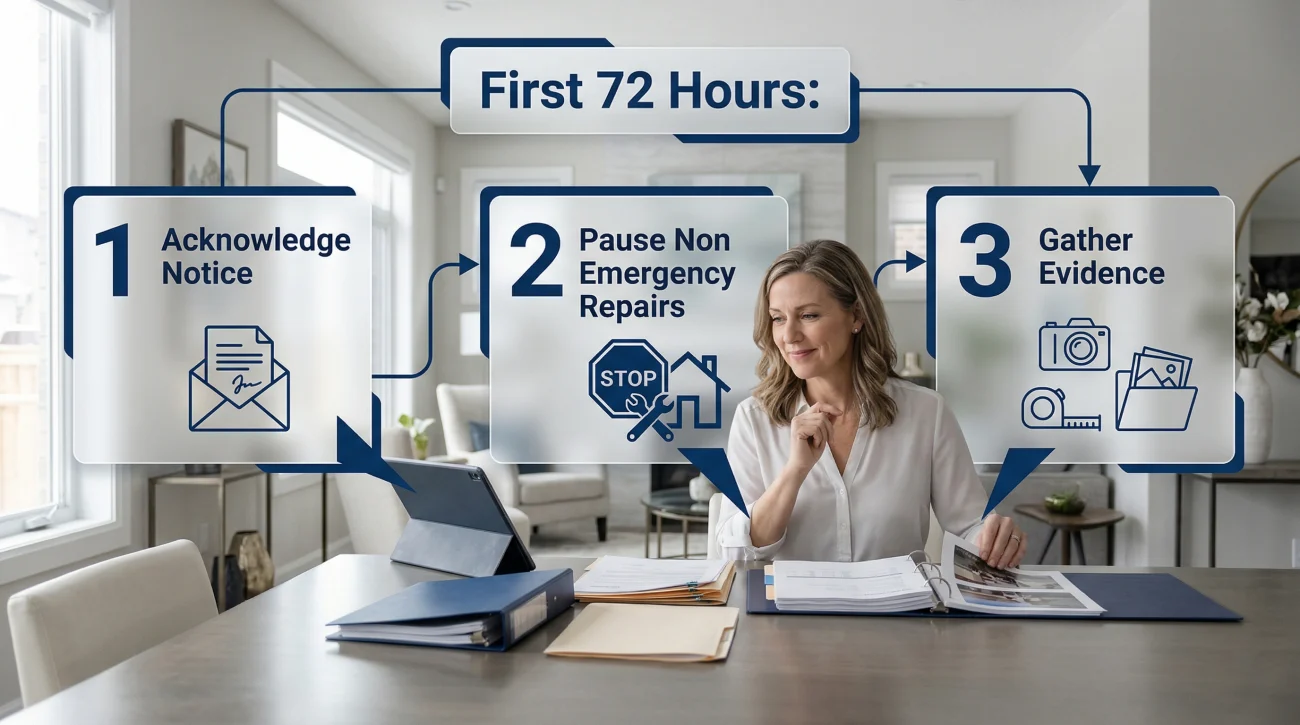
Before the investigation machinery starts moving, the window immediately after receiving the notice is where many homeowners make critical errors out of panic. Knowing exactly how to respond sets the tone for the rest of the process. If you just received this notification, follow these immediate steps:
- 1. Acknowledge receipt in writing: Reply to the adjuster’s email confirming you received the notice and stating that you are fully prepared to cooperate. Do not demand to know why you are being investigated.
- 2. Pause non-emergency repairs: Stop all permanent repair work immediately. You must still mitigate further damage (like tarping a roof or extracting standing water), but replacing drywall or flooring before the investigation concludes can result in a denial for destroying evidence.
- 3. Organize your timeline: Sit down and write out a chronological timeline of exactly what happened on the date of the loss. This prevents you from giving accidental, inconsistent statements later.
- 4. Gather pre-loss evidence: Locate your policy declarations page, utility bills proving occupancy, and any old photos of the damaged rooms before the incident occurred.
What Happens During an Insurance Claim Investigation
Now that you know what triggers these reviews and how to handle the initial shock, it helps to understand the exact sequence of events. When you are waiting in the dark, the process feels opaque. Homeowners often wonder what the adjuster is actually doing during those long weeks of silence. The insurance adjuster investigation process generally follows three distinct phases.
Step 1: The Internal Desk Review
The adjuster starts by building a chronological file without leaving their desk. They review your policy declarations to confirm exact coverage limits and exclusions. They run your name through databases to check for prior claims on the property. They will also verify the date of loss against historical weather data or public records (for example, checking if the fire department was actually dispatched to your address on the date you claimed).
Step 2: Independent Expert Assignments
The adjuster will likely send specialized independent experts to your home. I frequently see carriers send structural engineers to determine if a cracked foundation was caused by a recent plumbing leak or years of earth movement. For fire claims, they will dispatch cause-and-origin specialists. These experts do not work for you; they are hired by the insurer to provide technical reports on exactly how the damage occurred.
Step 3: Document Verification and Requests
While the experts are drafting their reports, the adjuster will request specific documentation from you. You might be asked to provide maintenance records for your HVAC system to prove it was properly serviced, or detailed photos of the damage area taken before the loss occurred. The investigation phase is primarily an exercise in matching your verbal account of the damage to the physical evidence and the policy language.
How Long Does a Home Insurance Claim Investigation Take?
The most common question I hear is regarding the timeline. You have contractors waiting to start repairs, you might be living in a hotel, and the financial pressure is mounting. How long should you realistically expect to wait?
Under normal circumstances, a routine review takes a month or two to conclude. However, this timeframe fluctuates based on how quickly you provide the requested information and how backed up the independent experts (like engineers or plumbers) are in your area.
There is also a major exception: Catastrophe (CAT) claims. If your home was damaged in a widespread event like a major hurricane, wildfire, or regional freeze, expect the timeline to stretch significantly. Adjusters and independent engineers are spread thin across thousands of properties. Investigations in CAT zones operate under entirely different logistical constraints, and delays of several months are common due to sheer volume.
To give you a better sense of the overall pacing outside of catastrophe situations, you can read our comprehensive breakdown of the overall timeline of the home insurance claim process. Most states have regulations requiring insurance companies to acknowledge your claim promptly and either accept or deny it within a set statutory period. If they need more time to investigate, they are legally required to send you a status letter explaining why.
Common Mistakes Homeowners Make During an Investigation
I have seen perfectly valid claims get bogged down for months simply because the homeowner made a procedural error out of frustration. When you are under a microscope, your behavior must be flawless. Avoid these common traps:
- ❌ Relying on phone calls: Having a verbal argument with your adjuster does not help your claim. Phone calls leave no record. You must transition all communication to email so there is a digital paper trail of everything requested and submitted.
- ❌ Throwing away damaged items: Even if a waterlogged sofa smells terrible, do not throw it in a dumpster until the adjuster or investigator has physically inspected it and given you written permission to dispose of it.
- ❌ Venting on social media: If your claim is escalated to SIU, investigators will pull your public social media profiles. Posting angry rants about your insurance company, or posting vacation photos while claiming severe financial hardship from a fire, will be used against you.
- ❌ Guessing the cause of damage: If the investigator asks why the pipe burst, and you say, “I think it has been dripping for a year,” you just handed them a reason for denial. Only state facts you know to be true.
How to Protect Your Claim
To keep the process moving, you must treat the investigation like a formal business transaction. If the adjuster asks for a repair estimate, do not just send a generic number. Get a detailed, line-item estimate from a licensed contractor, submit it via email, and follow up three days later to confirm receipt.
If you have not already organized your files, you need to review a proper home insurance claim documentation checklist to ensure you aren’t missing pieces that the investigator will inevitably ask for.
When an investigation crosses the normal statutory timeline for your state, it is appropriate to request a formal update. Do not just ask “what is taking so long?” Use email to create a timeline of your attempts to move the process forward.
Subject: Status Update Request – Claim #12345678 – Smith Property
Dear [Adjuster Name],
I am writing to check on the status of the investigation for my claim filed on [Date]. I submitted the requested contractor estimates and the plumbing report on [Date], and I have received written confirmation that my file is complete pending your review.
Could you please provide an estimated date for when this investigation will conclude and a settlement decision will be reached? As my home remains damaged, I am anxious to begin permanent repairs.
I look forward to your prompt update.
Regards,
[Your Name]
When you have done everything right and the process still stalls, the problem is no longer on your end.
When an Investigation Becomes a Tactic
Even with perfect documentation and flawless communication, things do not always go smoothly. This is where my experience tells me you need to be on high alert. While most investigations are legitimate, the term “investigation” is sometimes weaponized as a delay tactic. Insurance companies know that the longer a claim drags on, the more financial and emotional pressure the homeowner feels. A frustrated, exhausted homeowner is much more likely to accept a lowball settlement just to make the process end.
You need to be able to tell the difference between an adjuster who is waiting on an engineer’s report and an adjuster who is intentionally stalling your file. Here are the clear signs that your investigation is no longer routine and may be a precursor to a denial or a severe underpayment:
- 🚩 The Endless Loop of Requests: You submit a document, the adjuster waits two weeks, then asks for a different document. You submit that one, they wait two more weeks, and ask for something else. A legitimate investigator usually requests all necessary information upfront.
- 🚩 Repeated Requests for the Same Items: The adjuster claims they “never received” the photos or receipts you have already emailed to them twice, forcing you to restart the clock on their review time.
- 🚩 The Investigation Followed Pushback: You received an initial low offer, you refused it and submitted a higher contractor estimate, and suddenly the insurer decided the claim “needs further investigation.” This is a classic retaliatory delay.
- 🚩 Radio Silence: The file has been open for months, you have provided everything requested, but the adjuster has stopped returning your emails or calls entirely.
- 🚩 Requests Unrelated to the Damage: Your claim is for a kitchen fire, but the investigator is suddenly demanding five years of your personal tax returns and mobile phone records without a clear explanation.
For a deeper understanding of how delay fits into broader company strategies, I highly recommend reading about the most common home insurance claim adjuster tactics.
When to Stop Waiting and Start Escalating
An open investigation is not a denial, but if you recognize the painful patterns listed above, your claim is at severe risk. The worst thing you can do when faced with an intentional delay tactic is to passively wait for the insurer to dictate the next move.
Before jumping straight to legal action, you have intermediate steps. You can send a formal demand letter citing your state’s Department of Insurance fair claims handling guidelines. You can also file a complaint directly with your state’s insurance commissioner, which forces the carrier to formally respond to the state regarding the delay.
If those steps fail, or if the investigation is stalled due to disagreements over the scope of damage, it is time to bring in professional leverage. Having a professional step in forces the insurer to deal with someone who understands their internal deadlines and requirements.
Action Step: If your claim has been stalled for an unreasonable amount of time without clear communication, you can have a licensed public adjuster review your claim documents. They can identify exactly where the bottleneck is and push the insurer to finalize the scope.
However, if the investigation has shifted into SIU territory with a demand for an Examination Under Oath (EUO), or if the insurer is making unreasonable demands for personal records, the issue is no longer just about the damage estimate. If the investigation feels like it is building a case for a bad-faith denial, you should consider consulting an insurance claim attorney to protect your rights. For more context on what happens if the investigation ultimately fails, review the steps for handling a denied home insurance claim.
Final Thoughts on Navigating Investigations
Hearing that your home insurance claim is under investigation is never pleasant news, but it does not mean your claim is doomed. Do not let the word “investigation” intimidate you into abandoning a valid claim.
The most successful homeowners I work with are the ones who detach emotionally from the process. They treat the investigation not as a personal accusation, but as a rigid corporate hurdle that requires a methodical, organized response. Provide exactly what is asked for, keep your communication strictly professional, and trust your instincts. If the process stops feeling like a fact-finding mission and starts feeling like a war of attrition, do not hesitate to escalate the matter to level the playing field.
❓ FAQ
🕵️ Why is my home insurance claim being investigated?
Claims are usually investigated to verify the cause of the loss, confirm coverage limits, or accurately determine the repair scope. Large claims, complex damage types, or claims filed shortly after a policy is purchased are automatically flagged for routine review.
⏱️ How long does a home insurance claim investigation take?
A routine investigation typically takes 30 to 60 days. However, the timeline can be extended if the insurer needs to hire independent experts (like structural engineers) or if you delay in providing requested documentation.
🛑 Will my claim be denied if it goes to investigation?
No. An investigation is a fact-finding process, not a guaranteed denial. The vast majority of investigated claims are ultimately approved and paid once the adjuster gathers the necessary information.
📞 What happens during an insurance claim investigation?
The adjuster will review your policy, request documentation (like photos or receipts), and possibly send experts to inspect the damage. They are comparing your account of the event against the physical evidence to determine coverage.
🧐 What is an SIU insurance investigation?
SIU stands for Special Investigations Unit. This is a specialized department that investigates claims for potential fraud, material misrepresentation, or exaggerated damage. SIU involvement is uncommon for standard property claims.
📱 Can an insurance adjuster look at my phone records or social media?
In a routine investigation, no. However, if your claim is escalated to an SIU investigation for suspected fraud, investigators often review public social media profiles. They cannot access private phone records without your consent or a subpoena.
🏠 Can I start repairs while my claim is under investigation?
You should make temporary emergency repairs to prevent further damage (like putting a tarp on a roof). However, you should not begin permanent repairs until the insurer has fully inspected the damage and given written approval.
📝 Should I give a recorded statement during an investigation?
Many policies require you to cooperate with the investigation, which may include a recorded statement. Keep your answers brief, factual, and strictly related to the claim. Avoid speculating about the cause of the damage.
🤷♂️ What if I don’t have receipts for the items they are investigating?
If you lack receipts, you can provide alternative proof of ownership, such as credit card statements, owner’s manuals, warranty registrations, or photographs of the items in your home prior to the damage.
⚖️ Do I need a lawyer if my claim is under investigation?
For a routine investigation, usually no. However, if the investigation stretches on unreasonably, involves the SIU fraud department, or includes a request for an Examination Under Oath (EUO), consulting an attorney is highly recommended.
Understanding the whole process changes how you handle each stage.
- How a claim moves from filing to final payment
- What your policy actually covers and what it does not
- Which damage types get paid and which get excluded
- When filing a claim makes sense and when it works against you
- What to do after a denial and what your actual options are
- What a public adjuster does and when you actually need one
- When legal help is the move that changes the outcome
Low offers and scope disputes are common. These explain what to do.
- 5 patterns that signal your settlement is probably short
- Who the adjuster at your door actually works for
- Where water damage estimates most often fall short
- What fire damage settlements commonly leave out
- Why your roofer's number and the insurer's estimate do not match
- When a denial needs legal leverage, not just negotiation
- Four paths to fight a denial, including one most homeowners miss
Disclosure: I'm sharing my personal industry experience, but I am not an attorney or a licensed insurance agent. The guides on this site are for informational purposes to help you understand the operational side of property claims: process, organization, and documentation. Every policy is unique, so please defer to your specific policy language. For legal interpretation, contested situations, or binding advice, always consult a licensed professional in your jurisdiction.