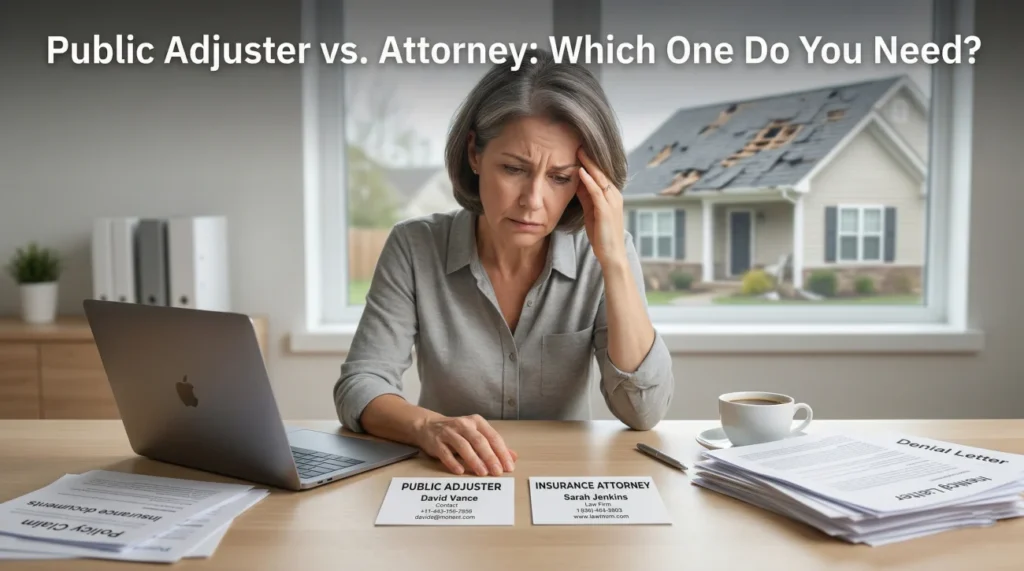
- A public adjuster (PA) and an insurance attorney serve completely different functions in a property claim dispute. Choosing the wrong one will cost you valuable time and money.
- Public adjusters are experts in construction scope and damage valuation. You hire them when the insurance company admits your claim is covered but refuses to pay the true cost of repairs.
- Attorneys are legal experts. You hire them when the insurance company completely denies your claim, misinterprets your policy language, or acts in bad faith.
- Public adjusters cannot practice law, file lawsuits, or force an insurer to cover an excluded peril. Attorneys typically do not climb roofs or write line-by-item construction estimates.
- In complex situations, you can use both. A public adjuster often builds the detailed damage report that an attorney later uses to win a legal settlement.
The Crossroads of a Problematic Claim
If your home insurance claim has stalled, been severely underpaid, or been met with a harsh denial letter, you have likely realized that fighting the insurance company alone is a losing battle. You need professional help. Almost immediately, you will hear about two very different options: public adjusters and insurance claim attorneys.
I speak with homeowners every week who are standing at this exact crossroads. The most common mistake I see is assuming that these two professionals do the same job. They do not. Using a public adjuster when you actually need a lawyer is like bringing a carpenter to fix a plumbing leak. Bringing a lawyer into a straightforward pricing dispute is equally inefficient.
To get your claim back on track, you must understand exactly where a public adjuster’s authority ends and where an attorney’s leverage begins. The distinction is not based on how angry you are at the insurance company. It is based entirely on the specific type of problem your claim is facing.
Here is how I break down the difference between the two roles, and how to identify which tool your situation actually requires.
The Role of a Public Adjuster: Scope and Valuation
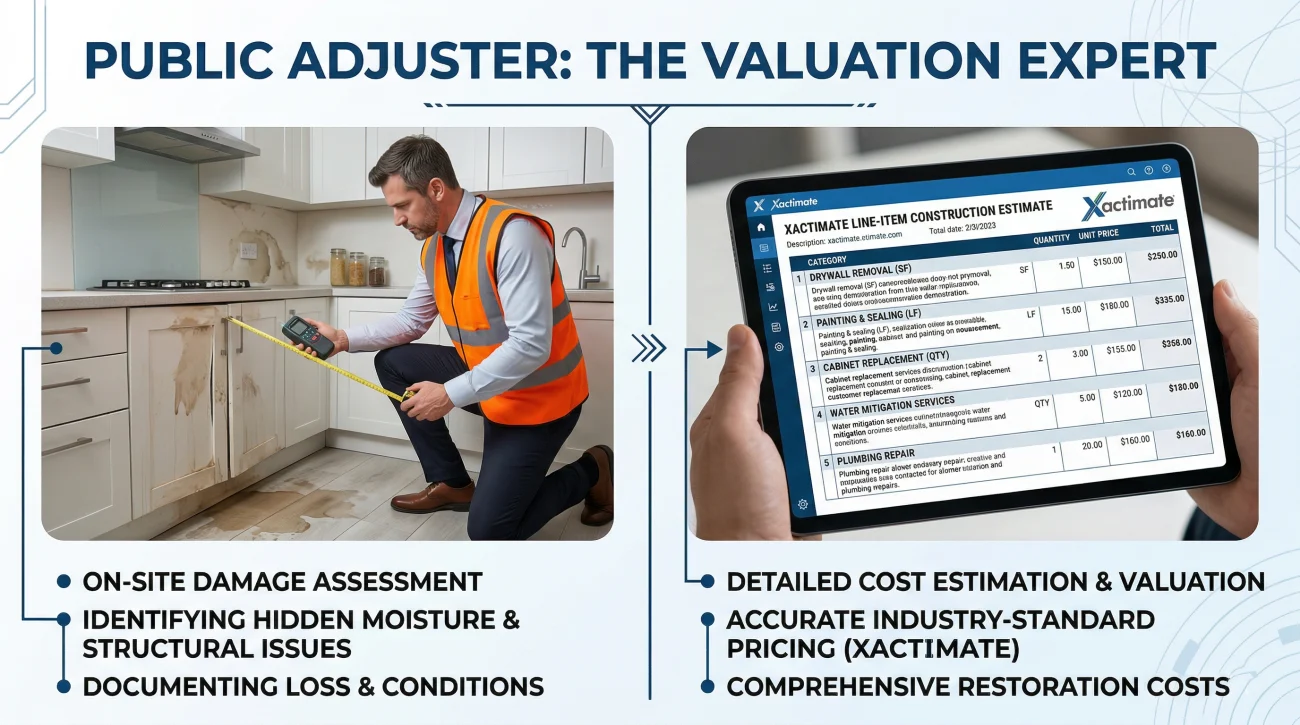
A public adjuster is essentially a mirror image of the adjuster your insurance company sent to your house, but they work exclusively for you. Their entire skillset revolves around physical damage, construction methods, and pricing software.
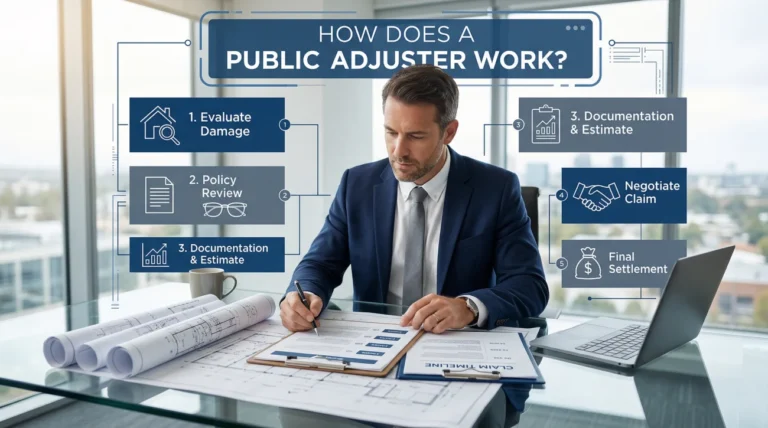
When a public adjuster steps into a dispute, their primary weapon is documentation. They will conduct an independent, exhaustive physical inspection of your property. They will measure rooms, photograph hidden moisture, and build their own line-by-item estimate using the exact same software the insurance company uses (typically Xactimate). If you want to know exactly how they move through a claim, see my detailed breakdown on how the public adjuster process works.
The public adjuster then presents this detailed scope of loss to the insurance company and negotiates the dollar amount. Their leverage comes from undeniable physical evidence and a deep understanding of construction reality.
I recently reviewed a claim where a homeowner’s kitchen flooded. The insurer offered $12,000, claiming the custom cabinets could be patched. A public adjuster took over, proved with manufacturer specifications that the cabinets were discontinued and could not be matched, and negotiated the payout up to $34,000. There was no legal argument involved, just pure construction facts.
Where the Public Adjuster Cannot Go
There is a hard boundary line for public adjusters: they cannot practice law. A public adjuster cannot provide you with legal advice. They cannot file a lawsuit on your behalf. They cannot compel an insurance company to hand over internal documents through the legal discovery process.
Most importantly, if your insurance company looks at your policy and says, “This specific type of water damage is excluded from your contract,” a public adjuster cannot argue the legal interpretation of the contract in a courtroom. They are valuation experts, not legal scholars.
The Role of an Insurance Attorney: Legal Leverage
An insurance claim attorney operates in a completely different arena. While a public adjuster argues over the price of drywall, an attorney argues over the enforcement of the insurance contract itself.
Attorneys do not typically climb onto roofs to count missing shingles, and they rarely write their own construction estimates. Their value lies in enforcing the contract, not pricing the damage. Their leverage is the threat of litigation and the power of the legal system.
An attorney can file a formal lawsuit. They can force the insurance company’s adjusters and executives to answer questions under oath during a deposition. If the insurance company is acting maliciously, an attorney can pursue punitive damages.
Hiring a lawyer to negotiate why your claim is $8,000 short on flooring costs.
Hiring a lawyer because the insurance company falsely claims your policy lapsed, or because they are actively hiding coverage limits.
The Bad Faith Factor
Attorneys are the only professionals equipped to handle “bad faith” claims. Bad faith occurs when an insurance company violates its legal duty to treat you fairly. This includes unreasonable delays, deliberately misrepresenting policy language, or refusing to investigate a claim properly. A public adjuster has no power to penalize an insurer for bad faith conduct. Only a lawyer can bring that specific legal action. For a deeper understanding of what constitutes this behavior, read our guide on bad faith insurance claims.
Which Tool Does Your Claim Need?
Deciding between the two comes down to identifying the root cause of your dispute.
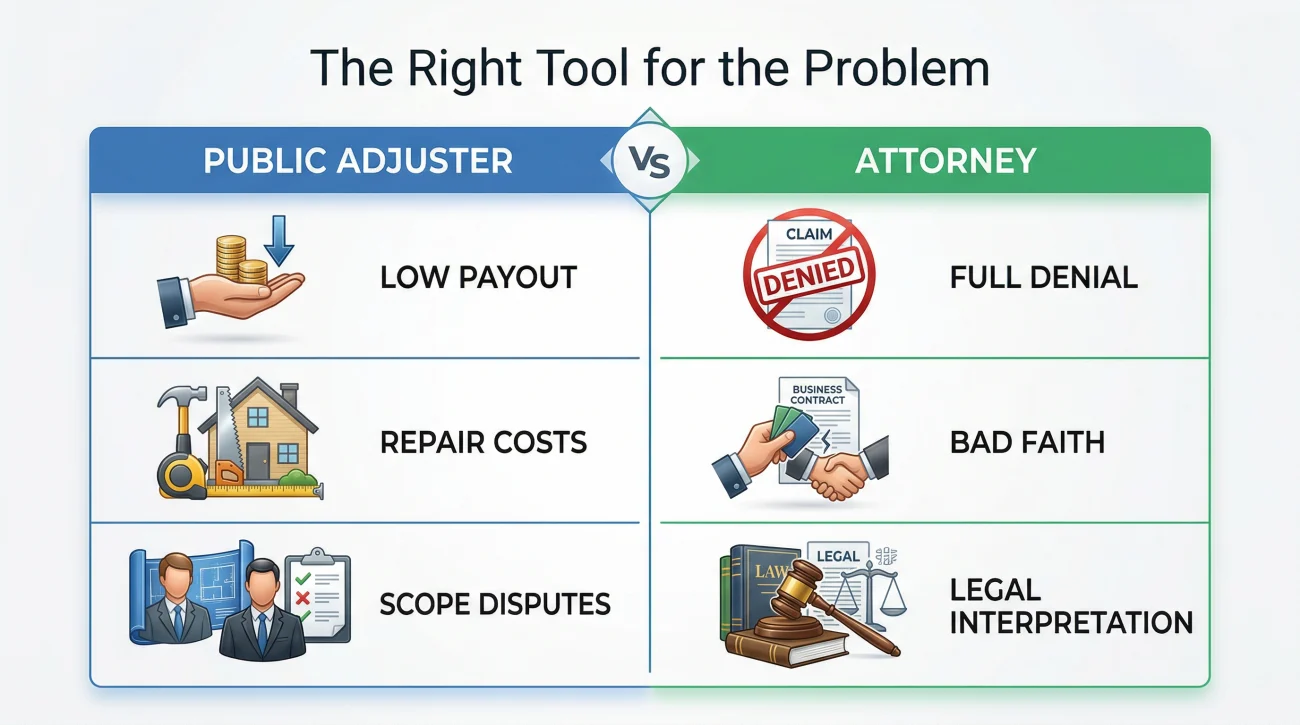
When a Public Adjuster is Usually the Right Choice
You generally want a public adjuster when the insurance company admits they owe you money, but their math is terrible. This is known as a scope or valuation dispute. Specific scenarios include:
- 👉 The adjuster’s estimate completely missed several damaged rooms.
- 👉 The settlement offer is drastically lower than the bids you received from local contractors.
- 👉 The insurance company applied excessive depreciation to your belongings and you need help fighting it.
- 👉 The claim is large and complex, and you simply do not have the time to document every single damaged item yourself.
When an Attorney is Usually the Right Choice
You generally need a lawyer when the dispute is about legal interpretation, full coverage denials, or unethical corporate behavior. Specific scenarios include:
- 👉 A full coverage denial where the insurer claims the event (like a fire or theft) is entirely excluded from your policy.
- 👉 The insurance company is investigating you for fraud or arson.
- 👉 The insurer has completely stopped communicating with you for months despite your formal appeals.
- 👉 The financial loss is massive, and you believe the insurer is intentionally acting in bad faith to protect their bottom line.
Can You Use Both? (The Sequential Strategy)
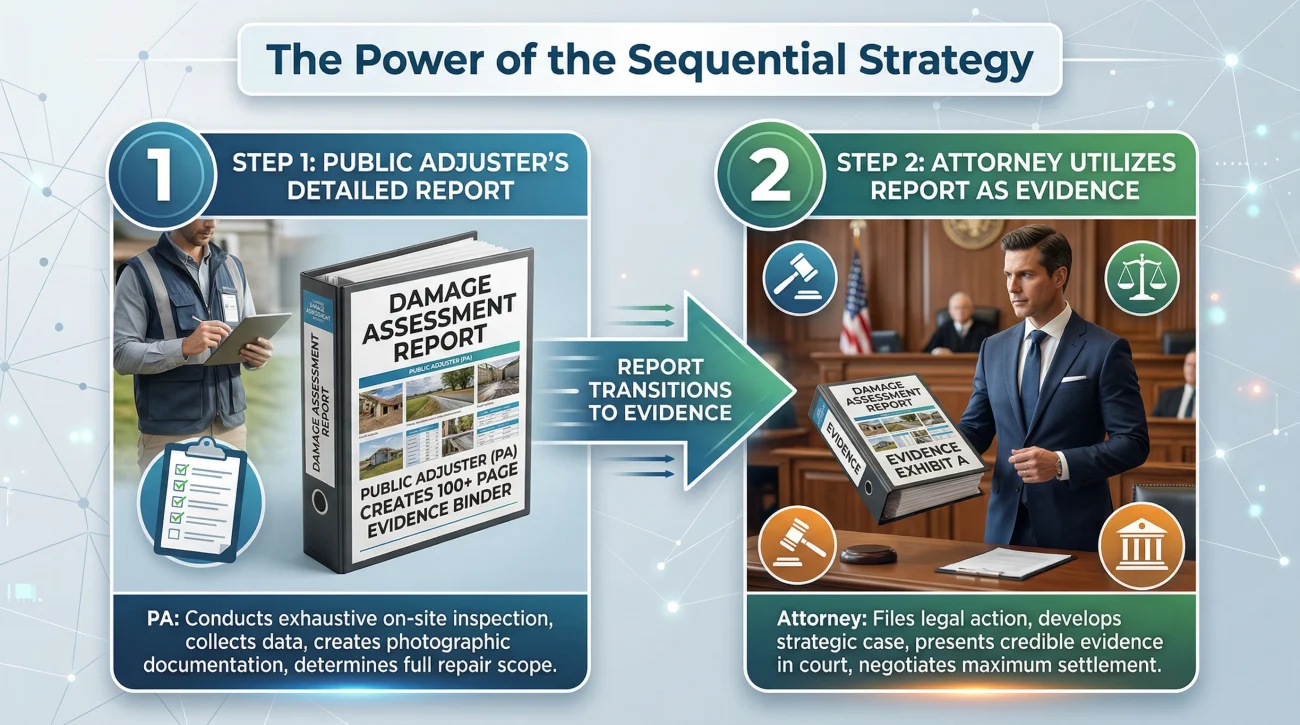
But the public adjuster vs. attorney question is not always an either-or decision. In fact, in very large or highly contested claims, using both professionals in a specific sequence is a highly effective strategy.
A public adjuster often precedes an attorney. Let us say you hire a public adjuster for a major fire claim. The PA does a fantastic job building a flawless, 100-page structural estimate proving the house needs $400,000 in repairs. However, the insurance company simply refuses to negotiate fairly and stonewalls the public adjuster.
When a public adjuster reaches a complete impasse with an unreasonable insurer, the homeowner often brings in an attorney. The attorney does not have to start from scratch. They take that incredibly detailed, professional scope of loss built by the public adjuster and use it as the foundational evidence for the lawsuit. It is a powerful combination.
In terms of cost, both typically work on contingency, meaning they take a percentage of the recovery. The public adjuster takes a percentage of the settlement increase they negotiate. If the case goes to an attorney, the attorney will structure their fee based on the legal recovery.
Signs You Might Need an Attorney First
While a public adjuster is the right call for valuation problems, hiring one when you actually have a severe legal problem will only waste time. If your claim is heading toward a courtroom, you need to recognize the signals early.
Here are the clear patterns indicating that an attorney, rather than a public adjuster, should probably be your first call:
- 👉 The absolute denial: Your claim was denied in its entirety, and the denial letter specifically quotes complex policy exclusions or legal statutes that you do not understand.
- 👉 The silent treatment: You have submitted formal appeals and repair estimates, but the insurance company has ignored your correspondence for months without explanation.
- 👉 The unethical conduct pattern: The insurer keeps changing their reason for denial, demands the same documents repeatedly, or sends multiple different adjusters who all contradict each other.
- 👉 The failed PA negotiation: You already have a public adjuster, they have produced undeniable evidence of the damage, but the insurer refuses to pay and the negotiation has hit a permanent wall.
The right professional depends entirely on whether your core problem is about the cost of the damage, or the conduct of the insurer. If you are dealing with a scope or valuation dispute, having a licensed professional review your estimate is the next logical step. If your claim was fully denied or you suspect bad faith, you need legal leverage. For a complete breakdown of all your options after a claim goes wrong, see our guide on how to fight a denied home insurance claim.
Next Steps:
If your dispute is about repair costs, missing items, or low settlement values, get a free claim review from a licensed professional by exploring whether you should hire a public adjuster.
If you received a full coverage denial letter or suspect the insurance company is acting in bad faith, request a free legal consultation through our guide on when to hire a home insurance claim lawyer.
Final Thoughts on Choosing Your Advocate
Navigating a disputed insurance claim is incredibly stressful, but choosing the right advocate does not have to be a guessing game. Remember the core rule: public adjusters fix math and construction problems; attorneys fix contract and legal problems.
Read your communication from the insurance company carefully. If they are nickel-and-diming your repair estimate, bring in the valuation expert. If they are citing obscure policy language to avoid paying a dime, bring in the legal expert. Understanding this boundary ensures you spend your time recovering your loss, rather than spinning your wheels with the wrong professional.
❓ FAQ
⚖️ Should I hire a public adjuster or an attorney?
Hire a public adjuster if the insurance company agrees to cover the claim but offers too little money. Hire an attorney if the insurance company completely denies your claim, cites policy exclusions, or acts in bad faith.
🚫 Can a public adjuster fight a denied claim?
A public adjuster can fight a partial denial (where the insurer disputes the extent of the damage). However, if the insurer issues a full coverage denial stating the peril is excluded, you typically need an attorney.
💰 Do attorneys charge more than public adjusters?
Both professionals typically work on a contingency fee basis, meaning they take a percentage of the recovery. The exact percentages vary by claim type, the amount recovered, and the complexity of the case.
🤝 Can an attorney hire a public adjuster for me?
Yes. It is very common for an insurance attorney to bring in a public adjuster or a specialized damage appraiser to evaluate the physical damage and provide expert testimony for the legal case.
📝 Does a public adjuster give legal advice?
No. Public adjusters are strictly prohibited from practicing law. They cannot interpret complex legal statutes, file lawsuits, or advise you on your legal rights in a courtroom.
🔨 Will an attorney climb my roof to check for damage?
Typically, no. Attorneys focus on legal strategy and contract enforcement. They rely on experts like public adjusters, engineers, or contractors to conduct the physical inspections and write the repair estimates.
⏱️ Who resolves a claim faster, a PA or a lawyer?
A public adjuster can often resolve a valuation dispute faster through direct negotiation. Once an attorney files a formal lawsuit, the legal process (discovery, depositions, court dates) usually takes much longer.
🗣️ Can a public adjuster sue my insurance company?
No. A public adjuster cannot file a lawsuit. If negotiation and the appraisal process fail, you must hire a licensed attorney to take the insurance company to court.
🕵️ What is bad faith, and who handles it?
Bad faith is when an insurer acts unethically, such as intentionally delaying payment or lying about coverage. Only an attorney can file a bad faith lawsuit against an insurance company.
🔄 Can I switch from a public adjuster to an attorney?
Yes. If your public adjuster hits a wall and cannot get the insurer to settle, you can hire an attorney. Be sure to review your contract to understand how the public adjuster’s fee will be handled if you transition to a lawyer.
PAs are most useful in specific situations. These explain the ones that matter.
- The claim lifecycle a PA or attorney works inside
- The policy language that determines what professional help can recover
- How damage classification affects what an expert can negotiate
- Whether the situation you have justifies bringing in outside help
- When a denial is the outcome a PA could have prevented
- What a public adjuster actually does inside a claim
- When the dispute has moved past what a PA can handle
Each of these covers a real situation where the decision is not clear-cut.
- The 5 patterns that make hiring a PA worth it
- What the adjuster who came to your house was actually there to do
- When water damage scope gaps make independent review necessary
- When fire damage complexity makes independent representation worth it
- When the gap between estimates is large enough to bring in a PA
- When bad faith makes legal action the only path that works
- PA, attorney, or appraisal clause: which path fits your denial
Disclosure: I'm sharing my personal industry experience, but I am not an attorney or a licensed insurance agent. The guides on this site are for informational purposes to help you understand the operational side of property claims: process, organization, and documentation. Every policy is unique, so please defer to your specific policy language. For legal interpretation, contested situations, or binding advice, always consult a licensed professional in your jurisdiction.